And discover a world of archaeological sites that date back before Inca times. Visit the relics left behind by cultures whose presence lingered long after they were conquered.
You can start at the pilgrimage site of Chavín de Huántar, a fortress temple, built around 1200 BC. Marvel at the impressive carved stone heads, and 15 foot high dagger-shaped stone monolith or "Lanzón" which lies inside a mysterious labyrinth of tunnels.
Witness the ancient imperial Chimú Culture, dating from 1100 BC at the remains of Chan Chan, the largest adobe brick city in South America. Located deep inside the northern desert, archaeologists still puzzle over how such an advanced culture developed in this harsh environment.
Another spectacular pre-Inca site is the fortress of Kuélap, a walled city built from stone at 9,840 feet above sea level and surrounded by a cloud forest. From the Chachapoyas culture, which means "the cloud people" this site lies at the summit of a mountain and is thought to have taken 200 years to build (from 1100 to 1300 BC).
Best seen by air, the famous Nazca Lines create a final memorable experience. One of Peru's great mysteries, these geometric lines form animal figures, and date back to 500 BC. The site is believed to have been used as a huge astronomical calendar.
Much earlier than the Incas and while civilizations like the Mesopotamian, Egyptian, Indian, and Chinese (3000 and 2000 B.C.) flourished, the city of Caral, located north of the city of Lima, was built; this was the first American expression of a Pre-Ceramic urban settlement with monumental architecture in an area greater than 10 hectares. Later, in the northern highlands, the Chavin achieved significant advances in architecture, engineering, and agriculture. Caral was declared Cultural World Heritage Site by UNESCO (June 2009)
Discover it all for yourself. Come to Peru. Where you'll experience all these archaeological monuments, along with the remains of an ancient culture that's still very much alive.
Peru is one of the countries that has a rich millennial tradition that begins with distant historical trace of nomads, hunters and collectors, the big pre-Inca civilizations appear, from the Chavín to the Chimú cultures, opening the way to the great Inca Culture.
Through the vast territory of the coast and mountain, we can find big and wonderful archaeological centers, in those that you can magnify the art and development of each one of these big towns, and to come closer to them, knowing their works, many of them harbored in museums.
It will be easy to find the beauty and greatness of these archaeological locations next to beautiful landscapes, among snowy mountains of the Mountain Range of the Andes.
Peru Historical & Cultural
The history of Peru continued getting rich after the Spanish conquest, and we have inherited the beauty of its architecture, painting, music, handicrafts and other big art expressions, many of them with the contribution of the Mestizo style.
They are more than 460 years, from the arrival of the Spaniards, and today Peru has cities and corners of singular beauty, with the inheritance of traditions in which the western and Indian cultures had melted. It is something common to travel by streets in which centennial traditions and soul are preserved.
Source from : http://www.go2peru.com
For more interesting topics related to archaeology, visit archaeology excavations.
Monday, February 28, 2011
Peru Archaeological and Historical Monuments

Ancient Animal Sacrifices
Sacrificial remains of humans and animals, believed to be at least 2,700 years old, have been found in central China's Luoyang city (map), Chinese archaeologists say.
The bones are part of a recently discovered burial complex covering nearly a quarter acre (945 square meters) and containing 14 tombs, a water channel, and 59 pits from the Western Zhou dynasty. (Related: "Ancient Mass Sacrifice, Riches Discovered in China Tomb.")
During the Western Zhou period (1100 B.C. to 771 B.C.), the sacrifices of animals—and sometimes humans—to ancestors or deities were a routine part of Chinese culture. The sacrifices were often made to bless houses, said David Sena, a China historian at the University of Texas at Austin.
"In general, there's been a tendency to describe Western Zhou as a more humanistic period, when the practice of human sacrifices"—which were commonplace during the preceding Shang Dynasty—"were waning," Sena said.
"But I think the archaeological evidence shows quite clearly that human sacrifices persisted throughout the Zhou period as well."
Source from : http://news.nationalgeographic.com
For more interesting topics related to archaeology, visit archaeology excavations.

Ancient Symbols of the Theosophical Society
The Theosophical Society was originally formed in 1875 by Helena Blavatsky, Henry Steel Olcott, William Quan Judge and others to seek the truth using investigation, study and explanation of certain phenomena and ancient symbols.
Several years after the society was formed, Blavatsky and Olcott moved to India to establish the International Headquarters at Adyar, Madras (Chennai). While in India, they became exceedingly interested in eastern religions so they were also included in the societies agenda.
After several iterations the Society's objectives have evolved to be:
1. to form a nucleus of the universal brotherhood of humanity without distinction of race, creed, sex, caste, or colour.
2. to encourage the study of comparative religion, philosophy, and science.
3. to investigate the unexplained laws of nature and the powers latent in man.
The leaders of the Theosophical society did not preach superiority towards any certain race. They felt that spreading the idea of the common origin and destiny of all humanity, and establishing the principle of universal brotherhood which would unite people in harmony.
Unfortunately, these ideologies were completely mixed up by Guido von Lizst who included nationalistic and fascist ideas with Blavatsky's ideals; this system of thought became known as Ariosophy.
Unlike Theosophists (whose first objective was "to form the nucleus of a Universal Brotherhood of Humanity without distinction of race, colour, or creed"), "The Thule Society preached Aryan supremacy and acted to achieve it. It provides the final link between occult racial theories and the racial ideology of Hitler, who skewed the fundamental principles of and understandings for sociological and economic control by the emerging Nazi party."
Star of David
Here are some of the insights provided:
"Well put it this way, the six-pointed star is NOT a Jewish symbol since it's totally absent from the Torah-- not found in there. This symbol re-appears within the religion in the Medieval era.
It's generally known to be an occultic symbol of pagan origins, much like the rest of most mainstream symbols." Oracle_of_Truth
"Well the hexagram, or, star of david as it is called when in a Jewish context, was actually a common symbol used by Christians as well (as well as many other religious, such as Islam and Hinduism), so in that emblem it does not necessarily have to denote any sort of connection to Judaism. Actually the symbol frequently has no connection at all to Judaism and is one of the most ancient recorded symbols we have.
It has also frequently been associated with occultism in general, and was a very common symbol in many emblems of the Freemasons and is on nearly every Masonic temple or structure that exists." Alex III
"The Shield of David (magen David - not star, but shield) as it is called by the Jews, is actually not a star at all or a hexagram - but two triangles intertwined. It was USED by David as his emblem, no one ever claimed he INVENTED it, and was indeed a symbol already in his time. Has philosophy behind it, like every other symbol.
There is NO connection between it and the bible, but it was adopted by Judaism as one of its symbols because of its meaning to kind David (one of the most revered figures in Judaism).
Just as the cross was not a Christian invention, the crescent was not an Arab invention, the swastika was not a Nazi invention..." Vera
"And the sign above the swastika is "OM" written in devanagari ......
OM stands for Brahman ........
You probably know it from the mantra : om mani padme hum ........" Merlin
Read more: Ancient Digger Archaeology: The Monday Ground Up: Ancient Symbols of the Theosophical Society
Under Creative Commons License: Attribution Non-Commercial
Brahman(OM)
Brahman is an awe-inspiring reality which is the Divine Ground of all matter, energy, time, space, being, and everything beyond in accordance with the Hindu religion.
Maharishi Mahesh Yogi's view on Brahman
In his writings on the Bhagavad Gita, Maharishi Mahesh Yogi defines Brahman as follows:[14]
Brahman, which is an all-pervading mass of bliss, does not exhibit any quality of bliss. It may be likened to a mass of energy- matter - which does not exhibit any quality of energy... Brahman is that which cannot be expressed into words, even thought the Upanishads use words to educate about Its nature. In the field of speech, Brahman lies between two contrary statements. It is absolute and relative at the same time. It is the eternal imperishable even while It is ever changing. It is said to be both This and That. It is spoken of as Sat-Chita-Ananda but includes what is not Sat, what is not Chit, and what is not Ananda. It is beyond speech and thought, yet the whole range of thought and speech lies within It. ‘Within It’ and ‘without It’ are just expressions, and like any other expressions about Brahman they do justice neither to Brahman nor to the speaker nor to the listener. Brahman is lived by man with ease but cannot be spoken of, in the sense that words are inadequate to encompass That which is the unlimited fullness of transcendental Being and the fullness of active life at the same time. Verse 29 of Chapter II (of the Bhagavad-Gita) speak of It as a “wonder”, for it is not anything that can be conceived of intellectually; it is not anything that can be appreciated by emotion…Brahman is the value of our life and the truth of it is that it is lived ‘with ease'.
Ankh
The Ankh is an Egyptian hieroglyphic that symbolizes eternal life. However, the origin of the symbol remains a mystery to Egyptologists, and no single hypothesis has been widely accepted. Some say that it represents the act of conception or a man and woman. Egyptians carried the symbols around their necks in a an attempt to maintain their health and strength of mind and body. It was a protector of life, as well as death.
Swastika
The swastika dates back to the Neolithic period and is associated with religions including Hinduism, Buddhism and Jainism. Once used all over the world, this symbol was tainted by the Nazi Regime, so now it's actually outlawed in Germany.
For centuries, the swastika has appeared on several shards in Iran and on pottery found in parts of Russia. "Indian swastika symbols were found at Lothal and Harappa, on Indus Valley seals."
The most interesting aspect of the symbol is that it has appeared in so many cultures, suggesting that it did represent a unity of ideals. However, in some cases that hypothesis can not be supported and the symbol is shrouded with hate and blood.
Source from : http://www.ancientdigger.com
For more interesting topics related to archaeology, visit archaeology excavations.
Sunday, February 27, 2011
Tel Dor: Archaeological Riches by the Sea
About 30 kilometers directly south of Haifa, Israel, lies a very large tel (an earth mound containing ancient architectural and artifact remains) that tells a story crossing at least eight civilizations. The story is largely a commercial one, as the ancient seaport city of Dor on the Mediterranean coast of present day Israel was host to the trading activities of a number of civilizations or cultures that ringed the Mediterranean world in ancient times. Once a Canaanite city, its history spans settlement or rule by "Sea Peoples", Phoenicians, the Solomonic monarchy, Assyrians, Persians, Greeks, and Romans. Finally, in the thirteenth century A.D., a Crusader castle was built on the site. Few sites of the ancient world can boast a settlement history more varied and complex than this.
The 2011 Excavation Season
From June 28 to August 5, archaeology excavations will resume at Dor under the direction of Ilan Sharon (the Hebrew University) and Ayelet Gilboa (Haifa University). The areas under investigation consist of an elite Iron Age I section that includes a large complex (possibly a palace or administrative building); further evidence of early Iron Age destruction; the Hellenistic city and large Iron Age Phoenician public structures; and other Persian and Iron Age layers, which include remnants of an Assyrian fort. Work will include the analysis of finds and stratigraphy at the site museum. The season will afford students and volunteers the opportunity to participate in all facets of state-of-the-art field archaeology. This will include archaeology excavation, digital registration of architecture and artifacts using advanced graphics and database software, sampling and analysis of deposits, analysis of finds and stratigraphy, and site conservation. Participants may arrange for academic credit (formal field school instruction) through the Rothberg International School of the Hebrew University. Students in this program will receive academic instruction in archaeological field methods and theory, the processing and analysis of material excavated each day, and afternoon lectures on archaeology, history, and specialized studies of the site and region.
There is no doubt that the Tel Dor excavation is considered to be one of the most exciting excavations in this part of the world, as history and archaeology at this location are exceptionally rich and the location boasts beautiful views of the bay and ocean!
Join The Team
Don't just read about history. Help make a difference -- feel it, discover it, and make it a part of you. You can learn more about the project and the application procedure by going to the website at http://dor.huji.ac.il/.
Contact Information:
eblochsm@sju.edu, or
bloch-smith@msn.com
For more interesting topics related to archaeology, visit archaeology excavations.

UncExploring the Early Years of Alexander the Great
In the Footsteps of Alexander the Great: from Boy to King
For more than 2,000 years Alexander the Great has excited the imagination of people around the globe. A tour in Greece and the Former Yugoslav Republic of Macedonia offers a unique opportunity to retrace his early footsteps from his birth through to the beginning of his extraordinary 22,000 mile journey of conquest.
Traveling back through time, participants will explore the world in which Alexander grew up, from the palace in which he was born to the rural idyll where he and his companions were educated by Aristotle. They will learn about Alexander’s personality and the lives of the people who inhabited his tumultuous world. They will follow in his footsteps from young prince to king and trace these action-packed years as he took on the mantle of warrior and leader and embarked on his campaign of conquest of the Persian Empire.
Alexander’s formative years were dominated by the rapid expansion of the Macedonian kingdom, as his father Philip II carved out vast new provinces. Participants will learn about this expanded realm from East to West and North to South, following routes that Alexander took as regent to his father, the king, while familiarising himself with the land that he was born to rule. They will explore the lakes and forests of Western Macedonia, the new cities of Herakleia Lynkestis and Philippi that his father founded to secure his realm, and the rich and fertile heartland of the kingdom itself: Pella, Vergina and Edessa. They will visit the sites of some of the most famous sieges and battles that accompanied this rapid expansion, from the cities of Methone, Olynthos and Stageira to the battlefield of Chaironeia.
Having explored the epicenter of Alexander’s kingdom, and stood in the magnificent tomb where his father was laid to rest, the group will head south into the heartland of ancient Greece. Here they will investigate the cities and sanctuaries that played a key role in the development of Macedonia, from Delphi to Corinth, Olympia to Athens, some of the most significant sites in the ancient world.
The adventure finishes in the most important sanctuary of the Macedonians, Dion, where Alexander feasted with his men and prepared them for the battles and marches to come on their epic journey east.
For more detailed information about this escorted tour, see Peter Sommer Travels.
For more interesting topics related to archaeology, visit archaeology excavations.

Excavating History at Bamburgh

Bamburgh is a small, picturesque village on the Northumberland coast of the United Kingdom, unique in its beauty and its history. The village is overlooked by a stunning medieval fortress that is iconic in the region. The citadel was the royal seat of the kings of Northumbria, who at one time ruled a kingdom that stretched from the River Humber to the Firth of Forth. Three were recognized as overlords of all Britain. The site has been pivotal throughout the history of the British Isles, and is -- remarkably -- still inhabited today.
The Site
The Bamburgh Research Project has been excavating at Bamburgh Castle, Northumberland, UK since 1996. The present castle is one of the most stunning locations in the UK, with an extensive archaeological legacy. The archaeology excavations are set within the castle walls in the West Ward, and we are excavating through 4 metres of stratified deposits that are the result of occupation on the site from as early as the Neolithic (and likely Mesolithic).
The archaeology excavations are now increasingly exciting, as excavators are approaching the 9th Century levels relating to the castle's heyday as a principal Anglo Saxon Palace and fortress of the Kings of Northumbria. The excavations have recently produced a large hoard of Anglo Saxon coins, known as Styccas, a great deal of assorted metalwork including gold mounts and horse harness fittings, spokeshaves, knives, Seaxes, a shield boss, chain-mail and evidence of intense metalworking on site, in addition to other craft activities such as weaving, bone-working and leather. They have even revealed a 'gin gang' mortar mixer, and evidence of stone-built buildings and timber structures. The castle at this period was a very busy place and the archaeology reflects it, with complex deep stratigraphy and large numbers of finds from all periods, including Roman material brought up from lower levels by large medieval pits.
The site has been featured on many TV programs, including a recent episode of 'Time Team'. The project staff also run their own media unit, recording the site through video and editing content during the season.
They also run a new site nearby, which is a wetland excavation - exploring a peat bog that began forming in the post-glacial period. There are many sites in the vicinity that have never been excavated, and they aim to explore some of those this summer. They began excavating the prehistoric lake edge last summer and have revealed an interesting flagstone feature associated with a great deal of charred material and Neolithic Flint Tools. A recent Archaeo-Mag date has placed this feature at 4500BC, which if correct, makes it a rather important and intriguing discovery. They will be stripping the area around this feature during the summer to see if they can uncover associated features or sites.
The Field School
Students who participate in the project will have the opportunity to dig at both the castle and the wetland sites (depending on the length of their stay). This field school is open to all students and volunteers. The professional staff provides training in all aspects of practical fieldwork techniques including excavation, drawing, photography, site recording, survey, post excavation analysis, databasing, sampling and environmental processing, artefact recognition and processing, and site interpretation. The site is run by professional field archaeologists who will work directly with participants in the trenches. The school runs between 6th June to 31st July in 2011. Price £160 per week plus £35 camping fee per week.
Students book using the online booking form on the ‘Get Involved’ section of our website.
The project is open to ANYONE - as full training will be provided. For more details please apply online using our website: www.bamburghresearchproject.co.uk
Dig for a Day – this is available to members of the public who want to experience the excavation but don’t have time to spend more than a day or so on site – email gerry.twomey@bamburghresearchproject.co.uk for more info or to purchase gift certificates that can be used during the excavation.
For more interesting topics related to archaeology, visit archaeology excavations.
Excavating a Colonial Era Fort
The Penn State Department of Anthropology will offer an archaeological field school that will excavate Fort Shirley, an important Colonial-era fort erected in 1755.
Whether you are a current anthropology student or simply interested in learning more about the subject, this program will provide an extraordinary opportunity for you to get firsthand experience in archaeological fieldwork. You can learn how to lay out grids, use a total station, excavate, and conduct preliminary laboratory work. Most instruction will be hands-on training in the field. The course will also offer lectures on historic archaeology and Pennsylvania history.
This course can provide good preparation for employment in contract archaeology and for graduate school in anthropology. However, students interested in history, geology, and other related fields also can benefit from this exciting and unique experience.
For more interesting topics related to archaeology, visit archaeology excavations.

ADS Peatland Archaeological Field School June – July 2011

Archaeological Development Services Ltd (ADS) are archaeological consultants to Bord na Móna (BnM), Irelands largest peat producer since 1998. During this time we have carried out fieldwalking surveys and have excavated over 200 archaeological sites in their industrial peatlands in the Irish Midlands.
The wealth and diverse nature of archaeological sites, artefacts and environmental information preserved in Irish peat bogs is unparalleled. The wooden trackways, platforms, gravel and stone roadways excavated to date have ranged from the Neolithic to Later Medieval Periods, many of which are unique to the archaeological record. With our academic partners in Reading University and Royal Holloway University of London we have facilitated hands on undergraduate training, Masters and Doctorate theses in Palaeoenvironmental research including tephrachronology, peat stratigraphy, insect analysis and the development of new geophysical survey techniques.
For 2011 we have developed a practical field-based training school providing a unique opportunity to those seeking an introduction to field archaeology. The two week field school has been developed with the aim of providing participants with practical training of the highest professional standard from experienced practising peatland archaeologists. There is also the opportunity for those who have completed the two week instruction course to participate in an additional two or four weeks archaeology excavation season.
The aim of the ADS Peatland Archaeological Field School is to provide the participant with the skills to locate, identify, record and excavate archaeological structures in Peatlands and to interpret the sites in order to gain an insight into human interaction within marginal landscapes. This information will be put into context with the surrounding archaeological monuments in the ‘dry land’ areas and provide a more detailed picture of the particular social group and their way of life.
Field School summary course outline:
Week 1 starts with a day in the classroom where participants will learn about Irish archaeology, Irish peatlands, the history of archaeology excavations in peatlands, sites excavated to date and their local and regional contexts.
On-site training will commence on day two with training in archaeological field walking. By the end of the week students will have learnt how to identify, record and sample sites.
In week 2 participants will receive training in the excavation of a trackway where they will be shown excavation techniques, recording, completion of feature sheets, drawing, peat stratigraphy, photography and sampling.
An additional two to four weeks archaeology excavation experience is also on offer to those that have completed the two week training course. During this time participants will get the opportunity to further their skills with additional supervision as well as gaining hands on experience in palaeoenvironmental sampling.
University accreditation is pending, participants will be supplied with a certificate of satisfactory completion of the field school and additional excavation season if completed.
Dates for 2011 are as follows:
Peatland Archaeological Field School 20th June – 1st July / 4th-15th July / 18th-29th July
Additional Practical Peatland Excavation 4th – 15th July & 18th-29th July
Fees:
Fees are inclusive of accommodation which is provided on a self catering basis, transport to and from site as well as a learning pack including field manual and log book and the provision of excavation equipment for use while in attendance. The school runs Monday – Friday inclusive 9am – 4.30pm participants are free to explore the beautiful sites and scenary of the Irish Midlands at the weekends or may avail of additional guided tours of sites of interest in the local area for a small additional fee.
Peatland Archaeological Field School €1,450
Additional Practical Peatland Excavation €1,200 for two weeks / €2,000 for four weeks
Location:
Accomodation will be provided in Athlone, Co Westmeath and the Field School will be based near Ballyforan, Co Galway.
Booking
A deposit of 50% of the fee payable before 31st March 2011 will secure your booking with the balance due by 1st May 2011. Booking forms and furter details are available by emailing training@adsireland.ie or by contacting Jane Whitaker directly at 00353 866012040.
For more interesting topics related to archaeology, visit archaeology excavations.
Thursday, February 24, 2011
Famous Sculpture The Thinker Statue by Auguste Rodin
One of Auguste Rodin’s most famous sculptures is The Thinker Statue, a piece originally conceived to be part of another work. The Thinker was part of a commission by the Museum of Decorative Arts in Paris to sculpt a monumental door based on The Divine Comedy of Dante. Each of the statues in the piece represented one of the main characters in the epic poem.
Initially named the The Poet, The Thinker statue was intended to represent Dante himself at the top of the door reflecting on the scene below. However, we can speculate that Rodin thought of the figure in broader, more universal terms. The Thinker is depicted as a man in sober meditation battling with a powerful internal struggle. The unique pose with hand to the chin, right elbow to the left knee, and crouching position allows the statue to survey the work with a contemplative feel.
Statue.com is proud to offer reproductions of this famous statue in both bonded marble and bronze. To view our entire collection of Auguste Rodin Sculpture, please click here.
For more interesting topics related to archaeology, visit archaeology excavations.
Famous Sculpture Venus de Milo Statue and other Venus Statues
There is no mistaking the classical elegance that has made the Venus statue one of the most common sculptures used in decorating today.
Whether known as Venus or her Greek name Aphrodite, she is the goddess of love, beauty, and fertility. She represents affection and the attraction that binds people together in marriage. Her beauty is said to have caused the Trojan War and she was pursued by every God.
In Greek Mythology, her son Eros is the God of love and sexual desire. Her Roman son, Cupid, is the messenger of Love.
Venus de Milo Statue
The most famous Venus statue is the Venus de Milo housed in the Louvre in France. Although the sculptor is unknown and the date of origin can only be estimated the second century B.C., it remains a masterpiece with few equals.
In the early 19th Century the statue was discovered in an underground cavern on the Aegean island of Melos by a farmer digging in his field. It was missing its arms but it is believed that one held a shield while the other held a mirror so that she could admire her own beauty. After a unique series of events, the French acquired the statue and renamed it the Venus de Milo.
Birth of Venus
Coming from the sea, is this lovely statue of the Birth of Venus. The ancient legends say that Venus sprung from the foam of the sea. Her arrival at the abode of the Gods threw Mount Olympus into an uproar. Everyone was charmed by her beauty and each asked her hand in marriage. This legend was taken by Botticelli for his famous painting The Birth of Venus, which now hangs in the Uffizi gallery in Florence.
Venus by Canova
Canova carved the original Venus Italica to replace the ancient Roman Medici Venus, seized by Napoleon in 1802 from the Uffizi Gallery in Florence. In the true Neoclassical spirit, Canova decided to reinterpret the ancient work rather than carve an exact replica. Drawing inspiration from other classical statues of the goddess, he made several significant changes in the figure; as a result, his Venus appears more natural and her movement more gentle than the Medici Venus. The Venus Italica was immediately hailed as Canova's masterpiece and a worthy successor to the ancient Venus. When I saw this divine work of Canova, wrote the poet Ugo Foscolo in 1811, I sighed with a thousand desires, for really, if the Medici Venus is a most beautiful goddess, this is a most beautiful woman.
At Statue.com, we are proud to offer an extensive collection of Venus statues ranging from replicas of the classical pieces above to more modern erotic sculptures. Most of our Venus Statues can be found in our Venus Statue Gallery by clicking on the link below, but you will also find some modern Venus sculptures in the Classical Sculptures Gallery and some large Venus statues in our Life Size Sculpture Gallery.
For more interesting topics related to archaeology, visit archaeology excavations.
Famous The Statue of David Sculpture
1. The Statue of David
One of Michelangelo’s many masterpieces, this sculpture earns the top position on most people’s list of the most famous sculptures of all time. What’s more amazing is that he sculpted it from a piece of marble that was actually too thin for the project.
Perhaps the most famous statue in the world today is the Statue of David by Michelangelo.
In 1501 Michelangelo was commissioned to create the David by the Arte della Lana (Guild of Wool Merchant), who were responsible for the upkeep and the decoration of the Cathedral in Florence. For this purpose, he was given a block of marble which Agostino di Duccio had already attempted to fashion forty years previously, perhaps with the same subject in mind.
Michelangelo breaks away from the traditional way of representing David. He does not present us with the winner, the giant's head at his feet and the powerful sword in his hand. Rather, he portrays the youth as tense with a sense of gathering power immediately preceding the battle. Perhaps he has caught him just in the moment when he has heard that his people are hesitating, and he sees Goliath jeering and mocking them.
Michelangelo places him in the most perfect contraposto, as in the most beautiful Greek representations of heroes. The right-hand side of the statue is smooth and composed while the left-hand side, from the outstretched foot all the way up to the disheveled hair is openly active and dynamic. The muscles and the tendons are developed only to the point where they can still be interpreted as the perfect instrument for a strong will, and not to the point of becoming individual self-governing forms. Once the statue was completed, a committee of the highest ranking citizens and artists decided that it must be placed in the main square of the town, in front of the Palazzo Vecchio, the Town Hall. It was the first time since antiquity that a large statue of a nude was to be exhibited in a public place. Strength and Wrath were the two most important virtues, characteristic of the ancient patron of the city Hercules. Both these qualities of passionate strength and wrath were embodied in the Statue of David.
Statue of David by Donatello
Donatello had an immense impact on Renaissance art and his statue of David was the first free standing nude statue in the Christian era.DAVID BY DONATELLO 11" HIGH SCULPTURE
As one of the greatest Florentine sculptors, Donatello invented the shallow relief technique. In the shallow relief technique the sculpture seems deep but is actually done on a very shallow plane. Greatly influenced by ancient Greek sculpture and Humanist theories, his statues display the human body as a functional organism where the human personality radiates a confidential individuality.
In this scuplture, Donatello does not have David admiring the head of his slain victim, but rather at his own graceful and powerful body. It’s as if the result of his heroic triumph, he has become aware of his body’s beauty and strength. This admiration of thy self is a dominant theme in Renaissance art.
Statue.com is proud to offer museum quality, imported replicas of these David statues made from bonded carrara marble as well as many other works from Michelangelo and Donatello. Click here to enter our Classical Gallery for the Donatello version of David.
You can also find busts from the Statue of David in our Bust Gallery
To enter our Statue Gallery, please click below.
For more interesting topics related to archaeology, visit archaeology excavations.
The Oldest Sculpture In The World
The world’s oldest sculpture, unearthed by archaeologists so far, is a quite recent find. It was only discovered in 2008 by a team of German archaeologists from the University of Tuebingen.
The sculpture was excavated in the Hohle Fels cave (which simply means hollow rock), where teams of the university have been digging on a yearly basis ever since 1977. It is believed to be approximately 35,000 years old and was re-assembled form several pieces that had broken apart.
The figurine depicts a voluptuous naked woman with clearly accentuated sexual features, which makes it likely that it was used as a kind of fertility amulet. Another interpretation would be a protection amulet since the woman is holding her belly; protection from illness for a pregnant woman for example.
The woman does not have a head, but instead there is a perforation, so the figurine could be worn as a pendant. It has been called the Venus of Hohle Fels in the tradition of other Venus figurines depicting female individuals.
I think it’s fascinating that people who lived such a long time ago were really not that primitive, as they are sometimes depicted, after all. They were not just struggling for survival, but they had more complex lives with rituals and an art of their own. A flute dating back to about the same time was found in that very cave as well.
What this find means to our perception of culture is also mentioned in an interesting short video clip about the figurine by Nature Magazine called Prehistoric Pinup that I recommend. It’s only a few minutes long:
Source from : http://germanglobe.com
For more interesting topics related to archaeology, visit archaeology excavations.

Wednesday, February 23, 2011
Artifacts from Temple Mount Saved from Garbage
In April 2005, a small team of Israeli archaeologists and volunteers discovered a series of relics dating back to the periods of the First and Second Temples in Jerusalem. The most startling aspect of this rare archaeological find was that it did not occur on the Temple Mount, but in piles of rubble at a garbage dump in the Kidron Valley thrown out by Islamic Waqf authorities. Under the direction of Bar Ilan University professor Dr. Gabriel Barkay, the team's discoveries are touted as the first of its kind because archaeology excavation has never been possible on the Temple Mount site.
The disrespect of the Temple Mount structure itself, as well as the removal of ancient Jewish artifacts, is hardly a new trend. In 1996, Islamic clerics converted two underground buildings from the Second Temple period into mosques, although they had never been mosques in the past. In 1999, the Waqf opened another exit to the mosque, at the expense of thousands of tons of artifact-rich dirt that was carried away by large trucks and dumped into the Kidron Valley. The Waqf authorities claim that the Temple Mount was an ancient mosque dating from the time of Adam and Eve, and reject any and all claims by Jews that the site is the place of both ancient Jewish temples.
This area of the Temple Mount, known as Solomon's Stables, has been under constant reconstruction supervised by Islamic religious authorities in an effort to erase any Jewish archaeological claims to the site. The former head of the Israeli Antiquities Authority called the removal and dumping of these artifacts "an unprecedented archaeological crime." The Bar Ilan archaeologists transfered nearly 70 truckloads of rubble from the garbage dump to the Emek Zurim National Park, and with a full view of the Temple Mount, conducted the first excavations of its kind by sifting through individual heaps of dirt.
The archaeologists discovered some very compelling relics from the rubble, including some pottery dating back to the Bronze Age and First Temple periods. Over 100 ancient coins were also recovered, including some from the Hasmonean dynasty. One coin from the period of the First Revolt against the Romans reads "For the Freedom of Zion," and was coined before the destruction of the Second Temple in 70 CE. Other finds include a Hasmonean lamp (ca. 165 BCE-70 CE), arrowheads, an ivory comb, and figurines.
Source from : http://www.jewishvirtuallibrary.org
For more interesting topics related to archaeology, visit archaeology excavations.
Jerusalem: Stone Vessel Workshop of the Second Temple Period
During construction work on the eastern slope of Mt. Scopus, a bulldozer broke through the ceiling of a large cave. It became immediately apparent to archeologiststhat the cave was man-made and had served as a quarry and workshop for the production of stone vessels, of a type well known from the late Second Temple period in Jerusalem.
This period was characterized by increased observance of halachic (of the halacha, Jewish Law) purity laws among the Jews. According to halacha, stone vessels, unlike pottery vessels, do not become ritually impure. Thus stone vessels were widely used as tableware, and for the storage of water and food, and many have been uncovered in archeological excavations.
The site consists of two separate underground cave complexes with a total area of about 5,000 sq.m., cut into a Senonian limestone layer. This rock formation was chosen for its softness, suitable for the manufacture of such vessels. The quarrying of rectangular stone blocks of about 1.5 x 0.7 m. left cutting grooves in the walls, floors and ceilings of the cave. After cutting around the blocks, they were detached from the bedrock by hammer-blows on metal wedges inserted behind them. From these blocks the stone vessels were manufactured in the quarry, some on lathes, some by hand.
Quantities of wasters of stone vessels discarded during the various production stages, and large numbers of cylindrical stone cores of different sizes (removed from the vessels during lathe-turning) attest to the manufacture of tens of thousands of items. Activity in the caves took place in the 1st century CE, until the destruction of Jerusalem by the Romans in the year 70 CE. Whole, undamaged vessels were not found; they were apparently delivered to the markets of Jerusalem and its environs.
Source from : http://www.jewishvirtuallibrary.org
For more interesting topics related to archaeology, visit archaeology excavations.
Jerusalem: Christian Architecture through the Ages
A survey of historic Christian architecture in Jerusalem is a study of continuity and survival despite the ravages of time, war, schism, earthquake and fire. It is also a study of the continuing influence of custom and established tradition on style, design and ornamentation.
Many of the churches, monasteries, convents and shrines mark sites associated with the earliest years of Christianity and the life and ministry of Jesus and his disciples. Even in later centuries, the design of these buildings was influenced as much by the religious traditions of the individual Christian community as by the building methods and styles current at the time of construction. Differences in tradition also affected the design of the sanctuaries. Simply stated, the Western churches tended to have an open, high altar; whereas the Eastern churches placed the altar behind an iconostasis, a wall separating the sanctuary from the main body of the church.
Building in Jerusalem also made repeated re-use of older stone work and architectural elements. Herodian- and even Hasmonean-cut stones can be found in buildings of the Byzantine, early-Islamic and Crusader periods; and a stone-carved rosette window from a Crusader church is incorporated in the 16th century Ottoman fountain opposite the Bab al-Silsila (Gate of the Chain) entrance to the Haram esh-Sharif (the temple Mount).
The earliest buildings used by Christians as places of residence and worship in Jerusalem were probably constructed in the contemporary Herodian and Roman styles. While no identifiable Christian structure survives from either of these periods, a sense of the architectural character of the surroundings in which Jesus and his disciples lived can be seen in the ruins of two buildings in Jerusalem destroyed by the Romans in 70 CE: the Burnt House in the Jewish Quarter, and the barrel-vaulted rooms found during archeological excavations at the Armenian Orthodox Church of the Holy Saviour on Mount Zion.
Roman - Byzantine Period (70 - 638)
Almost all early Christian architects borrowed heavily from the Romans, whatever the regional culture of the individual community. The principal feature of Roman architecture was the arch and the vault in domed roof construction. The Byzantines further developed this in the construction of great domed buildings, such as Hagia Sophia in Constantinople.
The basic design in early church construction was the basilica, the large, usually rectangular public halls used by the Romans for public meetings. Entrance to such churches was often through a large, colonaded courtyard, called atrium, and a vestibule, called narthex. The church itself was built in the shape of a "T". The vertical consisting of a nave, usually flanked by two or more side-aisles. A recessed, semi-circular, half-domed apse (usually at the eastern end of the church) contained the main altar. Such churches sometimes had the addition of two transepts, forming the arms of the "T".
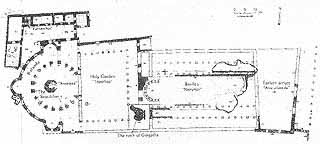
This design was employed in the construction of the 4th century Church of the Holy Sepulcher, which was originally composed of five basic elements: a Rotunda over the place of the Tomb; a chapel built on Golgotha, the place of the Cross; a Courtyard; a great, five-aisled Basilica, with apse and altar at the western end, toward the Tomb; and an Atrium at the eastern entrance to the Basilica from the Cardo Maximus, the colonaded main street that ran south from the present Damascus Gate. (A partially restored section of the Byzantine extension of the Cardo can be seen in the Jewish Quarter.)
A visit to the present Church of the Holy Sepulcher reveals little of the original Byzantine structure. The church was burned and looted by the Persians in 614, partially rebuilt by the Patriarch Modestos, damaged by earthquake in 808, and destroyed in 1009 by order of the Fatamid Caliph al-Hakim. A portion of the Church was again rebuilt by the Byzantine Emperor Constantine Monomachus in 1048, but most of the present building is the result of 12th century Crusader enlargement and reconstruction, as well as later renovations (the most recent preservation work was begun in 1959). The Crusader architects incorporated what survived of the original Byzantine fabric in the area of the Rotunda, Golgotha and the Courtyard into their church. (The present columns and piers of the Rotunda replicate the approximate shape and design of the 4th century original, but at half the height.) The Basilica and Atrium were never rebuilt. However, a portion of the eastern entrance from the Cardo Maximus can be seen in the nearby Russian Orthodox Hospice on al-Dabbaghin Street.
Reconstruction of the original Byzantine Church
Since the Crusades, the precincts and fabric of the Church of the Holy Sepulcher have come into the possession of the three major denominations - the Greek Orthodox, the Armenian Orthodox and the Latin Roman Catholics - whose rights of possession and use are protected by the Status Quo of the Holy Places, as guaranteed by Article LXII of the Treaty of Berlin (1878). The various chapels and shrines within the building are furnished and decorated according to the customs and rites of the religious community holding possession.
The Egyptian Coptic Orthodox, the Ethiopian Orthodox and the Syrian Orthodox also possess certain rights and small properties within the Church of the Holy Sepulcher. The Coptic Chapel on the western side of the edicule enshrines a fragment of stone molding from an earlier monument, which can be seen beneath the altar. The Syrian Orthodox have a chapel on the west side of the Rotunda in which a portion of the original 4th century outer wall can be seen. The Ethiopian Orthodox have a monastery on the roof of the Armenian Chapel of St. Helena, amid the ruins of a 12th century Crusader cloister and refectory.
A common and recognizable Byzantine building technique was the use of alternating courses of stone and brick in the construction of walls. This can be seen at various places in the Church of the Holy Sepulcher: in the Greek Orthodox Chapel of Adam beneath Golgotha, and in the support piers for the 11th century Arch of the Emperor between the rotunda and the Greek catholicon. The visitor should also note the Crusader re-use of Byzantine "basket-weave" capitals.
The oldest surviving church building in Jerusalem is the 5th century crypt of the Greek Orthodox Church of St. John the Baptist (Prodromos) in the Christian Quarter of the Old City. Now below street level, the structure is trefoil-shaped, with three apses (on the north, east and south), and a narrow, long narthex on the western side. Four piers support the dome. The upper storey was destroyed by the Persians in 614. It was rebuilt by St. John the Almoner, Patriarch of Alexandria, and later, in the 11th century, by Italian merchants from Amalfi. The present facade and small bell tower of the upper storey are modern. The church is reached through a courtyard from the Christian Quarter Road.
Another important architectural ruin from the Byzantine period is the apse and foundation walls of the monumental Nea Church, the "New Church of St. Mary, Mother of God" built by the Emperor Justinian in 543. These were uncovered in 1970 and 1982 during archeological excavations in the Jewish Quarter of the Old City. Little of the superstructure of the building was found, but one of the large underground cisterns can still be seen.
The Golden Gate in the eastern wall of the Old City may also date from the Byzantine period. There are references to a gate in the eastern wall of the Temple Mount during the Second Temple period, used by the priests in the biblical Ceremony of the Red Heifer; according to a later Christian tradition, this was the gate through which Jesus entered the city on Palm Sunday. The rounded arches with floral relief moldings are very similar to the Herodian double gate on the south side of the Temple Mount, and archeological investigations carried out during the British Mandate suggested that the present structure could be situated on the site of the original Herodian gateway. It is possible that the present gate was built in the mid-5th century by the Empress Eudocia to commemorate St. Peter's miraculous cure of the lame man (Acts 3:1-10).
Romanesque Architecture (500 - 1100)
A transitional style of architecture called Romanesque developed during the 6th century; it incorporates the earlier Basilica style and some elements of the later more complex Gothic style. A parallel development occurred in Armenia.
The finest examples of surviving Romanesque architecture in Jerusalem are the 11th century church of the Greek Orthodox Monastery of the Holy Cross, located near the Israel Museum, and the restored 12th century Church of St. Anne, near the Lions Gate in the Old City.
The fortress-like Monastery of the Holy Cross was built in the 11th century by the Georgian King Bagrat on the site of an earlier sanctuary. The church, entered through a narthex, has a nave and side aisles, with a dome supported by four pillars. The 12th and 17th century frescoes decorating the pillars and walls of the church recount the legend of the tree used to make the cross upon which Jesus was crucified. One of the frescoes commemorates the 13th century Georgian national poet Shota Rustaveli, who lived in the monastery. Since the 16th century, the monastery has been in the possession of the Greek Orthodox Patriarchate. It is open to visitors most days of the week. The floor contains sections of mosaic flooring from an earlier 5th century church.
The Church of St. Anne, a domed basilica with a nave and two aisles, is considered one of the most beautiful churches in the city. The interior is plain, perhaps attesting to the fact that after 1192 the building was used as a madrasa, a Muslim religious academy. (It is curious that none of the capitals on the interior columns are of the same design. One even portrays a cow - or an ox, a symbol perhaps for St. Luke?) In 1856, the Ottoman sultan gave the property to the Roman Catholic "White Fathers" in gratitude for French support during the Crimean War.
The walled Armenian Quarter (actually the Armenian Convent of Saint James) in the southwestern part of the Old City contains several churches and chapels dating from the Middle Ages. The most imposing is the Armenian Orthodox Cathedral of St. James the Great, acquired from the Georgians in 1141. The present structure incorporates earlier elements, including the Chapel of St. Menas, which may date from the 5th century. The interior design of the cathedral - a wide nave and narrow aisles, separated by four square pillars supporting vaulting and a
dome - is similar to already existing churches in Armenia. The original entrance was on the south side of the church, but in 1670 the portico was closed in to create the Chapel of Etchmiadzin.
The nearby Armenian Orthodox Church of the Holy Archangels, dating from the 13th century, is similar in plan to St. James, though on a much smaller scale. Both churches are decorated with 18th century blue-on-white Kütahya tiles. The walls of the entrance courtyard to the cathedral also contain katchkars, stones carved with crosses and inscriptions that were donated by pilgrims. The earliest is dated 1151.
A well-preserved Crusader church was discovered only a few years ago on Aqabat al-Khalidiyya Street near the Suq al-Qattanin (Market of the Cotton Merchants). It is presumed that this is the Church of St. Julian, though this is uncertain. Like several other religious Crusader buildings, it was later put to other uses; most recently it has been used as a carpentry and furniture shop. A three-aisled basilica with three apses, the plan is similar to that of St. Mary of the Germans, a 12th century church and hospice of the German-speaking Knights of St. John, the preserved ruins of which can be seen on Misgav Ladakh Street in the Jewish Quarter.
Other Romanesque and Crusader churches have survived as mosques and Muslim religious and educational institutions, but these are not open to casual visitors.
The outline of the 11th century Church of St. Mary of the Latins is preserved in the present German Lutheran Church of the Redeemer, built in 1898. The present building also incorporates the medieval north porch with its decorations of the Zodiac. Parts of the medieval cloister are preserved in the adjoining Lutheran Hospice.
Not all Crusader architecture was for religious purposes. The Triple Suq - the three parallel covered market bazaars in the center of the Old City - is mostly from the Crusader period. Some of the piers between the shops still bear the cipher "S. A." for "Santa Anna" signifying that they were the property of the Church of St. Anne.
The Great Greek Orthodox Monastery, which adjoins the Church of the Holy Sepulcher on the west, should also be mentioned. The monastery is a labyrinth of rooms, courtyards, chapels, steps and lanes from various periods. Its main Church of St. Thecla dates from the 12th century, but the monastery itself may be older. The flat roof of the monastery overspans Christian Quarter Road and extends to join the roof of the Holy Sepulcher.
Gothic Architecture (1100 - 1500)
The Gothic style of architecture developed from the Romanesque during the 12th century. It is distinguished by a predominance of vertical lines, the use of "broken" (or pointed) arches, clustered columns, and large decorated windows. Gothic architecture also used intricate and richly developed stone-carving, including fanciful or grotesque designs.
For historical, political as well as financial reasons, late-Medieval Christian architecture in Jerusalem did not develop into the soaring architectural styles found in the Gothic cathedrals and churches of Western Europe. Even so, elements of early-Norman Gothic can be found in the Crusader-built choir and ambulatory of the Church of the Holy Sepulcher (in and around the present Greek Orthodox catholicon); in the groined, ribbed-vaulting of the south transept; and in the two pointed, depressed-arch portals of the main entrance, with their distinctive columned door jambs and ornamental arch moldings. (The two 12th century Gothic lintels with intricately carved scroll-work and figures that once adorned the doorways are now in Jerusalem’s Rockefeller Museum.)
Similar 12th century depressed-arch portals can be found in the entrance to the small Syrian Orthodox Church of St. Mark, near the Jaffa Gate; and in the buttressed Crusader facade for the underground Tomb of the Virgin Mary in the Kidron Valley.
Following the Muslim re-conquest, there was little new construction of Christian religious buildings. The work that was carried out or permitted was mostly repair and maintenance. One notable exception was the Coenaculum, the Upper Room, on Mount Zion, built by the Franciscans on their return to the city in 1335. The ribbed vaulting of the ceiling is typical of Lusignan or Cypriot Gothic. The sculpted mihrab, the Muslim prayer niche, was added in 1523, when the Franciscans were expelled from the building and the room converted into a mosque.
19th century Pastische
Until 1833, the Franciscan Custody of the Holy Land was the only Western Christian representation permitted to reside in Jerusalem. This changed during the ten-year military occupation of the city by Ibrahim Pasha, son of the ruler of Egypt, Mohammed Ali, when the major European powers established consulates in the city. Ottoman political and administrative control was restored in 1844, but the major European powers now regarded themselves as protectors of the local Christian communities: France as protector of the Roman Catholics; Russia as protector of the Eastern Orthodox; and Great Britain and Prussia as protectors of the Protestant communities. The national churches of Great Britain and Prussia took advantage of the situation to establish a Protestant presence. Similar activities were carried out by the Russian Orthodox Church and by the Catholic churches and religious orders of Austria, France, and Italy.
As a rule, these groups tended to favor architectural designs expressing their own national culture and history. The result has graced Jerusalem with an English country cathedral, an Italian Renaissance palazzo, a Rhine Valley hunting lodge, and a Scottish castle. Some of the builders attempted to achieve a more indigenous effect by including "Moorish" and neo-classical elements in their designs. Some of these attempts were more successful than others. All the designs, however, had to contend with local materials and traditional building methods. For their part, the indigenous Eastern Churches continued to use traditional designs. An example of this is the Coptic Khan on the northern side of Hezekiah's Pool. Built in 1836 as a hospice for Egyptian Christian pilgrims, it has the classic layout of a medieval caravanserai with an entrance gateway and a central courtyard.
The first Western ecclesiastical building constructed in Jerusalem at this time was the Anglican Christ Church compound inside the Jaffa Gate of the Old City. Built in 1849 and designed in mock-Tudor style, it is the first and oldest Protestant church in the Middle East. It lacks a bell tower because it was fictiously built as a private chapel for the British consul-general.
A similar image of "merrie England" is found in the Anglican Cathedral of St. George the Martyr on Nablus Road, constructed in 1898. A scaled-down version of a rural English cathedral, it could easily be a stage set for one of Trollope's novels. Entered through a mock-Tudor gatehouse, the Cathedral Close includes apartments for the dean and bishop, a guesthouse for pilgrims, a school for boys, and in recent years an adult education college run by the affiliated Protestant Episcopal Church of the United States.
In 1852, the Roman Catholics began to build the Latin Patriarchate, following the restoration of that dignity in 1847. The actual residence was completed in 1858, the con-cathedral in 1872. The rather plain facade is neo-gothic.
Greek Orthodox building at this time tended to favor the Ottoman-Baroque, as can be seen in the facade of the Greek Orthodox School on St. Dimitri Street, and in the design of the bell tower in the Monastery of the Cross.
A sort of northern-Baroque style was favored in the construction of the Russian Orthodox Cathedral of the Holy Trinity, consecrated in 1871 within the walled Russian Compound. Built outside the Old City, the complex of buildings included a consulate, hospital, hospices and kitchens for Russian Orthodox pilgrims. A more traditional "Muscovite" style was used in the onion-domed design of the Russian Orthodox Church and Convent of St. Mary Magdalene at Gethsemane, built in 1888.
One of the more curious buildings is the Florentine-style Italian Hospital (which today houses offices of the Ministry of Education) on the Street of the Prophets. A startling apparition, it combines elements from the Palazzo Vecchio and the Medici Chapel.
A plainer neo-Renaissance look is found in the Franciscan-built Terra Sancta College building on King George Avenue, and the older Ratisbonne Monastery of the Fathers of Zion.
The Germans preferred the neo-Romanesque, of which there are four imposing examples: the German Lutheran Church of the Redeemer in the Muristan section of the Old City, built in 1897; the Roman Catholic Dormition Abbey on Mount Zion, built in 1901; the Roman Catholic St. Paul's Hospice across from the Damascus Gate, built in 1910 (which today houses Schmidt College); and the German Lutheran Church of the Ascension on the Mount of Olives, also built in 1910 as part of the Augusta-Victoria Hospice. The interior decoration, frescoes and mosaics of the Church of the Ascension are important to students of 19th century German art, as they are patterned after those of the Kaiser Wilhelm I Memorial Church in Berlin, which was destroyed during World War II. Similarly important late 19th-century decorations were used in the chapel of the Roman Catholic Austrian Hospice across from the 4th Station of the Cross on the Via Dolorosa.
One of the most successful of the Western architects working in Jerusalem during the mid-19th century was the German-born engineer and pioneering biblical archeologist Dr. Conrad Schick, whose design for St. Paul's Anglican Chapel on the street of the Prophets is a gem of Victorian "gingerbread", even though constructed of local limestone. (A similar use of stone to build Northern European-style houses is found in the German Colony, in the Emek Refaim neighborhood south of the Jerusalem Railroad Station.)
Several buildings constructed at this time sought to incorporate designs adapted from recent archeological finds. Such designs can be seen in the ornamentation on the French Hospital and the Convent of St. Vincent de Paul. However, in the case of the Convent of the Sisters of Zion, archeology became the architectural center of focus following the discovery in 1851 of a portion of what seems to be a 1st century city gate built by Herod Agrippa I, and later rebuilt as a Roman triumphal arch during the reign of the Emperor Hadrian (about the year 135). When the present convent was built in 1868, the recently discovered eastern arch of the monument was incorporated into the design of the chapel of the convent as a dramatic setting for the altar.
Archaeology also influenced the design of St. Stephen's Church, built in 1900 by the French Dominicans as part of the Ecole Biblique et Archéologique Française. The design is patterned on that of a classical basilica and, indeed the present structure is built on the site of an earlier Byzantine sanctuary. Remnants of the 5th century mosaic paving can be seen in the atrium and in the nave of the sanctuary.
That 19th century European architecture in Jerusalem could be functional as well as decorative is evidenced by Conrad Schick's own residence, Thabor House on the Street of the Prophets. Built in 1882, it today houses the Swedish Theological Institute. One of the first modern dwellings outside the Old City, it was built by traditional building methods, including rubble-filled walls (as was discovered during recent renovations), but the rooms in the main house have flat European ceilings. Other historic 19th century buildings along the Street of the Prophets are the tin-cupolaed roof of the former German Deaconess Hospital (today an annex to the adjoining Bikur Holim Hospital), and the semi-circular radiating pavilions of the former English Hospital (today the Anglican School).
Nearby, on Ethiopia Street, is the walled compound of the Ethiopian Cathedral and Monastery built in 1896. The church is built in the round. The screened sanctuary is in the center of the building, encircled by an ambulatory where the congregation stands.
Modern Architecture
The most distinctive architectural feature of modern Jerusalem is the fact that all buildings are faced in stone - even the public toilets! This is the result of an aesthetic decision made in the early 1920s by the first British governor of Jerusalem, Sir Ronald Storrs, who made it a city ordinance.
The result has given the city a certain uniformity of character. And though there can be startling incongruities between design and material, the requirement has, for the most part, tended to have a moderating effect on more radical designs.
Jerusalem has three examples of the work of the Roman Catholic architect Antonio Barluzzi, who created a series of churches and shrines for the Franciscan Custody of the Holy Land:
- the ornate Church of All Nations at the Garden of Gethsemane, built in 1924;
- a Romanesque-style church tower designed for the Franciscan church at Bethphage during renovations in 1954;
- and the small Chapel of Dominus Fleuvit on the Mount of Olives, built in 1955.
A radical departure from his usual conservative style, Barluzzi designed the chapel as a stylized tear-shaped building built in the form of a Greek cross.
The clean, plain lines of St. Andrews Scots Memorial Church and Hospice standing on the edge of the Valley of Hinnom, evoke images of a Highland castle and keep. This is appropriate since the church was built as a memorial to Scottish soldiers who fell fighting in this region during World War I.
The church was built in 1927 to the design of Clifford Holliday. The large, Crusader-style windows in the sanctuary use small, round panels of blue Hebron glass.
More eclectic is the lofty Jerusalem International YMCA. Opened in 1933, it was designed by A. L. Harmon, the architect of the Empire State Building.
The archangel, in bas relief, on the carillon tower was designed by the Bezalel artist Ze'ev Raban. The capitals along the loggia are carved with representations of local flora and fauna, as are the capitals along the arcades leading to each of the two domed extensions, one of which contains the Byzantine-ornamented auditorium, the other the gymnasium.
Very modern are the clean lines and comfortable functionalism of the new sanctuary of the Narkis Street Baptist Congregation, a design that blends well with the "Bauhaus" international style of the surrounding neighborhood.
An equally modernistic approach was used in the design of the Jerusalem Center of Middle Eastern Studies, built in 1988 as a branch of the Mormon Church affiliated Brigham Young University. Situated on the southern slope of Mount Scopus, its architecture takes advantage of situation and view, especially in the glass-walled concert hall, where the audience looks out onto the Old City and the Temple Mount.
The Eastern churches, however, have continued to follow traditional designs, especially in the construction of new churches.
An example of this can be seen in the recently constructed Greek Orthodox Church of Bethphage, which is classically Byzantine.
It is perhaps appropriate for the new Millenium that the most recent work of Christian construction in Jerusalem has involved the renovation and restoration of the dome of the Rotunda in the Church of the Holy Sepulcher. The first shall be last and the last shall be first, as it were.
Source from : http://www.jewishvirtuallibrary.org
For more interesting topics related to archaeology, visit archaeology excavations.
Building remains from First Temple Period exposed west of Temple Mount
In an excavation being carried out by the Israel Antiquities Authority in partnership with the Western Wall Heritage Foundation in the northwestern part of the Western Wall plaza a rich layer of finds from the latter part of the First Temple period was recently discovered. Also found was a seal that bears an inscription in ancient Hebrew which reads: [belonging] to Netanyahu ben Yaush.
A rich layer of finds from the latter part of the First Temple period (8th-6th centuries BCE) was recently discovered in archaeological salvage excavations that are being carried out in the northwestern part of the Western Wall plaza, c. 100 meters west of the Temple Mount.
In the archaeology excavations, which the Israel Antiquties Authority has been conducting for the past two years under the direction of archaeologists Shlomit Wexler-Bdoulah and Alexander Onn, in cooperation with the Western Wall Heritage Foundation, remains of a magnificent colonnaded street from the Late Roman period (2nd century CE) were uncovered that appears on the mosaic Madaba map and is referred to by the name - the Eastern Cardo. The level of the Eastern Cardo is paved with large heavy limestone pavers that were set directly on top of the layer that dates to the end of the First Temple period. Thus the Roman road “seals” beneath it the finds from the First Temple period and has protected them from being plundered in later periods.
This is actually the first time in the history of the archaeological research of Jerusalem that building remains from the First Temple period were exposed so close to the Temple Mount - on the eastern slopes of the Upper City. The walls of the buildings are preserved to a height of more than 2 meters.
Another impressive artifact that was found in the salvage excavations is a that was apparently inlaid in a ring. The scarab-like seal is elliptical and measures c. 1.1 cm x 1.4 cm. The surface of the seal is divided into three strips separated by a double line: in the upper strip is a chain decoration in which there are four pomegranates and in the two bottom strips is the name of the owner of the seal, engraved in ancient Hebrew script. It reads: לנתניהו בן יאש ([belonging] to Netanyahu ben Yaush).
The two names are known in the treasury of biblical names: the name נתניהו (Netanyahu) is mentioned a number of times in the Bible (in the Book of Jeremiah and in Chronicles) and the name יאש (Yaush) appears in the Lachish letters. The name Yaush, like the name יאשיהו (Yoshiyahu) is, in the opinion of Professor Shmuel Ahituv, derived from the root או"ש which means “he gave a present” (based on Arabic and Ugaritic). It is customary to assume that the owners of personal seals were people that held senior governmental positions.
It should nevertheless be emphasized that this combination of names - נתניהו בן יאוש (Netanyahu ben Yaush) - was unknown until now.
In addition to the personal seal, a vast amount of pottery vessels was discovered, among them three jar handles that bear LMLK stamped impressions. An inscription written in ancient Hebrew script is preserved on one these impressions and it reads: למלך חברון ([belonging] to the king of Hebron).
These finds, as well as the numerous fertility and animal figurines, are characteristic of the Kingdom of Judah in the latter part of the First Temple period - the end of the 8th century BCE to the destruction of the Temple in the year 586 BCE.
Source from : http://www.jewishvirtuallibrary.org
For more interesting topics related to archaeology, visit archaeology excavations.
Tuesday, February 22, 2011
King Tut treasures missing after Cairo Museum break-in
An inventory check at the Cairo Museum, Egypt - two weeks after the protests at the capital lead to a break-in at the national museum - shows that not all of ancient Egyptian treasures are accounted for.
Amongst the missing antiquities - ranging from little shabtis to larger stone statues - are objects that were discovered in King Tut’s tomb.
Dr. Zahi Hawass, Egypt’s Minister of State for Antiquities Affairs, announced today that the staff of the database department at the Egyptian Museum, Cairo have given him their report on the inventory of objects at the museum following the January break in.
Sadly, he said, they have discovered objects are missing from the museum.
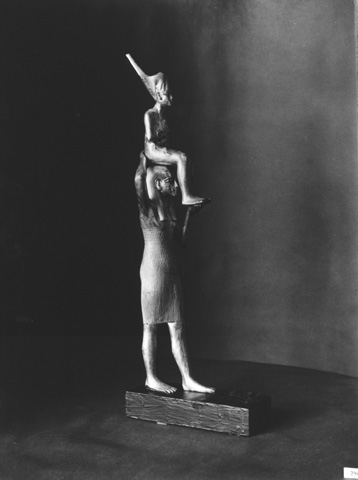
Objects that were likely taken during the break-in, are a gilded wood statue of the 18th Dynasty King Tutankhamun being carried by a goddess; and one of two ritual figurines showing Tutankhamun harpooning a hippo (the damage the statue has sustained can be seen in the image in 'Egypt Protests Sees Cairo Museum Looted as Artefacts and Mummies are Damaged').
From the latter, only the torso and upper limbs of the Pharaoh are missing.
Also stolen from the museum are a limestone statue of Akhenaten holding an offering table, and a statue of Nefertiti making offerings.
Further objects that were recoreded to be lost are a sandstone head of an Amarna princess; a stone statuette of a scribe from Amarna; eleven wooden shabti statuettes of Yuya; and a Heart Scarab of Yuya.
Update Feb 16 2011: Some of these objects have been found and have been returned to the Cairo museum. These are the statue of Akhenaten, one of Yuya's shabtis, her Heart Scarab and parts of the statue of King Tut being carried by the goddess Menkaret.
Hawass asserted that an investigation has begun to search for the people who have taken these objects, and the police and army plan to follow up with the criminals already in custody.
Other Tutankhamun objects - such as the statue of the Pharoah standing on a black panter - damaged during the looting, are amongst seventy artefacts that will be restored.
In another terrible turn of events, on the night of 11 February, 2011 a magazine in Dahshur - called De Morgan’s - was broken into.
This magazine contains large blocks, as well as small artifacts.
The statement does not say if any objects were taken from the De Morgan's magazine.
For more interesting topics related to archaeology, visit archaeology excavations.

2,500 years of tree rings reveals link between Europe's climate and social upheaval
By measuring tree rings, researchers have found striking chronological parallels between significant variations of climate and major historical periods.
The scientists reconstructed the summer climate in Europe over the last 2,500 years from the information provided by annual tree growth, and found that both the times when the Roman Empire and the Middle Ages were at their zenith, the summers were relatively humid and warm.
The team, consisting of climatologists and archaeologists, put together a complete history of rainfall and temperature over the past two and a half millennia in Central Europe. In order to do this, they analysed the annual growth rings of some 9,000 samples of sub-fossil, archaeological-historical and living wood originating from Germany, France, Italy, and Austria. The results were then compared with weather data in order to collate the findings with actual information on rain- and snowfall, and temperature variations.
This enabled the scientists to consider major historical events and epochs in the context of the fluctuations of the European summer climate in the period from the late Iron Age 2,500 years ago right up to the 21st century.
"During the Roman era, the climate was predominantly humid and warm, and also relatively stable," explains one of the authors of the study, Ulf Büntgen of Swiss Federal Institute for Forest, Snow and Landscape (WSL) in Zurich.
The decline of the Western Roman Empire coincided with a period after 250 AD in which it became much colder and climatically changeable. This phase of more marked climatic variation persisted for 300 years, accompanying the 'Barbarian Invasions' and the associated socio-economic destabilization in Europe that occurred roughly from 300 to 700 AD.
The cultural revival of the early Middle Ages occurred as both temperatures and rainfall began to increase with the dawn of the 7th century. It is also possible that climatic factors may have contributed towards the spread and virulence of the Black Death (most likely an outbreak of bubonic plague) after 1347.
In addition, the new findings suggest that a cold period during the Thirty Years' War in the first half of the 17th century could have aggravated the contemporary widespread famines.
The study, published in 'Science' (abstract) as 2500 Years of European Climate Variability and Human Susceptibility, also compares the climate of the 20th century and the changes (partly) attributable to human activity with the natural fluctuations of the past 2,500 years.
Recent warming is unprecedented – the summers of the late 20th and early 21st centuries appear to be have been unusually warm when considered against the background of natural temperature variation. On the other hand, there were also periods of very heavy precipitation in the past that, in terms of quantity of rainfall and duration, were more extreme than anything we are witnessing today.
However, the team of authors explicitly draws attention to the complexity of the relationship between climatic change and historical events, and warns of the dangers of drawing overly simplistic conclusions with regard to cause and effect.
For more interesting topics related to archaeology, visit archaeology excavations.
