Tuesday, August 30, 2011

Country's oldest sunken garden discovered


Restoration work on a lesser known tomb in the heart of the city has led to the discovery of the country's oldest “sunken garden”, a serendipity that will put the history of the Mughal gardens in a new perspective.

Restorers at the Isa Khan's tomb in the precincts of the Humayun's Tomb World Heritage Site have discovered that the Isa Khan's tomb stood within a hitherto unknown sunken garden that predates the famed gardens that the Mughals built and popularised. Also uncovered at site are pieces of underlying archaeology.

And with this discovery, the country now has a new chapter added to the history of the Mughal gardens.

“It is an important discovery as the Isa Khan's Tomb garden predates the Humanyun's Tomb garden by two decades. It is also very significant as Isa Khan's garden tomb can now be considered the earliest example of a sunken garden in India – attached to a tomb – a concept later developed at Akbar's Tomb and at the Taj Mahal,” said Ratish Nanda, Project Director of the Aga Khan Trust for Culture, that has been undertaking an urban renewal project in the Humanyun's Tomb Nizamuddin Basti area.

“We were not expecting to discover that the earth levels in the enclosure were over a metre lower than the existing levels, when we began the restoration of the Isa Khan tomb. We realised that the level of the garden, as was designed originally was much lower than its existing level. So we began the work of restoring the garden to its original design,” he added.

The restoration work of the Isa Khan's Tomb is being carried out by the AKTC in partnership with the Archaeological Survey of India and with co-funding from the World Monuments Fund.

The ongoing restoration work has thrown up underlying archaeology, including building elements such as finials of the dome and canopies and terracotta toys, all of which have immense historical relevance.

Referring to the work that has been underway for the past eight months, he said: “Once we discovered that the garden was much lower than what it had risen to, we had to begin earth moving work. And since we were operating in an area rich with underlying archaeology, we could not use machines, and everything had to be done manually. Over 3000 cubic metre of earth was removed to restore the garden to its original level.”

Over 20,000 man-hours later, the AKTC team today is in the middle of restoring the garden and the tomb that it circumferences to its original glory.

After a peer review, with national and international experts, before the onset of works from July – December 2010, restoration work began with test pits being created that revealed the original levels to be 1m lower than existing levels. Restorers also found parts of building elements such as columns of the tomb's dome and finials buried in the garden that are now being used for its restoration.

“It is an exciting and a wonderful discovery. The sunken garden here has revealed how the gardens have risen over the years, just as layers are added to history; layers have been added to the gardens as well. Over the years gardens have come up at the level of the monuments, but this garden has revealed that here it was originally three to four feet below the monument with the tomb sitting high,” said Amita Beg of the WMF.

The discovery has also shed light on the grandeur of the tombs, rising above the gardens and overlooking the trees and the landscaping. “By placing the tomb higher than the garden, not only was the magnificence of the tomb enhanced, but it would also allow visitors to the tomb to be at eye level with the surrounding tree species such as citrus varieties popularly used by the Mughals,” said Mr. Nanda.

Isa Khan finds mention in history as a brave and valiant noble under Sher Shah Suri, the Afghan ruler who had overthrown Humayun. The tomb built in 1547 is octagonal in shape and has exceptional decorative detailing.

For more interesting topics related to archaeology, visit archaeology excavations.

Archaeologists make new discoveries on Algarve’s West Coast


A mosque, 21 burials and a funerary head stone with an Arabic inscription have been discovered this summer during an archaeology excavation at the Ribãt de Arrifana, Aljezur, led by two Portuguese archaeologists from the Universidade Nova de Lisboa.

”In the Ribat [convent], we found a new mosque, 21 new burials and a second funerary head stone in situ that has a seven line inscription in Arabic,” archaeologist Rosa Varela Gomes told Lusa News Agency.

The Ribat da Arrifana, which is located on the Atalaia Peninsula, five kilometres from Aljezur, was identified by archaeologists Rosa and Mário Varela Gomes from the Universidade Nova de Lisboa 10 years ago. Since then, the pair have carried out excavations, unearthing the ruins of eight mosques, a minaret, a prayer wall, a necropolis, ceramic objects, pans, metal weapons and a funerary head stone in situ.”

More than 20 archaeology students from the University are currently working on this latest excavation at the site, between 9am and 6pm. The work will continue until the end of August and has been possible due to funding from the “Polis Litoral do Sudoeste Alentejano e Costa Vicentina,” an urban redevelopment programme.

The Ribãt da Arrifana is a unique Islamic convent in Portugal, which was founded in 1130 by warrior monks to spread Jihad (holy war).

“The Polis [programme] will strengthen the structures found and enable the place to be preserved for the public to visit, giving the heritage back to the community, which should happen in 2013,” said the archaeologist, adding that the convent is the largest of its kind on the Iberian Peninsula.

There is another similar structure in Alicante in Spain, but it is smaller than the one found in the Algarve.

The Ribãt da Arrifana was founded in the 12th century by the master and warrior monk Sufi Ibn Qasi, who made a pact of non conflict with Portugal’s first king, Dom Afonso Henriques, enabling him to conquer the lands between the Mondego and Tejo.

The ruins at the convent-fortress reveal some cells where the warrior monks slept and prayed.

Rosa Varela Gomes revealed that a Koran school, a large necropolis and a place to wash the dead are other discoveries that have been made at the site, adding that the burials all face the Islamic holy city of Mecca.

For more interesting topics related to archaeology, visit archaeology excavations.

Monday, August 29, 2011

Oldest human dwelling in Sri Lanka excavated from Badulla


Professor Raj Somadeva of the Post Graduate Institute of Archaeology at Kelaniya University says that archaeology excavations in Haldummulla in Badulla district have led to the discovery of the oldest human dwelling identified on the island so far.

The archaeological site in Koswatta, Haldummulla, is situated 850 meters above sea level and it is the highest ground that remains of ancient human dwellings have been reported. The archaeologists have recovered the foundations of four houses and believe more remain under soil.

The excavations started last year and the second phase, now under way, will end in the next two weeks. Many pieces of red-colored pottery, clay beads, and ironware are among the findings.

For more interesting topics related to archaeology, visit archaeology excavations.

Archeological excavations underway in Azerbaijan's Fuzuli


Sheikh Baba sanctuary is one of the greatest architectural monuments of Azerbaijan. Mausoleum and a dilapidated minaret of the sanctuary have survived to this day, Archaeology and Ethnography Institute at the Azerbaijan National Academy of Sciences said.

The mausoleum was built in 1373-1374 in honor of Sufi sheikh Ali Baba Yaqub by architect Majiddin. Archaeological excavations are conducted by Fuzuli archaeological expedition at the order of the Culture and Tourism Ministry since early 2011.

The archeological excavations that cover an area of 1,100 square meters have unearthed ruins of public buildings of the XIV century and underground tomb in an area of 576 square meters so far.

Head of the expedition Khagani Almammadov said six stone coffins relating to the XIV century have been found here. Archaeologists have not met this form of burial in Azerbaijan so far.

These stone coffins have been constructed of special bricks and stones adorned with ornaments. There is no doubt that medieval warriors have been buried there. A skeleton without the skull have been discovered in one of the tombs while skeleton and arrows have been discovered in the other.

Along with the archeological excavations, restoration and conservation works are also planned in this area.

For more interesting topics related to archaeology, visit archaeology excavations.

Sunday, August 28, 2011

Archaeologist, volunteers dig up old Saginaw home

In the Cathedral District, a bag of Cheetos can make history make sense.

For Jeff Sommer, curator of archaeology at the Castle Museum of Saginaw County History, when Cheetos happen to pop up at his dig sites, they sometimes tell him stories other artifacts can't.

This week, two bags of the snack — with buy-by dates from 1993 — were discovered in the same pile with 19th century brick, glass and nails at an archaeological effort that Sommer hopes paints a better portrait of the average Saginaw family, circa 1893.

The junk food likely wasn't a part of the diet of the McMasters — the family that lived in a home at the site before Saginaw's Great Fire of 1893 burned the house to the ground — but both bags' presence, along with evidence of a nearby ground hog tunnel, clue him in that this dig hasn't remained entirely untouched over the decades.

"That makes me feel better," Sommer said. "That explains why there's other stuff mixed in (with the older artifacts.) That makes sense."

In archaeology, details are important, he'll tell you.

Sommer and a group of Central Michigan University interns and other volunteers for two weeks have been shoveling out such details from the old McMaster residence, now buried feet-deep in the soil of an otherwise-normal Cathedral District neighborhood.

Sommer chose to dig around the location because Neighborhood Renewal Services owns the land and granted him and his team permission to explore.

According to city directories from 1893-94, the McMasters were a family of six: Anna, Allen D., Allen D. Jr., James F., Lizzie and Solomon. Allen D. Jr. was a letter carrier, and James F. was a janitor.

Other items recovered at their former residence so far: Burned glass, burned wood, burned nails, burned brick. Evidence of the fire that swallowed more than 257 Saginaw buildings — a blaze that stretched from Ojibway Island northeast to this neighborhood — is at Sommer's feet.

All he has to do is dig.

"We're hoping this is going to tell us about the everyday lives of the ordinary family back then," he said, "rather than the extraordinary events we know about."

The most interesting item, Sommer said, was a clay marble child's toy that may have belonged to some modern Saginaw resident's distant ancestor.

He's hoping for more evidence. And he's inviting the public to join the discovery.

Throughout this month and September, Sommer plans to tend to the dig every Tuesday and Thursday from 10 a.m. to 2 p.m. and has invited residents to stop by and watch.

So far, he and his crew have shoveled about 6 feet into the dirt, in a 10-foot-by-15-foot rectangle of earth.

The archaeologists are more precise in their digging than, say, an undertaker.

Segmenting 1-meter-by-1-meter sections, Sommer and his group carefully brush, dig and polish away soil from their findings before moving on to the next space.

When they're finished, Sommer hopes to collect the most significant findings and begin work on a new Castle Museum exhibit that tells the McMasters' story.

For more interesting topics related to archaeology, visit archaeology excavations.

Saudi Arabia discovers 9,000 year-old civilization


The discovery of the civilization, named al-Maqar after the site's location, will challenge the theory that the domestication of animals took place 5,500 years ago in Central Asia, said Ali al-Ghabban, Vice-President of Antiquities and Museums at the Saudi Commission for Tourism & Antiquities.

"This discovery will change our knowledge concerning the domestication of horses and the evolution of culture in the late Neolithic period," Ghabban told a news conference in the Red Sea port of Jeddah.

"The Maqar Civilization is a very advanced civilization of the Neolithic period. This site shows us clearly, the roots of the domestication of horses 9,000 years ago."

The site also includes remains of mummified skeletons, arrowheads, scrapers, grain grinders, tools for spinning and weaving, and other tools that are evidence of a civilization that is skilled in handicrafts.

Saudi Arabia, the world's largest oil exporter, is trying to diversify its economy away from oil and hopes to increase its tourism.

Last year the SCTA launched exhibitions in Barcelona's CaixaForum museum and Paris's Louvre museum showcasing historic findings of the Arabian Peninsula.

For more interesting topics related to archaeology, visit archaeology excavations.
Wednesday, August 24, 2011

Medieval remains could lie under planned Shrewsbury college site


A report by Shropshire Council’s Archaeology Service is recommending that a field evaluation is carried out to determine exactly what is below a piece of land at the college in Priory Road.

The area earmarked for the building is thought to have once been part of a cemetery for the Augustinian Friary, known as the Austin Friars, which established its first house in Shrewsbury in about 1254.

Archaeologists say the area has been identified by the Shrewsbury Urban Archaeological Assessment as a “key site” for the recovery of skeletal remains which could provide information on cemetery populations.

The report, produced for the college, says: “The western part of the site, now occupied by SSFC and a children’s playground in The Quarry park, appears to have been the friary’s burial ground.

“It is considered that the cemetery will contain a closed group of remains that would yield data on population and demography, disease and pathology.”

According to the report, at the beginning of the 19th century, the antiquarian Reverend Hugh Owen commented on “the great quantity of human bones that have been from time to time dug up in the precinct” of the friary. In 1910, six human skeletons, one of which was enclosed in lead, were found on the sixth form site at a depth of 2.1 metres during archaeology excavations for the boiler room.

And in 1984, human remains were found at a depth of between 1 metre and 1.5 metres between two of the present college buildings.

The report says that groundworks at the site would have an “adverse effect” on any surviving archaeological remains.

It says: “There is a possibility that human remains of medieval date are located within the study area. In the event of human remains being present, additional statutory and Department of Justice requirements (Burial Act, 1857 and amendments) may apply.”

Under the plans by the college, temporary classrooms would be replaced by a building for the geography, environmental science and geology departments.

For more interesting topics related to archaeology, visit archaeology excavations.

Saving Ancient Nineveh


After 2,700 years, the walls and gates of ancient Nineveh can still be seen near the banks of the Tigris river just opposite the modern city of Mosul in Iraq. In ancient times, it was the capital of the great Assyrian empire, a city of more than 100,000 people, and it was a subject of a supreme being's attention throughout the books of the Old and New Testaments in the biblical account. "Now the word of the Lord came unto Jonah the son of Ammittai, saying, Arise, go to Nineveh, that great city, and cry against it; for their wickedness is come up before me."[1] The prophet Jonah's efforts there were rewarded. Nineveh, at least for a time, was saved from destruction. But the city of Nineveh today will require a different kind of saving. There are comparatively few people living there now. It features mostly ruins. Even the ruins, however, will disappear unless, according to the Global Heritage Network's early warning system, urgent steps are taken to arrest the elements that endanger it and to restore and protect what is left.

Not an easy thing to do these days in a war-torn country. War has distracted and preoccupied the energies of a people who otherwise could be identifying and procuring the necessary resources needed to save and protect the city.

But long before war, it has been plagued by looting and vandalism. Artifacts have appeared on international markets for sale, reliefs have been marred by vandalism, and chamber floors have seen holes dug into them by looters hoping to find anything that will yield cash for their needs. The expanding suburbs of adjacent Mosul, too, threaten it with encroachment, with sewer and water lines having already been dug and new settlements already established within the area once occupied by the ancient city.

Even without looting, vandalism and suburban encroachment, however, Nineveh will crumble and succumb to the natural elements. Reports the Global Heritage Fund (GHF)*, a non-profit organization that specializes in saving and restoring archaeological sites, "without proper roofing for protection, Nineveh's ancient walls and reliefs are becoming more and more damaged by natural elements every day. Exploration of the city is an important objective at this time, but preservation measures would go a long way as well".[2]

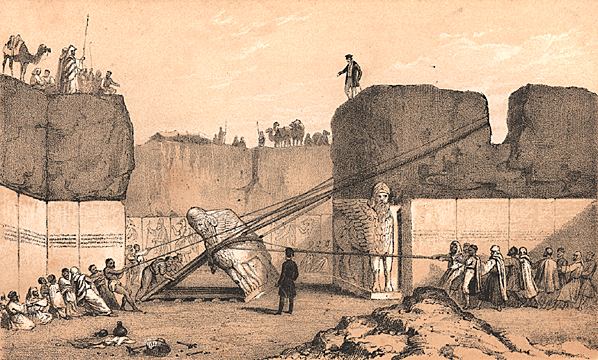
Historically, the site of ancient Nineveh, which consists of two large mounds, Kouyunjik and Nabi Yunus ("Prophet Jonah"), has been the subject of numerous excavations and exploratory expeditions since the mid-19th century. Beginning with French Consul General at Mosul, Paul-Émile Botta in 1842, and most notably through the excavations of famous British archaeologist Austen Henry Layard (pictured right) and many others thereafter, the remains of Nineveh became one of the sensational archaeological revelations of modern times. Before that, Nineveh, unlike the clearly visible remains of other well-known sites such as Palmyra, Persepolis, and Thebes, was invisible, hidden beneath unexplored mounds. Even historical knowledge of the Assyrian Empire and its capital city was sparse in the beginning, changed primarily by the great archaeological discoveries that followed Botta's initial attempts. One palace after another was discovered, including the lost palace of Sennacherib with its 71 rooms and enormous bas-reliefs, the palace and library of Ashurbanipal, which included 22,000 cuneiform tablets. Fragments of prisms were discovered, recording the annals of Sennacherib, Esarhaddon, and Ashurbanipal, including one almost complete prism of Esarhaddon. Massive gates and mudbrick ramparts and walls were unearthed. The walls encompassed an area within a 12-kilometer circumference. Many unburied skeletons were found, evidencing violent deaths and attesting to the final battle and siege of Nineveh that destroyed the city and soon brought an end to the Assyrian Empire.

Despite its long history of excavation, the ancient site of Nineveh leaves much to be explored. But conservationists and others are arguing that further excavation and exploration would be pointless without a concerted, meaningful plan and efforts to preserve the finds for posterity, beginning first with what has already been uncovered. "Nineveh has already been heavily attacked by looters, and now development pressures from nearby Mosul have begun to take their toll as well," reiterates GHF. "If this encroachment continues, Nineveh's ancient remains could again be buried forever."[2]

In an October 2010 report titled Saving Our Vanishing Heritage, Global Heritage Fund designated Nineveh among the top 12 sites in the world most "on the verge" of irreparable loss as a result of looting, development encroachment, and insufficient management of its cultural resources.

For more interesting topics related to archaeology, visit archaeology excavations.

Roman Ships Found Off Sicily; New Sites Broaden Study

Exploring off the northwest coast of Sicily with a once-secret nuclear submarine, oceanographers and archeologists have discovered the largest concentration of ancient shipwrecks ever found in the deep sea, including one ship that may have carried a prefabricated temple.

The findings, announced yesterday, take archeology deeper than ever before, promising a new era of discoveries in maritime history.

A research team led by Dr. Robert D. Ballard, whose previous finds include the Titanic and the German battleship Bismarck, announced the discovery of eight sailing ships lying 2,500 feet beneath the Mediterranean. Until now maritime archeology has been largely confined to coastal shallows of less than 200 feet, the range for scuba divers.

But with the United States Navy's NR-1 nuclear submarine, the explorers were able to reach 3,000 feet and search the bottom for weeks at a time, using long-range sonar to detect shipwrecks at great distances. Then, with the remotely controlled vehicle Jason, which can descend 20,000 feet and use grappling arms to collect artifacts, the team inspected the wrecks up close and retrieved 115 items from the oldest ships.

Because the artifacts were found in international waters, they presumably belong to the salvagers under maritime law. Their historical value is inestimable, their monetary value unestimated.

Five ships were from Roman times, presumably lost in storms while plying the busy trade routes from Rome to North Africa. The oldest, a 100-foot-long vessel dating from about 100 B.C., is one of the earliest Roman wrecks ever discovered. Her holds were filled with amphoras, the clay shipping containers of the ancient world. Another Roman ship, probably from the first century A.D., carried cut stones, apparently ready for assembly into a temple.

Also in the wreckage, which is spread over 20 square miles, were three more modern sailing ships. One was an Islamic ship from the 18th or early 19th century; the other two were lost in the 19th century.

Dr. Ballard, president of the Institute for Exploration, in Mystic, Conn., and other team members described the discovery in interviews and at a news conference at the National Geographic Society in Washington.

Recalling the view of the wrecks from the submarine, Dr. Ballard said in an interview, ''All of sudden, we realized we had found a graveyard of ships spanning 2,000 years.''

For more interesting topics related to archaeology, visit archaeology excavations.
archaeology's flawed hero


Billed as the 'hottest ticket' at this year's Cannes Film Festival, the launch today of Indiana Jones and the Kingdom of the Crystal Skull coincides with National Archaeology Week, which was established to increase public awareness of Australian archaeology and enhance protection of Australia's unique cultural heritage.

This serendipity of timing raises a number of questions: What role do the Indiana Jones films play in public perceptions of archaeology? Do they enhance the discipline, or detract from it? Can archaeology match the excitement of an Indiana Jones film?

A broader question concerns the inter-relationships between film and the discipline areas upon which they are based.

Over the last three decades, Indiana Jones has become the stereotypical image of an archaeologist-rugged, physically active, adventurous. His female counterpart is Lara Croft, Tomb Raider, the archaeologist hero whose femininity is inscribed within an active, assertive discourse of survival. Neither character represents 'real' archaeology, but that is not their purpose-nor their value to archaeology.

Indiana Jones is based on a combination of two early twentieth century adventurers: Hiram Bingham and Roy Chapman Andrews. Bingham was reputed to be the discoverer of Machu Pichu (popularly known as the Lost City of the Incas), in Peru, while the ranger-hatted, revolver-carrying Andrews was a surveyor of Outer Mongolia, and finder of dinosaur eggs. Andrews' career started with scrubbing the floors of the American Museum of Natural History in New York, and ended with him as Director.

Indiana Jones excites the archaeological imagination.

While archaeologists may not model their behaviour on Jones (and some would argue this point), neither do they spurn the exotic and adventuresome connotations of the job.

Embracement of the Indiana Jones mystique is apparent in this year's program for National Archaeology Week. This year the exhibitions, talks and tours are supplemented by a range of activities celebrating the release of Indiana Jones and the Kingdom of the Crystal Skull.

The Indiana Jones spirit of adventure emerges in the on-line quiz 'Meet the Archaeologists' (http://www.archaeologyweek.com), where attention is drawn to real life archaeological engagements with flesh-eating worms, nests of scorpions-and volunteer fieldworkers tired of eating devon sandwiches for a week.

The great value of Indiana Jones for the archaeological community is that he makes a pedantic and exacting science appear exciting.

It is in the field that archaeology is at its most exciting. As Jones advises a student in Crystal Skull, 'to become a good archaeologist you have to get out of the library'.

Like Indiana Jones, archaeologists work in exotic places, and sometimes in life-threatening situations. One of my colleagues was held at gunpoint while his four-wheel drive was used for a bank robbery in New Guinea. Another had his life threatened while recording graffiti in cells used to house political activists in Argentina. Others have needed armed guards while they excavated mass graves near Bosnian villages that still housed the murderers.

There are substantive differences between Jones and professional archaeologists, of course. While clearly useful in a wide variety of social contexts, Jones' tools of the trade, a pistol and a bullwhip, are not standard archaeological issue. A compass, a tape measure and a trowel are more usual.

Nevertheless, archaeology departments in Australia and overseas can expect an increase in students following the release of Crystal Skull. And while students may enrol in university courses with the aim of learning about exotic artefacts, they leave with an understanding that stone tools, rock art and historic buildings also can unlock the mysteries of ancient worlds.

The Indiana Jones films have spurred occasional direct benefits, as well. Shortly after the release of Indiana Jones and the Last Crusade Harrison Ford donated an iconic bullwhip to the Institute of Archaeology at University College London. This was auctioned for a substantial sum, towards the building of new laboratories.

This week the Archaeological Institute of America increased its international profile with the announcement that Harrison Ford had been elected to their Board of Directors.

Irrespective of his personal contributions, as a Board member of the AIA Ford will attract new members and sponsorship for the organization, as well as new opportunities.

Given that the Indiana Jones films clearly contribute a great deal to archaeology, why is it that so many archaeologists have a problem with Indy?

The basic concern is that Indy's cavalier approach undermines attempts to instil ethical archaeological practices and diminishes archaeology's hard won standing as a legitimate science.

Despite his growing eminence in the field (by the end of Crystal Skull he has become Associate Dean), it is an archaeologist's nightmare to have Dr Jones teach Archaeological Ethics.

In pursuit of 'fortune and glory' Jones ignores international treaties, treats human remains as weapons, and destroys archaeological sites in a bid to escape from potential entombment, and other worrisome possibilities.

Archaeologists are concerned with preserving the past, not making a profit from it, and sometimes Jones seems more finely tuned to the commercial value of an artefact, than the information it can give us about past peoples. This impression is reinforced by occasional references to him as a grave robber.

In Crystal Skull, as in the other films, Indiana Jones walks a fine line between archaeological enquiry and looting. The removal of artefacts from their original context is still looting, even if it is done in the name of a museum-just ask the Greeks for their opinion on the Parthenon Marbles (also known as the Elgin Marbles), still housed against their wishes at the British Museum.

It would be naive, however, to argue that contemporary audiences believe Indiana Jones represents 'real' archaeology. There would be few who are not capable of distinguishing fantasy action sequences from the pedantism of archaeological excavation or artefact cataloguing.

It is more difficult to challenge underlying assumptions relating to imperialism, sexism and ethnocentrism, or to understand these in terms of the social and political contexts within which the archaeological action takes place.

For example, the quest element of the Indiana Jones films rests on the imperialist assumption that the protection of cultural heritage in far-flung parts of the world depends on virtuous interventions from the west. The native people who hinder Jones in Crystal Skull are, in fact, descendents of the people who made the artefacts that Jones seeks and the contemporary cultural custodians of the site.

From an archaeological viewpoint, Indiana Jones' fatal flaw is that he shows little interest in the context within which artefacts are found, or the constellation of connections that can be understood only through in situ analysis.

The intellectual excitement of archaeology comes from connecting with the past. When you excavate an artefact that has been covered for thousands of years you feel a connection to the person who left it there. It is the pursuit of such connections, rather than fortune and glory, that motivates archaeological research.

While Indiana Jones and the Kingdom of the Crystal Skull has great entertainment and promotional value, it is no blueprint for good archaeological practice!

For more interesting topics related to archaeology, visit archaeology excavations.

Monday, August 22, 2011

Wreck of 16th century Swedish warship found in Baltic


A team of divers discovered the wreck at a depth of 75 metres (250 feet), 10 nautical miles (18.5 kilometres) north of the Swedish island of Oland, Stockholm’s maritime history museum said in a statement.

The find came after several years of research.

“Everything suggests that it is indeed the Mars that we have found,” Richard Lundgren, one of the divers, said in the statement. “The size and the age of the ship correspond,” with historical records, he added.

A stack of corn, the symbol of the Swedish royal family at the time, was found engraved on a cannon, providing another strong clue.

“This is a wreck we have waited a long time to see,” said Andreas Olsson, head of the museum’s archaeology department, practically certain that the find is indeed the ship described as “mythical” by the museum.

The remains of the ship will be important for research, he added, particularly in comparison with other recovered finds of historical importance, including the Swedish Vasa which was sunk in 1628, and the British Mare Rose which went down in 1545.

Equipped with 107 cannons and a crew of 800, the Mars was one of the biggest ships of its day.

Just a year after being launched it was sunk in May 1564 during a major battle against the Danish fleet.

More than 450 years later, the experts think the Mars has reappeared and “it seems to be well preserved,” though with a hole in its side, Olsson told reporters.

The local Kalmar prefecture has decided to ban diving and fishing in the area to allow the divers and archaeologists to continue their work.

The beautifully restored Vasa is now a major tourist attraction in Stockholm.

For more interesting topics related to archaeology, visit archaeology excavations.

Archaeology Digs at Bulgarian Black Sea Coast Reveal Precious Finds


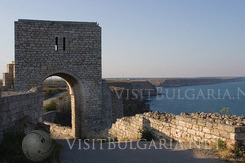
The archaeological excavations at the Bulgarian Black Sea Kaliakra cape have been renewed at the beginning of August, immediately yielding more artifacts.

The information was reported by the Head of the archeological team, Boni Pertunova, from the Bulgarian Academy of Sciences (BAS).

Until now, the researchers have already discovered 20 gold objects – mostly jewelry as well as silver jewelry. They were located inside a necropolis and date from the 12th-14th century. The most interesting find has been a golden earing with two exquisite pearls, Petrunova explains.

43 tombs have been found in the area of the so-called Church 2 in Kaliakra. The most precious find there is a stamp with the portrait of the Virgin Mary, discovered on August 15th, the very same day when the Christian world celebrates the Dormition of Mary. The stamp also has the monogram of its owner – a wealthy, prominent person.

The latter find proves that in the 5th-6th century local residents wrote plenty of documents and correspondence, history experts say, pointing out the stamp is extremely rare and even unique.

The archaeology excavations will continue at least until the end of the month since there is still a lot to research, Petrunova reports.

The work of her team is financed by the Town Hall of the Black Sea city of Kavarna.

For more interesting topics related to archaeology, visit archaeology excavations.

Sunday, August 21, 2011

Ancient Roman jar riddled with mystery


An ancient clay vessel reconstructed from pieces discovered at a Canadian museum is riddled with tiny holes, leaving archaeologists baffled over what it was used for.

The jar, just 16 inches (40 centimeters) tall and dating back about 1,800 years, was found shattered into an unrecognizable 180 pieces in a storage room at the Museum of Ontario Archaeology. But even after it was restored, the scientists were faced with a mystery. So far no one has been able to identify another artifact like it from the Roman world.

"Everyone's stumped by it," Katie Urban, one of the researchers at the London, Ontario, museum, told LiveScience. "We've been sending it around to all sorts of Roman pottery experts and other pottery experts, and no one seems to be able to come up with an example."

The jar may have held rodent snacks for ancient Romans, or even served as a lamp, the researchers speculate, though no theory definitively holds water.

Where did the jar come from?

Archival research indicates the jar was among artifacts from Roman Britain (the part of Great Britain under Roman control from about A.D. 43 to 410) that were given to the museum in the 1950s by William Francis Grimes, an archaeologist who died in 1988. Grimes' team had dug them out of a World War II bomb crater in London, England, not far from an ancient temple dedicated to Mithra, an Iranian god who was popular throughout the Roman Empire. [Top 10 Ancient Capitals]

Urban cautioned, however, that it is not certain the jar is from that dig. The vessel does not appear to be on the list of artifacts received from Grimes, although she added that the jar was found in 180 pieces and the list was short on details.

For more interesting topics related to archaeology, visit archaeology excavations.

Civil War prison yields new artifacts 150 years after the war began


A Civil War prison in Georgia -- briefly the largest prison camp of the conflict -- continues to provide archaeologists with fresh artifacts, including the personal belongings of Union soldiers held there.

Camp Lawton, in Millen, Ga., has been the site of an archaeology excavation by a team from Georgia Southern University since last year.


For more interesting topics related to archaeology, visit archaeology excavations.

Friday, August 19, 2011

Children found sacrificed in pre-Incan ritual

Peruvian archaeologists have uncovered the remains of 12 children and 20 llamas sacrificed some 800 years ago by the pre-Incan Chimu civilization.

The bodies were discovered in good condition during archaeology excavations in the northern coast of the country at Huanchaquito, some 500km from the capital Lima.

The bodies were found near the ancient city of Chan Chan, a government and religious centre of the Chimus.

Experts believe the children and animals were killed in a ritual similar to the Incan ceremony known as Capacocha, which was organized before the imminent death or birth of an Incan emperor.

Archaeologists also suspect the sacrifice could have been done to settle down nature's forces because the remains were found amid clay, suggesting they were buried during a rainy season.

Head of the excavations, Gabriel Prieto, said it was unlikely for the site to have been a cemetery.

"All these bodies seem to be from the Chimu period, that is, they are associated with Chan Chan and they lived in a time ranging from 1,200 to 1,400 years after Christ," he explained.

"And, more than a cemetery, this seems to be an offering - a ritual that these people celebrated probably to honour the sea due to rains. It is also possible that his could have been a Capacocha ritual, which was very common in the Incan time. When an Incan governor lived, was born or died. Great sacrifices were made to honour these events."

The remains were found tied with ropes and there were no burial offerings around.

Prieto said the animals were strategically buried in relation to the bodies, reinforcing the hypothesis that they were laid to rest during a sacrifice ceremony.

Chan Chan was built by the Chimu civilization around 850 AD and is considered a UNESCO World Heritage Site.

Peru is a country rich in archaeological treasures. It has hundreds of sites that date back thousands of years and span dozens of cultures, including the Incan empire that was in power when Spanish explorers arrived in the early 1500s.

For more interesting topics related to archaeology, visit archaeology excavations.

UI archaeologists find 7,000-year-old site in Des Moines


A 7,000-year-old archaeological site in Des Moines is so well-preserved and complete that it will provide researchers with exciting insight into the types of tools the people in the village used, the types of animals they kept and ate and the types of seeds they planted, University of Iowa archaeologists said Thursday after the find was announced.

The site, nicknamed “the Palace” because of its size and preservation, yielded the remains of two humans, a woman and an infant, that are the oldest human bones to be found in the state.

“It’s always fun to find the oldest of something … but the real significance lies in how well-preserved it is,” State Archaeologist John Doershuk said. “This site is important because it was intensively occupied and very quickly river floods sealed the deposits and very quickly preserved items that otherwise could have been lost. It’s all about preservation context, and that’s what this site really has in abundance that other sites don’t.”

Because so many items were found together at the site – UI archaeologists gathered more than 6,000 artifacts – it helps researchers put into context the information they learn about how the villagers lived, what they ate and how they were developing as a people, Doershuk said.

“It’s all the archaeological questions that anthropologists wish they could answer in more detail but often can’t,” he said.

Construction work was ongoing at the site, the future home of a new wastewater treatment facility north of the Des Moines River in southeast Des Moines, when workers moving dirt noted charcoal and burned earth stains, Doershuk said. The Office of the State Archaeologist, based at the UI, was called to the site in December 2010 to monitor the work and investigate interesting findings. The site is owned by the Des Moines Metropolitan Wastewater Reclamation Authority, made up of 16 metro area municipalities, counties and sewer districts.

Anytime a project has federal permitting or federal funding, like this one does, it triggers certain requirements, including archaeological studies, Doershuk said.

“They realized, essentially, there was much more there than previously had been thought,” he said.

The UI archaeologists worked through May to collect as much information and as many artifacts as possible before construction work had to return to that portion of the site. They found the remnants of four oval-shaped deposits, possibly houses, as large as 800 square feet with hearths.

“It became clear very quickly that the site was something spectacular — something none of us had seen before or probably will ever again, as well-preserved house deposits of this age are extremely rare west of the Mississippi River Valley,” Bill Whittaker, a project archaeologist who co-directed the dig, said in a UI statement Thursday.

The burial pit was discovered in March, about six or seven feet below the ground surface. Items were found in the grave along with the remains, including a spear point. The remains were handled in accordance with burial protection laws after they were studied.

“We were looking for more village-types of deposits, hearths and storage pits,” Doershuk said. “Fortunately the crew working that day had enough experience with what human bone looks like that they recognized it right off.”

The age of the site was determined by radiocarbon dating based on wood charcoal from the burial feature and also the spear point found there, by matching it to the time frame of other similar artifacts found in the Midwest, Doershuk said.

The crew also used laser technology to map more than 12,000 archaeological data points so they can develop 3-D models of the site with computer software.

“The field work is done, but it’s just getting going in the lab,” Doershuk said. “We have at least a year’s worth of analysis and writing and comparative work.”

While construction on the wastewater treatment plant at the site continues, there is adjacent, un-excavated land that researchers believe will yield more archaeological finds, and they are working on a preservation plan.


For more interesting topics related to archaeology, visit archaeology excavations.

Paul Litchy’s backyard at the end of a modern-day Franklin cul-de-sac was once a stomping ground for ice age man and beast.


Paul Litchy’s backyard at the end of a modern-day Franklin cul-de-sac was once a stomping ground for ice age man and beast.

This week, his backyard became one of 11 places added to the National Register of Historic Places by the state Historical Commission.

An archaeological excavation last fall turned up the bones, artifacts and animal remains that archaeologists now say prove human activity occurred here before 12,000 B.C. Litchy’s property — known as the Coats-Hines site — is one of the two oldest human settlements documented in Tennessee.

But Litchy, a part-time civil and environmental engineering instructor at Vanderbilt University, knew nothing of the land’s historic significance when he bought the property in 1998. Today, he’s low-key about the artifacts, some of which are less than 1/8th of an inch in size.

“They show me a little piece of something or other and I think, ‘So what?’ ” Litchy said, laughing. “I tell them, ‘When you guys are excited, tell me so I can be excited with you.’ ”

The other oldest human settlement in Tennessee is known as the Johnson Site, along the Cumberland River east of Nashville.
Digs date to '70s

Since the first archaeology excavations began here in 1977, the property has made archaeologists such as Aaron Deter-Wolf beam because the artifacts show so much about life at the end of the last ice age.

Excavations at the property in 1994 revealed the only known example in the southeastern U.S. of mastodon remains directly associated with human-made stone tools in an undisturbed context, according to Deter-Wolf, state prehistoric archaeologist.

Last fall, archaeologists and students from Middle Tennessee State University turned up human artifacts, pollen samples and more than 1,500 animal bones that can be traced to a variety of species. Ultimately tests on last fall’s samples put early humans at the site before 12,000 B.C.

While the bones and artifacts are important, the Coats-Hines site is nationally significant because it is a rare instance in which archaeologists can show ancient people interacting with animals and their context.

“That’s really the meat of archaeology,” Deter-Wolf said. “It’s the association of the items and not just the items themselves.”

Archaeologists believe there was a pond in Litchy’s backyard where animals were killed by hunters.

Those animals included mastodons — elephant-like creatures related to woolly mammoths. Crews have recovered bones from three mastodons at the site.
More digs planned

The discovery of the bones last fall means more excavations are ahead for the property. Archaeologists from the Center for the Study of the First Americans at Texas A&M are planning archaeology excavations at the site.

“Coats-Hines is extremely important to our understanding of both Tennessee and the Nashville area’s ancient past,” Deter-Wolf said. It “has the potential to provide important new information on initial human migration into North America, the tools these earliest Americans used, the food they ate and how they adapted to the changing environment at the end of the last ice age.”

Litchy’s listing on the National Register of Historic Places doesn’t restrict how he might use his property in the future, though it does provide a measure of protection for the site if there is a project that will use federal funding or licensing, said Claudette Stager, preservation specialist with the state Historical Commission.

Only time will tell if the presence of mastodons in the backyard increases the value of Litchy’s house.

For more interesting topics related to archaeology, visit archaeology excavations.


Tuesday, August 16, 2011

Iron Age road link to Iceni tribe


A suspected Iron Age road, made of timber and preserved in peat for 2,000 years, has been uncovered by archaeologists in East Anglia.

The site, excavated in June, may have been part of a route across the River Waveney and surrounding wetland at Geldeston in Norfolk, say experts.

Causeways were first found in the area in 2006, during flood defence work at the nearby Suffolk town of Beccles.

It is thought the road is pre-Roman, built by the local Iceni tribe.

Exact dating has yet to be carried out but tree-ring evidence suggests a date of 75BC.

That dates the timber road to more than 100 years before the Roman invasion, which saw the Iceni and their leader Boudicca lead a revolt which threatened to end Roman rule.

In AD60, the Iceni ambushed one Roman legion and sacked Roman settlements at London and Colchester before being defeated.

For more interesting topics related to archaeology, visit archaeology excavations.

Excavations hope to uncover secrets of Norfolk’s Roman town at Caistor St Edmunds


Archaeologists have spent the last two summers at the site of Venta Icenorum at Caistor St Edmund, with Channel 4’s Time Team filming them for a TV special last year.

The archaeologists returned at the weekend for another three week of digging, this time excavating parts of the Roman forum.

Led by Dr Will Bowden, associate professor of Roman archaeology at the University of Nottingham, the team hope to find out when the forum was built and what happened to it in the later Roman period.

Parts of the site were originally excavated between 1929 and 1935 following the publication of dramatic aerial photographs showing evidence of streets and public buildings, which made national newspaper headlines.

Those who studied the site in 1929-35, thought the Roman forum had been destroyed by fire and lay in ruins for around a hundred years before it was rebuilt.

The team carrying out the new excavations are looking for evidence of that blaze and are also digging in the north west of the town.

They are looking for signs of what happened at Caistor after the Roman period and trying to find out whether the walled town was occupied during the Anglo-Saxon period, before it was eventually overshadowed by the rise of Norwich.

Dr Bowden said: “It’s going pretty well. It’s early days yet, but we have opened up the trenches and we’re now down into the archaeology now.

“Parts of the forum were dug before, but we’re looking for the parts which have not been disturbed.”

He said the dig could end up rewriting the interpretation of the town, as it could demonstrate the Romans occupied it later than originally thought.
He said: “We have always thought of it as being about AD70, but its possibly AD120, which will put a different slant on the reason the town is here.”

The site is now a Scheduled Ancient Monument owned by the Norfolk Archaeological Trust and managed in partnership with South Norfolk Council.

The archaeology excavations are open to the public, free of charge, seven days a week until September 3. There will also be two family activity days where people can join in the dig.

For more interesting topics related to archaeology, visit archaeology excavations.

Thursday, August 11, 2011

Archaeology dig seeks clues to Nebraska’s prehistoric past


A reservoir in McCook, Nebraska is opening a window into the state’s prehistoric past.

Matt Marvin and Steve Sarich are digging and sifting. Marvin is using a shovel to remove dirt from their excavation site, a half centimeter at a time. Sarich is carefully sifting the dirt through a screen. They’re standing amidst grass, weeds and dead reeds, fighting flies, ticks and sometimes 100 degree heat in the middle of the drained Hugh Butler Lake, north of McCook. There’s no Indiana Jones glamour in this real archaeology world.

“It’s not really shoveling as it is shaving,” Marvin said. “You want to make sure that if there is anything, like for instance the hearth that we found, you’ll be able to see it.”

The hearth is at the bottom of a shoulder-deep, L-shaped hole.

“It’s a fireplace, or where they placed a fire, right on the surface of the earth, and it’s discolored the soil to kind of an orange, pumpkin-orange color,” said Alan Osborn, the white-haired curator of anthropology at the University of Nebraska State Museum and leader of this project. “And within it are chunks of bison bone, charcoal, other flakes of stone and so forth from resharpening tools. So that was a food preparation area, probably.”

Osborn said this hearth is a sign that roaming hunter-gatherers stopped here, near Red Willow Creek, sometime between 200 B.C. and 1200 A.D. Osborn and his crew have been working here since early July. Marvin, who is from Lincoln, and Sarich, a native of Milwaukee, Wis., are undergraduate anthropology majors at the University of Nebraska-Lincoln. Bran Mims, from Virginia, is a graduate student at East Carolina University. Steve Reynolds is an Omaha native who previously worked on the University of Nebraska at Omaha’s Bethsaida Project in Israel.

Osborn says they’re here because earlier surveys found signs of prehistoric life in this area.

“This area was littered with bison bone, prehistoric stone tools and chipping debris, as well as a number of little concentrations of rock that are probably hearths,” he said. “Either for roasting plants and or for processing bone grease from the bison.”

Osborn said the small finds provide perspective on the day-to-day life of the people who spent time here long ago.

“So they were bringing in their tools, cutting up bison, processing plants perhaps, and having to resharpen their implements all the time,” said Osborn, who has worked on digs like this almost every summer since 1966. “The bones that we did find on the surface reflect bones that a lot of times were associated with the low-quality parts of bison: the back, the backbone, legs that don’t have any meat on them. So that may reflect they were scavenging a dead bison or a bison that had died a natural death pretty recently.”

“A bone can tell you not only what the animal was, its age, sex sometimes, what it was eating, but it can also reflect the climate and the environment in which the people lived, so there are ways of knowing what was going on,” he added.

The prehistoric people who stopped here were constantly moving. Osborn said he believes they may have been following bison or connecting with family members. They were few in number. By the 15th century, there were just a couple hundred thousand people spread out over the Great Plains.

“The Great Plains is a million square miles, and we’ve come in and put in six 3-by-3-foot holes trying to find something, and we did. And that’s almost a miracle, I guess,” he said. “In terms of probabilities, it should be pretty low. But we’re able to zero in on some of these sites pretty successfully, and we don’t come home with trunks of treasure. But small boxes of fragments of bone and flakes of stone have really a lot more to tell us than archeologists used to assume.”

This repetitive, sometimes tedious detective work is “incredibly fun,” according to Osborn. And incredibly important, because of the light it sheds on the way that humans lived for most of our existence.

“These kinds of folks that lived here who were hunter-gatherers dominated the earth, lived on the earth for 99 percent of human evolution,” Osborn said. “They were sitting near streams, collecting firewood, killing animals, getting through the winter, traveling, and that helped kind of flesh out that whole 99 percent of the story that is still pretty underappreciated.”

Osborn and his crew finished this year’s work at Hugh Butler Lake on Aug. 6. They plan to continue this archeological survey over the next four years.

For more interesting topics related to archaeology, visit archaeology excavations.

Wednesday, August 10, 2011

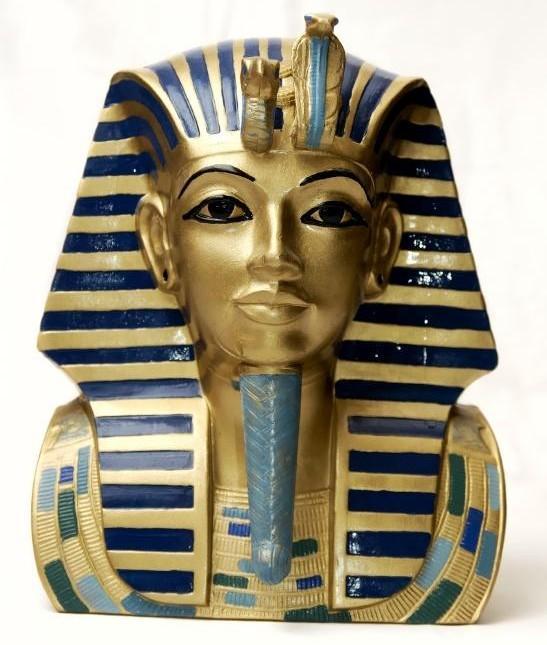
Tutankhamen Fathered Twins, Mummified Fetuses Suggest:


Robert Connolly, who is working with the Egyptian authorities to remains of Tutankhamen and the two stillborn children, will discuss the new findings at the Pharmacy and Medicine in Ancient Egypt Conference at The University of Manchester on September 1, 2008.

Mr Connolly says: “The work carried out by Catherine Hellier in Norway and I suggests that the two fetuses in the tomb of Tutankhamen could be twins despite their very different size and thus fit better as a single pregnancy for his young wife. This increases the likelihood of them being Tutankhamen’s children.

“I studied one of the mummies, the larger one, back in 1979, determined the blood group data from this baby mummy and compared it with my 1969 blood grouping of Tutankhamen. The results confirmed that this larger fetus could indeed be the daughter of Tutankhamen.

“Now we believe that they are twins and they were both his children. The forthcoming DNA study on them by Dr Zahi Hawass’s group in Egypt will contribute another key piece to this question.”

Mr Connolly, Senior Lecturer in Physical Anthropology at the University of Liverpool’s Department of Human Anatomy and Cell Biology, adds: “It is a very exciting finding which will not only paint a more detailed picture of this famous young King’s life and death, it will also tell us more about his lineage.”

More than 100 delegates from 10 countries, including the Director of the Cultural Bureau of the Egyptian Embassy in the UK and researchers from Egypt’s Conservation of Medicinal Plants project in Sinai and the British Museum, are attending the conference, hosted by the KNH Centre for Biomedical Egyptology at The University of Manchester, in conjunction with the National Research Centre in Cairo, Egypt, and sponsored by The Leverhulme Trust.

For more interesting topics related to archaeology, visit archaeology excavations.
Clues to Medieval Archaeology vigour:


A few tantalising pieces of evidence for why Manchester came to dominate North-West England in the industrial age, an event long regarded as something of a mystery, have been pieced together as a result of recent archaeological and historical work in the city.

Traditionally Manchester was thought to have developed only from about 1750, having been a very minor settlement in the Middle Ages – far less important than established towns nearby such as, for example, Preston. The recent work, however, suggests that Manchester was already one of the region’s principal centres by the mid-16th century, and may have flourished commercially for centuries before that.

Two archaeology excavations have now produced evidence suggesting a wealthy and vigorous city in the later Middle Ages. Discoveries in Hangman’s Ditch, the city’s early medieval boundary, include 14th and 15th century gold pins, imported pottery, a rare decorated sword scabbard, and vast quantities of leatherwork – apparently the discarded contents of an entire leathershop. The collection resembles those found from major cities such as London.

Meanwhile, investigations in the moat at Denton Old Hall in Tameside, dating from the 16th century, have produced the timber, rubble, metalwork and objects of an earlier building that had been demolished to make room for a grand new home in the fashionable style of the period – another indicator of prosperity in the region.

The discoveries, by the University of Manchester Archaeological Unit (UMAU), build on the work of archaeologist Mike Morris, whose analysis of tax returns and similar documents of the period produced the first indications of Manchester’s medieval vitality, and were published in the book Medieval Manchester in 1983. More recent analysis of the city’s street pattern by UMAU have suggested the possibility that the town had a large planned market in the 13th century, similar to that known for Preston.

According to John Walker, Director of UMAU, the social conditions of late medieval Manchester led naturally to the entrepreneurship of the industrial age. The absence of guilds, strong local lords or a powerful church allowed an unrestricted, socially mobile community to flourish, turning to craftwork and industry in an area of poor land. The view that Manchester was an insignificant place owed partly to the absence of information about the medieval town, as many of the town’s official documents were burned while temporarily stored in London during the Great Fire of the 17th century.

For more interesting topics related to archaeology, visit archaeology excavations.

Community Archaeology at the Baranov Museum, Kodiak, Alaska


During the last ten days of June 2008, the Baranov Museum of Kodiak sponsored a community archaeology project on its property and in the adjacent Sargent Park to celebrate the 200th anniversary of the A.D. 1808 construction of the Russian-America Company magazin (warehouse), which houses the Baranov Museum. Also known as the Erskine House National Historic Landmark, the magazin is the oldest standing building in Alaska and the earliest documented wooden building on the U.S. West Coast.

The Baranov Museum Bicentennial Archaeology Project was coordinated with its Kodiak Historical Society parent and included support from the City of Kodiak and the National Trust for Historic Preservation.
As initially conceived by Baranov Museum Executive Director Katie Oliver, this project was intended to involve local community volunteers and students along with professional archaeologists to understand the entire human land use history of this small part of the present-day city of Kodiak.
Mark Cassell (Territory Heritage Resource Consulting, Anchorage) served as principal investigator, with Margan Grover (Bold Peak Archaeological Services, Eklutna) as field director and Patrick Saltonstall (Alutiiq Museum, Kodiak) supervising volunteers. We were honored to have the assistance of Dr. Don Clark, longtime subarctic archaeologist and native of Kodiak. The archaeological excavations amounted to just 10 m2 of the 4500 m2 of the properties, or a 0.22% sample. In the course of its expectedly brief but surprisingly successful run, the project documented approximately 3500 years of human land use at this little piece of Kodiak. All this was conducted by dozens of volunteers and students and witnessed by hundreds of community and cruise ship visitors.

The history of the Baranov Museum and Sargent Park study block is nested within that of Kodiak. While no pre-European archaeological sites had previously been found within the city, sites occur throughout the Kodiak archipelago representing archaeological traditions dating from ca. 5500 B.C. to A.D. 1750; the latter date is roughly consonant with the development of regional indigenous Alutiiq society. The Russians set up a permanent post on Kodiak Island in 1784, and the Russian-America Company (RAC) established its Alaskan capital at the present city of Kodiak in 1792, using Native Alaskans as the primary fur trade labor source.

In 1867, Russia transferred Alaska to the U.S. government, including the RAC holdings. With transfer, the Alaska Commercial Company (ACC) obtained a commercial monopoly, using the previous RAC facilities in Kodiak and being headquartered at the 1808 RAC magazin. W. J. Erskine joined the ACC as Kodiak factor in 1908, and in 1911 bought out the ACC’s Kodiak interests, including the magazin, where he set up his own commercial company and lived with his wife, renowned for her extensive, successful, and innovative gardens.

The Erskines built an annex onto the magazin which, like many buildings in the city and region, collapsed from the heavy ashfall of the 1912 Mt. Novarupta volcanic eruption (known as the Katmai eruption). Mr. and Mrs. Erskine resided in the magazin building until their deaths in the 1940s. Next to the Erskine’s magazin residence, the Sargent family built their house about 1910.

World War II brought tens of thousands of American military personnel to Kodiak Island and the city, and the expansion of the city that had proceeded at a modest pace since 1792 suddenly exploded in a frenzy of development. Residential, commercial, and agency buildings were set up in the study block. Tenants sporadically used the magazin for residential and/or commercial purposes into the 1960s, and the building soon fell into disrepair.

The 1964 Good Friday earthquake in south Alaska created a tsunami that leveled much of Kodiak, spawning what is locally known as the Eurban renewals period: much of the existing city was bulldozed to remove traces of prior unplanned development and to begin anew. The magazin and adjacent block, located on a low bluff in Kodiak, were not damaged by the tsunami. Nonetheless, existing structures on the study block were razed during “urban renewal,a leaving only the magazin standing. The rapidly deteriorating building found its salvation in the 1967 creation of a community museum there by the Kodiak Historical Society. Enclosing the area that once contained a microcosm of life in Kodiak, the current grass-covered Sargent Park was created in 1980, with only a modicum of hand grubbing to modestly level the ground surface.
Period illustrations, maps, and photographs from the 1790s into the 1950s describe a burgeoning and then-vibrant social and material landscape in the study block surrounding the magazin, as represented by the presence of and changes in numerous buildings, fences, and roads. This archival background, together with known artifact finds on the property, formed the basis for the excavation areas. Four locations were chosen for excavation on the museum and park properties. To the north of the magazin, two 1 x 1 m units were picked due to the suspected proximity to the annex collapse after the 1912 ashfall; it was hoped that these units would yield information concerning the building interior vs. exterior due to changes in construction and ashfall content. Two 1 x 1 m units were opened to the northwest of the magazin to see what might exist amidst the structures shown there in period graphics. West of the magazin, near the back door of the former Sargent house, two 1 x 1 m units were laid out to see if any remains could be found directly related to the Sargent tenure. Finally, two adjacent sets of two 1 x 1 m units were opened immediately south of the magazin, as gardening activities a couple years back had yielded a number of Russian-era materials there.

For more interesting topics related to archaeology, visit archaeology excavations.

Tuesday, August 9, 2011

Archaeologists discover brick foundations near Wren Building


A set of undocumented brick building foundations—“a little island of preservation” hidden for centuries beneath William & Mary’s Historic Campus—will provide a glimpse back into the College’s time-shrouded early years.

“It is wonderful that our colonial campus, about which so much is known, still can surprise us after all these centuries,” said Louise Kale, director of William & Mary’s Historic Campus.

College archaeologists say the partially unearthed foundation looks to be the remains of “a fairly massive outbuilding,” a structure that was almost certainly associated with slaves who worked at William & Mary in the early 18th century. The foundation runs 20 feet east-west and more than 16 feet north-south. The remains extend underneath a sidewalk south of the Wren Building. Their discovery prompted postponement of scheduled repairs to the sidewalk.

The precise location of the foundation has been recorded and the areas exposed for examination have been filled in. The site will remain preserved under nearly two feet of earth. The College is already making plans for a complete archaeological excavation of the site.

“The discovery of these foundations is too important to rush the process,” Kale explained. “We need some time to put together a partnership of all the necessary scholars to interpret this site. When we do this project, it’s important that we do it thoughtfully and that we do it right.”

She said that such an archaeological dig calls for a large amount of preliminary research, including a review of all relevant documents and papers. Kale added that the College will also need time to raise the necessary funding for the project and also make sure there is an opportunity for students to be involved in the work.

Joe Jones, director of the William and Mary Center for Archaeological Research (WMCAR), said that the foundation could reliably be dated to the 18th century by the type of mortar used. Other contextual clues led him to believe that construction of the foundation may date as early as the second quarter of the century. Such a figure would put the foundations as somewhat more recent than the Wren Building, which was constructed between 1695 and 1700.

“It’s a substantial outbuilding or dependency,” Jones said. “Based on the time period, where it’s located and the dimensions, it’s probably a specific-function building like a kitchen building or maybe quarters for slaves.”

Neil Norman, ACLS/Mellon Foundation New Faculty Fellow in the Department of Anthropology, says the foundation is relatively substantial—three brick courses wide—a finding that tends to eliminate some functions from discussion of the building’s purpose.

“It’s probably not a privy, probably not a stable, probably not a smokehouse,” he said. “Those kinds of structures are usually wooden and relatively ephemeral. If it was an outbuilding, it was a relatively substantial one and one that could have been used for quite some time. If you are going to invest money into durable materials and energy into creating what, back then, was a relatively massive structure, then it’s something intended to endure.”

Norman is a specialist in the archaeology of Africa and the African diaspora. He is a participant in the College’s Lemon Project, an ongoing initiative that examines the relationship of the College with slavery. The project draws its name from Lemon, an enslaved man whose name appears in early 19th-century records of William & Mary. Norman says a careful examination of the foundation will provide an opportunity to understand life in the early days of the College more fully.

“At William & Mary, we’re surrounded every day with accounts and images of illustrious early Americans,” Norman said. “Thomas Jefferson is ever-present here, but we don’t really know about the lives of the people like Lemon who, during Jefferson’s time, cooked, cleaned and made academic life possible. This site has the potential to allow us to interpret the conditions of their lives and add them to the emerging narrative of the College.”

Norman says that artifacts still in the ground might show that the building had served several different functions over the years.

“If it was associated with laundry, you might find buttons that were worn and discarded after they were replaced. You might find needles from darning garments,” he explained. “It would be a real boon to find a kitchen area. That would give us a window into cuisine and food preparation. Given that elite young colonial men were educated at the College, Native Americans at the Brafferton, and Africans and African Americans at the Bray School, it would be interesting to see what types of artifacts and food remains are represented.”

Jones said several bags of artifacts have been removed from the test units at the site. Both Jones and Norman agree on the need for a thorough archaeological examination to recover artifacts and other information from what Jones believes will be the important strata below the foundation brickwork. Jones rates the site “a solid 10” in terms of archaeological potential, as indications show that it’s relatively undisturbed.

“This site is like a little island of preservation,” Jones said. “In every direction, if you go more than three, four or five feet out, we know from other projects you get into areas of massive ground disturbance. You can take five steps and it’s a jumble.”

Jones said WMCAR found evidence of the foundations several years ago during test excavations associated with proposed utility line improvements nearby. Given expectations that the foundations might extend near or beneath an existing brick walkway, WMCAR was asked by Kale to conduct a test dig at the site before the sidewalk work began. He added that he’s found no historical record of a building at the site. Edward Chappell, Roberts Director of Architectural and Archaeological Research at the Colonial Williamsburg Foundation, concurs, adding that there is no indication of the building on the famous 1782 document, the Frenchman’s Map, used to launch planning of the restoration of Colonial Williamsburg.

“There is not something there on the Frenchman’s Map,” Chappell said, “so that suggests that this building is either earlier or later than the Frenchman’s Map—although the Frenchman’s Map is not always completely accurate.”

Jones has reviewed records from the early days of the Colonial Williamsburg restoration, during which teams of workers dug trenches throughout much of Williamsburg’s Historic Area—including William & Mary’s Historic Campus.

“Their whole goal was to find these Colonial-era brick foundations,” he said. “They apparently dug some of their trenches within a step or two of where we found these foundations. These workers weren’t aware of many of the types of archaeological features and deposits that we now know can produce critical information, so it is somewhat miraculous that they managed to miss this site with their trench archaeology excavations.”

For more interesting topics related to archaeology, visit archaeology excavations.

Archaeologists uncover 3,000-year-old lion adorning citadel gate complex in Turkey


Archaeologists leading the University of Toronto's Tayinat Archaeological Project in southeastern Turkey have unearthed the remains of a monumental gate complex adorned with stone sculptures, including a magnificently carved lion. The gate complex provided access to the citadel of Kunulua, capital of the Neo-Hittite Kingdom of Patina (ca. 950-725 BCE), and is reminiscent of the citadel gate excavated by British archaeologist Sir Leonard Woolley in 1911 at the royal Hittite city of Carchemish.

The Tayinat find provides valuable new insight into the innovative character and cultural sophistication of the diminutive Iron Age states that emerged in the eastern Mediterranean following the collapse of the great civilized powers of the Bronze Age at the end of second millennium BCE.

"The lion is fully intact, approximately 1.3 metres in height and 1.6 metres in length. It is poised in a seated position, with ears back, claws extended and roaring," says Timothy Harrison, professor of near eastern archaeology in the Department of Near and Middle Eastern Civilizations and director of U of T's Tayinat Archaeological Project (TAP). "A second piece found nearby depicts a human figure flanked by lions, which is an iconic Near Eastern cultural motif known as the Master and Animals. It symbolizes the imposition of civilized order over the chaotic forces of the natural world."

"The presence of lions, or sphinxes, and colossal statues astride the Master and Animals motif in the citadel gateways of the Neo-Hittite royal cities of Iron Age Syro-Anatolia continued a Bronze Age Hittite tradition that accentuated their symbolic role as boundary zones, and the role of the king as the divinely appointed guardian, or gatekeeper, of the community," says Harrison. The elaborately decorated gateways served as dynastic parades, legitimizing the power of the ruling elite.

The gate complex appears to have been destroyed following the Assyrian conquest of the site in 738 BCE, when the area was paved over and converted into the central courtyard of an Assyrian sacred precinct.

"The stylistic features of the lion closely resemble those of a double-lion column base found in the 1930s in the entrance to one of the temples that formed the Assyrian sacred precinct," says Harrison. "Whether reused or carved during the Assyrian occupation of the site, these later lion figures clearly belonged to a local Neo-Hittite sculptural tradition that predated the arrival of the Assyrians, and were not the product of Assyrian cultural influence as scholars have long assumed."

TAP is an international project, involving researchers from a dozen countries, and more than 20 universities and research institutes. It operates in close collaboration with the Ministry of Culture of Turkey, and provides research opportunities and training for both graduate and undergraduate students. The project is funded by the Social Sciences and Humanities Research Council of Canada and the Institute for Aegean Prehistory (INSTAP), and receives support from the University of Toronto.
For more interesting topics related to archaeology, visit archaeology excavations.

Late Antique Ostia Project 11th-25th September 2011 – Field Staff Required

The University of Kent is carrying out a final season of archaeology excavation and survey in the central area of Ostia, Port of Rome, directed by Luke Lavan, as part of the Kent-Berlin Ostia Project. Work focuses on the survey, cleaning and archaeology excavations of a public square, an exedra of shops and a nymphaeum: all of late Roman date. We have also studied the transformation of a bath palaestra into a second public square, including the erection of a very late temple. Our site contains early medieval archaeology (house remains and bone dumps), as well as mid-Roman rubbish deposits. The late antique layers are very thin and challenging to excavate.

*Volunteer site assistants*

Experienced diggers of 18 years or over are welcome to apply to join our team, on payment of 100 GBP per week for field participation. This payment would cover accommodation, breakfast and lunch. Graduate students studying late antique archaeology would be especially welcome.

Because of the exceptionally high cost of staying in Rome, accommodation will be in tents in a well-equipped modern campsite. If you are interested in applying for a place please send your CV pasted into an email (not in attachment) to the following email (l.a.lavan at kent.ac.uk). The closing date is Friday 30th June.

For more interesting topics related to archaeology, visit archaeology excavations.

Monday, August 8, 2011

1,600-year-old human remains unearthed

Archaeologists have discovered the remains of a man, which they believe could be more than 1,600 years old. The team from Northamptonshire Archaeology made the discovery while carrying out investigations on a building site.

A small piece of pottery found alongside the crouched skeleton was
used to date the burial to somewhere between the years 43 and 410 – suggesting the body is Roman.

Archaeologist Andy Chapman said: “It was a very interesting find."

“There’s a Bronze Age barrow next to where we found the remains so it looks like the Romans just came along 2,000 years later and buried this man right next to it. It was a really interesting site for our team to work on," he added.

As the piece of pottery is really small, experts will now use carbon dating techniques on the remains to work out more accurately how old they are.

Chapman said: “The bones were actually in a fairly poor condition, because they were in quite sandy soil.

“So the body was pretty poorly preserved, but hopefully the carbon dating will give us a bit clearer picture of how old the remains are,” he added.

For more interesting topics related to archaeology, visit archaeology excavations.

1,600-year-old human remains unearthed

Archaeologists have discovered the remains of a man, which they believe could be more than 1,600 years old. The team from Northamptonshire Archaeology made the discovery while carrying out investigations on a building site.

A small piece of pottery found alongside the crouched skeleton was
used to date the burial to somewhere between the years 43 and 410 – suggesting the body is Roman.

Archaeologist Andy Chapman said: “It was a very interesting find."

“There’s a Bronze Age barrow next to where we found the remains so it looks like the Romans just came along 2,000 years later and buried this man right next to it. It was a really interesting site for our team to work on," he added.

As the piece of pottery is really small, experts will now use carbon dating techniques on the remains to work out more accurately how old they are.

Chapman said: “The bones were actually in a fairly poor condition, because they were in quite sandy soil.

“So the body was pretty poorly preserved, but hopefully the carbon dating will give us a bit clearer picture of how old the remains are,” he added.

For more interesting topics related to archaeology, visit archaeology excavations.

Greatest world discoveries of the last century


July 24 will be the 100th anniversary of American historian Hiram Bingham discovery of the forgotten Inca city Machu Picchu in Peru. In honor of Bingham, The List this week looks at some noted archaeology and geographical discoveries made in the last 100 years since Machu Picchu was revealed to the broader world.

Machu Picchu (1911) - On July 24, 1911, a local 11 year-old Quechuas boy led Yale University professor Hiram Bingham up to a pre-Columbian 15th-century Inca site in Peru, which is situated 7,970 feet above sea level. Bingham called the complex “The Lost City of the Incas.” Machu Picchu was declared a UNESCO World Heritage Site in 1983.
Olduvai Gorge (1911) - A German entomologist named Wilhelm Kattwinkel searching for butterflies came across the important prehistoric site Olduvai Gorge, sometimes called “the Cradle of Mankind,” situated in the eastern Serengeti Plains in northern Tanzania. The gorge is one of the most important prehistoric sites in the world.
Tomb of Tutankhamen (1922) - In 1922 Howard Carter and George Herbert, 5th Earl of Carnarvon opened the nearly intact tomb of Tutankhamun in the Valley of the Kings, in Egypt exposing treasures unsurpassed in the history of archaeology. The event received worldwide press coverage.
The cemetery at Ur (1927) - Working in Ur in Iraq in 1927, archaeologist Leonard Woolley uncovered a remarkable complex of tombs - known now as the “royal cemetery at Ur.” The cemetery produced objects, in gold and lapis lazuli, buried with the occupants of the tombs (presumed to be a king and queen) in about 2500 BC. Agatha Christie visited the site in 1930 where she met archaeologist Max Mallowan, and married later that year.
Peking Man (1929) - Peking Man refers to a batch of Homo erectus fossils found in Zhoukoudian, near Beijing, beginning in 1929 estimated to be over 500,000 years old. The site yielded remains of 40 half-human, half-ape creatures.
Sutton Hoo (1939) - One of the most famous archaeological finds in England took place in 1939 at Sutton Hoo, a village near Ipswich, where a the ceremonial ship in which Raedwald, Saxon king of the East Angles, was buried in 624, is discovered. The ship, containing a treasure of jewelry, weapons and armor, was dug up almost intact.
Cave of Lascaux (1940) - The cave, decorated with prehistoric drawings, was discovered on September 12, 1940 by four teenagers. Carbon-dating suggests the murals were created between 15,000 and 17,500 years ago. The cavern is a UNESCO World Heritage site.
Dead Sea scrolls (1947) - In 1947, Bedouin shepherds found seven scrolls or parts of scrolls and fragments, along with store jars and broken pottery jars in a cave overlooking the northwest end of the Dead Sea. When a dealer acting on behalf of the shepherds sold the scrolls, they came to the attention of scholars in Jerusalem and then the scholarly world.
Workshop of Phidias (1954) - An ancient building was excavated in 1954 just to the west of the temple of Zeus at Olympia. Discarded tools, heavy pottery moulds and fragments of worked ivory were found. They date from about 430 BC, revealing the workshop of Phidias, a Greek sculptor.
Catal Huyuk (1958) - In 1958, James Mellaart excavated Catal Huyuk, an early agricultural settlement in Turkey occupied about 8,000 years ago. The houses were packed together like New York City apartment buildings, with entrances on their roofs that would have made Catal Huyuk a tough town to ransack.
The art of the San (1969) - Archaeologists, digging in 1969 in a remote cave in the Hun Mountains in Namibia, unearthed stone slabs on which animals were been painted, probably done by the San people, the earliest modern inhabitants of southern Africa. Radiocarbon dating revealed the painters lived between 28,000 and 26,000 years ago. Until the discovery of Chauvet cave, in 1994, they are the world’s earliest known images.
Terracotta Army (1974) - A legion of life-sized terracotta clay soldiers and horses were discovered in 1974 by local farmers in Xian, in China near the 2,200-year-old burial ground of China’s first emperor, Qin Shi Huangdi. Current estimates suggest there are over 8,000 soldiers, 130 chariots with 520 horses and 150 cavalry horses, the majority of which are still buried in the pits.
The Ebla archive (1975) - In 1975 an Italian team excavating Tell Markikh, in Syria, uncovered a pile of cuneiform tablets. The tablets turn out to be part of a library amounting to some 15,000 items revealing a community of great economic significance from perhaps as early as 2500 BC.
Uluburun Shipwreck (1982) - The world’s oldest shipwreck, known as Uluburun, was located 150 feet below the water’s surface near Kas off the southern coast of Turkey in 1982 by Mehmed Çakir, a local sponge diver. The ship sank in 1316 BC. The discovery was said to be as one of the top 10 historic finds of the past 50 years.
The frozen corpse in the Alps (Otzi the Iceman) (1991) - On 19 September 1991, in the Hauslabjoch gully high in the Alps on the border between Austria and Italy, two German climbers come across the head and shoulders of a man, face down, protruding from the ice. The man in the ice turns out to be more than 5000 years old, Europe’s oldest natural human mummy.
Chauvet Cave (1994) - In December 1994, in the Ardèche region of southern France, three expert potholers decided to explore a small cavity (only about 30 inches high and 10 inches wide) on a hillside. It led them into a vast cave system, previously unknown where the walls were covered in paintings of animals said to be the earliest known cave paintings.

For more interesting topics related to archaeology, visit archaeology excavations.