Monday, October 31, 2011

"Archaeology" Tarkeinta Loytojen 10 Picks 2009


Archaeology 'Picks of the 10 most important discoveries of 2009

Archaeologies L'est une science incremental, et des sont rares Eureka Moments. Ici, les dix rarest de la dernier année dans le monde de Partout, tel que par les experts du Determine the magazine Archaeology.

Conosciuto meglio È over-the-top parrot governanti gioielli funerali Usati own, i nel nord Peruvian Moche (AD 100-800) sono di Oggetto dibattito access your governano stessi essi eat. I Moche were a raccolta Città di-stato plead, nella sua ognuno valley, or l'centrale Authority?

A discovery in the village of Úcupe suggests the latter. Archaeologists have found a series of gilded copper masks, shields, crowns and the tomb of a local lord who resemble the archaeology excavations in the elite tombs of up to 25 kilometers. From the tombs are in different valleys, the finding suggests a unified political order.

For more interesting topics related to archaeology, visit archaeology excavations.

Libya Did Witness The Biggest Theft In Archaeological History?


A gang of thieves in Libya have targeted the priceless treasures of gold and silver, estimated to date at the time of Alexander the Great (356-323 BC).

The thieves took the pieces, known as the treasure of Benghazi, after drilling through a concrete roof at the National Bank of Commerce of Benghazi, the Daily Mail

Besides the coins, several artifacts, including monuments and statues of bronze, glass and ivory, as well as jewelry, bracelets and lockets, also believed to have been seized by the thieves.

Most of the treasures of Benghazi on Libyan soil came after a mass recovery of the collection between 1917 and 1922 in the temple of Artemis at Cyrene - an ancient Roman city, now the Libyan territory.

During the Second World War, much of this treasure was exhibited at the Museum Africa, Italy, in Rome. However, concerning the land of Libya in 1961 and has remained in the bank.

According to experts, could be a song called "one of the largest in the history of archaeological theft."

While the break-in was originally supposed to have been part of the rebellion against the Libyan leader, Muammar Gaddafi, Walad Hafed, an archaeologist working on the Libyan King `s College in London told The Sunday Times, could have been "working` insiders'.

"He seems to have been done by people who knew what they wanted."

The tax was valuable because of its historical value, the Italian archaeologist said Serenella Ensoli, Second University of Naples.


For more interesting topics related to archaeology, visit archaeology excavations.

Sunday, October 30, 2011

13800 Years Old Spear That Killed Mastodon Show The People Of North America, One Of The Millennium Is Thought

Some 2250 years ago in Egypt, the man known today as the M1 struggled for a long time, a painful, progressive disease. Dull pain throbbed in his lower back, then spread to other parts of his body, so most of the movements of misery. When the M1 finally succumbed to a mysterious illness, aged between 51 and 60, his family paid for him to be mummified so that he could be born again and enjoy the pleasures of the Afterworld.

Now an international team of researchers has diagnosed that plagued the M1 is the oldest known case of prostate cancer in Egypt, and the second oldest event in the world. (Early diagnosis of prostate cancer has become the backbone of 2,700 years of Scythian king of Russia.) Moreover, a new study is now in the international press Journal of Paleopathology suggests that the earlier researchers may have underestimated the incidence of cancer ancient people because of the high-resolution computed tomography (CT) scan can find tumors in size, only 1 2 mm in diameter was only available in 2005. "I think that researchers previously have probably lost a lot without this technology," says team leader Carlos Prato, radiologists in private practice Imagens Médicas Integradas Lisbon.

Prostate cancer starts in the prostate size of a walnut, a part of the male reproductive system. Gland produces a milky fluid part of semen and is located below the bladder of a man. If aggressive disease, cancer cells of the prostate can metastasize, or spread, into the bloodstream and invade the bone. After conducting high-resolution scans of three Egyptian mummies in the collection of the National Archaeological Museum in Lisbon, Prats and his colleagues discovered many small, round, dense M1 tumors in the pelvis and lumbar spine, and in its arms and legs bones. These are the areas most commonly affected by metastatic prostate cancer. "We could not find any evidence to challenge this diagnosis," said Prats.

"I recognize that this is a case of metastatic prostate cancer," said Andreas Nerlich, a pathologist at the University Hospital Munich-Bogenhausen in Germany, who was not involved in research. "This is a study very well done. "

Researchers have long struggled to detect the presence of cancer in the bones and flesh of the ancient mummified dead. However, the reported cases of cancer in older populations are rare. In fact, a study published in 1998 in the Journal of paleopathology estimated that only 176 cases of malignant bone tumors have been reported in tens of thousands of human beings in age. The small number of cases led to a theory that the cancer started flourishing industry in modern times, when the cancer has spread in food and the environment and people began to live longer, allowing more time for tumors grow and proliferate.

But the ancient peoples, says Albert Zink, an anthropologist at the Biological Institute for Mummies and the Iceman in Bolzano, Italy, were not strangers cancer. Soot wood-burning fireplaces and chimneys, for example, contains a substance known to cause cancer. And bitumen heated in ancient boat builders to seal and waterproof the vessels is associated with lung cancer and cancers of the respiratory and digestive systems. "I think that cancer was quite common in the past," says Zink, "more common than we have seen."

But the situation could change, says Prato, such as physical anthropologists, to reach a new generation of high-resolution CT scanners. Devices that Prato and his colleagues used to study the M1, for example, the pixel resolution of 0.33 mm, the radiologists to see up to Fleck injury size.

Researchers who study the origin of cancer and the complexity of the diet of the environment, and the prevalence of disease genes, such as improved detection could lead to new disease that has plagued humanity for thousands of years, if not more. "And of course there is always the hope that the achievement of a better understanding of the roots of cancer in some way help to improve," says Zink.

They managed to put the date in the analysis of collagen protein and DNA coast of the same bone and spear.

Previously, the first signs of Mastodon hunt adhered to the "Clovis culture", born about 1000 years later.


For more interesting topics related to archaeology, visit archaeology excavations.

Mummy Was The Second Oldest In The History Of Prostate Cancer

Some 2250 years ago in Egypt, the man known today as the M1 struggled for a long time, a painful, progressive disease. Dull pain throbbed in his lower back, then spread to other parts of his body, so most of the movements of misery. When the M1 finally succumbed to a mysterious illness, aged between 51 and 60, his family paid for him to be mummified so that he could be born again and enjoy the pleasures of the Afterworld.

Now an international team of researchers has diagnosed what ailed M1: the oldest known case of prostate cancer in ancient Egypt, and if the second oldest in the world. (Early diagnosis of prostate cancer has come from the skeleton of a Scythian king 2700 years, Russia). In addition, the new study in the press in the International Journal of paleopathology suggests that researchers may have previously underestimated the prevalence of cancer in older populations, and high resolution computed tomography (CT), able to find tumors that measures just 1.2 mm in diameter were not available until 2005. "I think the first researchers, probably lost a lot without this technology," says team leader, Carlos Prats, a radiologist in private practice in Lisbon Integrated Medical Imagens.

Prostate cancer starts in the prostate size of a walnut, a part of the male reproductive system. The gland produces a milky fluid part of semen and is located below the bladder of a man. If an aggressive disease, prostate cancer cells can metastasize, or spread in the bloodstream and invade the bone.

After conducting high-resolution scans of three Egyptian mummies


in the collection of the National Archaeological Museum in Lisbon, Prater and his colleagues detected many small round tumors, dense in the basin of M1 and the lumbar spine and in his arms and bones the legs. These are the areas most affected by metastatic prostate cancer. "We did not find any evidence to challenge this diagnosis," said Prater.

"I agree that it is a case of metastatic prostate cancer," said Andreas Nerlich, a pathologist at the University Hospital Munich-Bogenhausen in Germany, who was not involved in the research project. "It's a very well done study."

Researchers have long struggled to detect cancers at skeletons and mummified flesh of the dead ones. But the reported cases of cancer in older populations are rare. In fact, a study published in 1998 in the Journal of paleopathology calculated that only 176 cases of malignant bone tumors were reported among tens of thousands of seniors studied. The small number of cases led to a theory that cancer started flourishing industry in modern times, when the carcinogens are more common in food and environment, and when people began living longer, giving more time for tumors to grow and multiply.

However, older people, said Albert Zink, an anthropologist at the Institute for Mummies and the Iceman in Bolzano, Italy, were no strangers to carcinogens. The soot from fireplaces and wood fireplaces, for example, contains substances known to cause cancer in humans. And the boat builders of old asphalt is heated to seal the water and boats has been linked to lung cancer and tumors in the respiratory and digestive tract. "I think the cancer had spread in the past," Zink said, "more widespread than we have seen."

But this may change, Prats said that physical anthropologists have access to the new generation of scanners, high-resolution CT. The equipment Prats and his colleagues used to study M1, for example, has a pixel resolution of 0.33 mm, radiologists in order to see Fleck lesion size.

For scientists who study the origins of cancer and the complex interaction between environment, diet and genes on the occurrence of the disease, such as better detection shed new light on a disease that has struck humanity for thousands of years if not more. "And certainly, there is always hope for a better understanding of the roots of cancer will help in any way to a cure," finished in zinc.

For more interesting topics related to archaeology, visit archaeology excavations.

Thursday, October 27, 2011

Sicán Old Tomb Discovered In Northern Peru


Archaeologists in Lambayeque, Peru, revealed a 900-year SICAN grave, believed to be the final resting place for a number of elite in society.

"We have been since last February and archaeology excavation in the area have called the Palace, a room had been detected and led to the discovery of the tomb of an important part of the elite Lambayeque, roughly from the 12th century. His funeral was preceded by a series of offers, "said a local archaeologist.

ITN News reported that the tomb is more than nine hundred years, was found Chotuna-Chornancap area, reportedly a ceremonial role.

"It 'reaches the level of the burial tomb of a person's first appearance in the crown of copper and silver teeth, copper mask, disc necklace and other ornaments of copper," archaeologist added.

These items will help investigators piece together information on the funerary practices and also hope to work more in the life of the person clearly important.

For more interesting topics related to archaeology, visit archaeology excavations.

Jaffna Is A Unique Dutch Settlers - Head Of Archaeology


Jaffna is the second largest city in the world, which was the Dutch rule, which is Dutch settlements outside the main Dutch Fort, Director General of Archaeology Dr. Senarath Dissanayake said.

Participation in the tour of observation yesterday Jaffna Fort, said the Dutch first solution, which is outside of the Dutch Fort in South Africa. "Therefore, the archaeological value of Jaffna town has a large and important role in the Fort of Jaffna," he said.

"There are 31 archaeological monuments identified in the inner part of the Jaffna Fort," said Dr. Dissanayake.

Among the objects are Chinese coins and Roman urns and, he said.

"Restructuring programs will continue under the guidance of the Department of Archaeology and the Dutch government," said Dr. Dissanayake. Queens House, the Dutch Church and the Jaffna Fort are the main sites of less focused on the restoration program, he said.

Fifty percent of the conservation program has been completed. Netherlands has increased from Rs 64 million and the government of Sri Lanka has spent Rs 40 million for this, he said.


For more interesting topics related to archaeology, visit archaeology excavations.

Wednesday, October 26, 2011

Lovers Of The Skeleton? Pair Of Hand 1,500 Years

The skeletal remains of a pair of Roman times, show the couple has been together for 1,500 years.


Italian archaeologists say a man and a woman was buried at the same time, between 5 and 6 century AD, in central and northern Italy. He wears a bronze ring, is positioned as a woman seems to be staring at her boyfriend.

"We originally were buried with their faces looking in the other. The position of the vertebrae of man indicates that his head rolled after death," Donato Labate, the director of the archaeological dig at the Superintendency of the Emilia-Romagna, told Discovery News.

The discovery of the offer was made during construction common in Modena and was announced this week. Labate said the search has revealed three layers of scientific interest.

The deeper the layer, about 23 meters below surface, contained the remains of Roman buildings of the era, including a Calcara where the mortar was produced. The ruins belong to the outskirts of Modena, Modena was then called.

"An intermediate layer at a depth of 10 meters, with 11 of the burials, while a third peak in the stratification of the necropolis, found seven empty graves," said Labate.

Excavated by archaeologist Diamonds Lycia, the skeleton belonged to a pair of 11 cemetery burial. According Labate, a simple pit (pit), the tombs show that the people buried in was not particularly rich.

The region has suffered several floods of the river, near Tiepido - which may have caused the skull of the skeleton man to run from the female skeleton after burial. The cemetery was covered by alluvium, and above them, more than seven tombs built.

"These tombs were empty. It is most likely to be covered by another flood, just after construction. We believe that this was a catastrophic flood that took place in 589, as reported by the historian Paul the Deacon," said Labate.

Lovers Of The Skeleton? Pair Of Hand 1,500 Years Two skeletons, which are poorly preserved, now have studied ion George Grupp, an anthropologist at the University of Bologna. The study will include the establishment of age of the couple, their relationship and the possible cause of death.

"Antiquity is not surprising to learn of spouses or family members die at the same time, when epidemics like the Black Death ravaged Europe, one of the family often die when the family tried to bury another member," Kristina Kill Grove, an anthropologist biology at the University of North Carolina, told Discovery News.

For more interesting topics related to archaeology, visit archaeology excavations.

Archaeology Excavation Of 20 Years: 150 000 Artifacts From The Early Image Of The Painting Stoney Creek

For more interesting topics related to archaeology, visit archaeology excavations.


Years of work and countless hours clocked by local historians, history students and volunteers led to the recent release of two important books on local history.

The first is a print publication that details an archaeological excavation of the property 20 years in Rochester Hills Museum at Van Farm Hussein. The second is a new website with an interactive map of local historic sites and resources.

These two new publications are among the most significant contributions to the preservation of local history, genealogy and anthropology in the last two decades.

An archaeological interpretation of Van HOOSE Farm site was written by Deborah J. Remer, a long-time volunteer and supporter of the museum. The book, published in September, was a large company that Remer and several contributors have examined more than 150,000 artifacts discovered during excavations around the museum grounds, with many photographs, maps and tables detailing the founding of the village of Stoney Creek and the lives of first families of settlers who traveled to the area of ​​Michigan on the east coast in the early 1820s.

Not only does the book contains a complete history and detailed Stoney Creek settlement (including the difference between "Stoney" and "Rocky"), it also traces the lineage of its pioneer families, including Taylor, Millard, Van Wagoner and Van HOOSE reveal some information that may surprise the residents of the region.

For example, 13 U.S. President (1850-1853), Millard Fillmore, was the son of Nathaniel and Polly Millard Fillmore, Millard and cousin of the family, Stoney Creek.

Fillmore, of course, was not the only parent of a family of Stoney Creek to make a name in national politics. Former United States Congressman William S. Broomfield is a descendant of the Taylor family.

Of course, Van Van Hoosen Hoosen Jones Bertha and Sarah, who was the last of the Van Hoosen farm to live in the 1840 which is now part of the complex of Rochester Hills Museum are among the descendants of the most notable and recognizable Stoney Creek Pioneer Village.

An excavation 20 years

Archaeological excavations began in the record book in the spring of 1988 as a way to determine the place of the original 1840 farmhouse, the location of a log cabin and other buildings are used outside before the house was built and the size of "Big Barn", which burned in 1968.

Over the years, hundreds of volunteers - retirees, students, families and others - dug the property of the museum. The excavation site was later expanded to the north and then south, coming to the stables in the mid 1990's.

I was fortunate to be part of this exciting and important excavation, while still in my teens. It may not have been like Indiana Jones looking for the Grail, but for the field of local history, unveiled the 150,000 objects, most of the excavation in the story of how the region came to Rochester be and how early settlers lived and worked. A lot of history can be drawn from the handle of a spoon or an old penny and when you are a part of such an interesting project as an archaeological site, find a nail or a bit of pottery is a great experience .

For two decades, uncovered teams of volunteers and budding anthropologists all possible traces of the original design of the site and the state and the people who once called home. Artifacts carefully extracted from the ground include glass, farm implements, door hardware, nails, dice, plates and cups broken clay pipes, shoes, a bottle of ink and more. All documents have been cataloged and labeled and are in permanent storage at the museum and is sometimes presented in museum exhibits.

For those who worked on the archaeology excavation, and those who support local history ", in the fertile valley of Stony Creek:" An archaeological interpretation of Van HOOSE Farm site is a testament to the rich history and abundant in the Rochester area.

Friday, October 21, 2011

Mastodons Were Hunted In North America 800 Years Earlier Than Thought


The people were hunting large mammals in North America about 800 years earlier than previously thought, a new analysis of a single controversial Mastodon - what appears to be the spearhead of the rib - seems to confirm.

The discovery suggests that humans were hunting mastodons using bone tools over a thousand years before the start of the "Clovis culture," the first known human culture in North America. Other evidence points to hunt mammoths with stone tools around that time, but the notion of pre-Clovis hunting remains controversial.

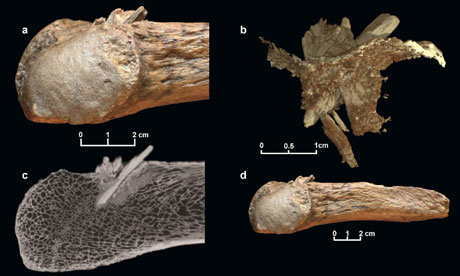
The mastodon was found in 1977 by a farmer named Emanuel Manis. He contacted the archaeologist Carl Gustafson, who excavated the skeleton and noticed a sharp object stuck in his ribs. Gustafson had a blurred X-ray and the object interpreted as a projectile point made of bone or wood.

For the dating of organic materials around the fossil, he felt it was about 14,000 years. Other archaeologists questioned the dates of Gustafson and interpretation of the fragment as a key man.

Decades later, Professor Michael Waters of Texas A & M University contacted him about the review of the model of modern technology. His analysis was published in the journal Science on Thursday.

Mastodon waters located in industrial CT scanner at the University of Texas. "And 'more efficient than in the hospital. They are taking a 0.06 mm slices, half the thickness of a piece of paper," he says. "3D has clearly shown that the object was sharp and tip. 'Was clearly the end of bullet points of bones."

The water tested collagen protein from the rib of the mastodon tusks and to confirm that the animal died of 13,800 years ago almost exactly as predicted Gustafson.

He also extracted DNA rib and a spearhead. The analysis showed that both belonged to the Mastodon, suggesting the animal was killed with his gun-shaped remnants of its kind.

"Without doubt, it should be regarded as evidence of hunting.'re Thrown back to explain something else," said Professor Daniel Fisher of the University of Michigan.

Two other sites in Wisconsin appear to show people hunted woolly mammoths and the use of stone tools made between 14,200 and 14,800 years. The sample indicates that Manis also hunted mastodons and used bone tools.

Together, the three sites provide strong evidence for pre-Clovis hunting. "They are undeniable," said Waters. "Clearly, people were hunting mammoths and mastodons and again, play a role in his disappearance."

He believes that predators can gradually succumbed to the pressure of human hunting, and fast, "Clovis blitzkrieg".

Despite the efforts of Waters, it will be in the ribs Manis mastodon still draw debate. "It is not definitely proved that it is a projectile point," says Professor Gary Haynes of the University of Nevada, Reno. "Today, the elephant pushing each other all the time and break each other coast, so it could be a bone splinter that the animal just ran over .."

Waters did not credit this alternative hypothesis. "Ridiculous, that if the stories are meant to explain something that people do not want to believe," he said. "We took a sample of bone disease, showed him the TT, and asked if there was some way could be internal injuries. He said that is absolutely not."

Waters added, "If you break a bone, a splinter not turn magically through the muscle and penetrate your chest bones Something might come of this stuff with a lot of power to bring him in the ribs .. "

The javelin thrower has had a strong hand, because the fragment would have hit the hair, skin, muscles and even 30 cm, and Mastodon. "Bone projectile point is actually a deadly weapon," said Waters. "It 'a sharp needle tip, and slightly larger than the diameter of a pencil. It' s like a bullet. And 'designed to reach deep into the elephant and the body was hit ... I saw them launched through the old machines. "

What does it take to finally convince the skeptics? "I will not dig your heels and Stonewall," said Haynes. "If you took out and showed no scratch marks and has been polished and shaped, that convinces me."

Waters said he did not tamper with this extraordinary individual. "It would destroy it. I despised and rejected. And 'useless with modern technology. I could make 3-D printers, and creates the object itself."


For more interesting topics related to archaeology, visit archaeology excavations.

Archaeologists Uncover Viking Thousand Years Fault In Scotland


The first Viking burial ground intact vessel is in Britain was discovered in Scotland, archaeologists said Wednesday.

Place in the Scottish Highlands, on the west coast of the Ardnamurchan peninsula remote is supposed to be about 1,000 years and contains the remains of a Viking important - who was buried with an ax, a sword and a spear, a Sky News reported.

Experts from across the UK to explore the area, said the ship about 200 staples had been completely excavated.

Archaeologist Helen Gray, described the find as "once in a lifetime event."

"We did research on the region since 2006, and most of our work has focused on another area," she said. "We saw a small rise in the low ground and decided to investigate. We had no idea it would be this seems important. "

A head shield and bronze ring pin with the Vikings were buried with a number of other artifacts.

Project co-director Dr Hannah Cobb said: "Although we have many important artifacts excavated over the years, I think it is fair to say that this year, archeology has really exceeded our expectations."

She added: "A funeral Viking boat is an amazing discovery, but also learn how to make artifacts and preserve this one of the largest ever Norse pits dug in Britain."

Oliver Harris, one of the project leaders, said the archaeologists in the region are not looking only for the time of Viking artifacts, but examining social change from the first settlers in the 18th and 19th century.


For more interesting topics related to archaeology, visit archaeology excavations.

Thursday, October 20, 2011

Viking vessel funeral obtain is UK landmass first


The 5m-long serious provided the is still of a higher position Viking, who was hidden with an axe, a blade with a attractively designed hilt, a spear, protect manager and brown ring-pin.

The Viking had been hidden in a deliver, whose 200 or so material rivets were also revealed by the company.

The 1,000-year-old obtain, on the distant Ardnamurchan Peninsula, was created by the Ardnamurchan Changes Job (ATP) which is a company led by specialists from the Colleges of Birmingham, Leicester, CFA The archaeology of gortyn Ltd and The archaeology of gortyn Scotland

Funded this period by The Classes of Birmingham, Newcastle Classes and The Leverhulme Confidence, the project creates together individuals and school at what may be one of Britain’s most major Viking websites.

Other confirms provided a blade, what could be the tip of a brown enjoying horn, a whetstone from Norwegian, a band pin from Eire and Viking art.

Dozens of items of material yet to be revealed by the company were also revealed at the website, which has now been absolutely excavated.

Co-Director of the project and archaeology Training Other Dr Hannah Cobb, from The Classes of Birmingham, has over the last six a prolonged time been digging up artefacts in the Ardnamurchan Peninsula underpinning 6,000 a prolonged time of its record.

Dr Cobb said: “This is a very enjoyable obtain. Though we have excavated many major artefacts over the a prolonged time, I think it’s reasonable to say that this period the archaeology has really surpassed our goals.

“A Viking vessel funeral is an wonderful development, but also to that, the artefacts and maintenance create this one of the most major Norse graves ever excavated in England.

“Viking Consultant Dr Colleen Batey from The Classes of Glasgow, has said the vessel is likely to be from the 10 hundred years AD.

“We are really happy to the kindness of the Ardnamurchan Property who have recognized our project and granted us to operate throughout the estate over the last six a prolonged time.

“We are also very happy for the service of CFA The archaeology of gortyn who are currently giving the specialist space for storage for the wonderful artefacts that we revealed september.

“It has been an wonderful chance of our basic individuals to study about archaeology at such an around the globe major website.”

The company believe the website is also the first whole questionnable Norse serious of its variety to have been excavated in landmass Scotland for 30 a prolonged time and the first ever on the Western Shore Mainland.

But the website has produced other money over the a prolonged time, such as an Iron Age ft from between 2500 to 1500 a prolonged time ago this period.

Dr Oliver Harris, project co-director from the Classes of Leicester’s Classes of The archaeology of gortyn and Old History, said: “This project exams telecomutting saves gas on the Ardnamurchan Peninsula from the first stating 6000 a prolonged time ago to the Highland Clearances of the eighteenth and nineteenth hundred years.

“In earlier months our operate has reviewed information of shifting opinions and living models in the location through a research of funeral routines in the Neolithic and Bronze age times 6000 - 4500 a prolonged time ago and 4500 to 2800 a prolonged time ago respectively.

“It has also produced information for what will be one of the best old Neolithic chambered cairns in Scotland when all of our submit excavation operate is total.

“But the obtain we disclose currently has got to be the sugar on the food.”
Notes for editors

Journalists are welcome to see the artefacts which are being currently placed at the CFA The archaeology of gortyn Ltd in The capital of scotland between 10am and 12am on Wednesday Eighteenth July BST.

The Ardnamurchan Changes Job is Instructed by:
Dr Hannah Cobb from The Classes of Manchester
Dr Oliver Harris, from the Classes of Leicester
Héléna Grey from CFA The archaeology of gortyn Ltd
Phil Richardson from The archaeology of gortyn Scotland.

Oliver Harris and Phil Richardson created the excavation while at Newcastle Classes.

Images of xrays are available. Please credit score Pieta Greaves, Person Conservator at AOC Archaeology

Other pictures are available please credit score Dan Addisson.

For more interesting topics related to archaeology, visit archaeology excavations.

Old pictures of a mom labor revealed

Old pictures of a mom labor revealed

An foreign company of archaeologists has found what might be the first manifestation of labor in traditional western art, they presented Friday.

Consisting of two pictures of a person labor to a kid, the personal world was revealed on a tiny fragment from a clay one is more than 2,600 a long time of age.

It was excavated by Bill Nutt, a scholar student in anthropology at the Classes of Arizona at Arlington who is lawfully shades.

About 1-3/4 x 1-1/4 in. (4 x 3 cm), the fragment was element of a boat created of bucchero, a commonly Etruscan dark art.

The graphic present the brain and again of a child growing from a mom. Created using her experience in account and a prolonged ponytail managing down her again, the person has her legs and one arm increased.

The graphic could be the first manifestation of labor in traditional western art, according to Phil Perkins, lecturer of the archaeology of gortyn at the Start Classes, in Milton Keynes, Britain.

"Such pictures are unusual in ancient and established art. A few, much later Ancient and Roman pictures are known, but this one times to about 600 B.C.," Perkins, who first revealed the world, advised Development Information.

A fun caring and diverse persons who among other items shown the France how to create wines, the Romans how to create streets, and presented the art of composing into Western countries, the Etruscans started to blossom around 900 B.C., and centered much of Italia for five decades.

Known for their art, farming, good metalworking and business, they started to decrease during the fifth hundred a long time B.C., as the Romans increased in energy. By 300-100 B.C., they gradually became consumed into the Roman business.

Since their puzzling, non-Indo-European expressions was essentially put out (they remaining no materials to report their society),the Etruscans have prolonged been regarded one of antiquity’s wonderful enigmas.

Indeed, much of what we know about them comes from their cemeteries: only the richly designed tombs they remaining behind have offered signs to absolutely restore their record.

Poggio Colla is one of the few websites giving information of the Etruscan living in a non-funerary situation. It ranges most of Etruscan record, being populated from the 7th to the second hundred a long time B.C.

Centering on the acropolis, a around block level, the website was also property to a sanctuary: several votive remains indicate that for some element of its record, it was a holy location to a divinity or divinities.

The variety of weaving methods and a beautiful put in of precious metal jewellery found in earlier archaeology excavations


, have advised that the client divinity may have been girl.

In this perspective, the standard interpretation of labor becomes even more useful, according to Greg Warden, lecturer and connect dean for school matters at the Meadows Classes of the Disciplines at SMU and a property of the Mugello Area Historical Job.

For more interesting topics related to archaeology, visit archaeology excavations.

Wednesday, October 19, 2011

Counterfeit Biblical Trick

Prof. Yuval Goren was the only engine, there are at least three inscriptions on the artifacts known to be false Jewish Bible. He spoke with authority, influence because it is not a field archaeologist or a language expert or writing, but a scientist uses a hard microscope and scientific jargon. Others have relied on his expertise. He led the troops to find the following entries, among other artifacts of the Jewish Bible to be false:

1. The case is well known James ossuary, or bone, the inscription "James, son of Joseph, brother of Jesus."


2. A small ivory pomegranate bearing the inscription "Belonging to the Tem [example of Yahwe] h, holy to the priests." Although, this ivory pomegranate could come from the temple of Solomon.
3. An inscription of 15 lines on a piece of black stone attributed to King Jehoash (Yehoash in Hebrew), which, according to the Bible (2 Kings 12), repaired the temple in the late ninth century BC If authentic, it would register Israeli real thing ever discovered.

Professor Goren also said a stone oil lamp richly decorated, recently published in the Journal of Biblical Archaeology, * as one of the Jewish artifacts (the James ossuary, the ivory pomegranate and the Jehoash inscription) affirms the Bible, are false.

It will take place, but not in their Jewish artifacts, but a significant new voice, a professor that Gore proved to be reliable. As James ossuary inscription ossuary is a new post. And as the James ossuary and the ivory pomegranate, a charnel house again should be a flea market, no one knows where it is found, or rather, had been robbed.

The Aramaic inscription is clear and reads as follows:

"Miriam Daughter of Jesus son of Caiaphas, the priest of Beth Imri Ma'aziah '"

In the event that the ossuary of Miriam, Professor Goren was concluded that the inscription was "true beyond a reasonable doubt."

We have no reason to question this conclusion. It is interesting to note, however, is that an experienced investigator can study writing ossuary, and finally, without reservation, that it is genuine. How can do it here, but it is not the case with other Jews, is opposed to the biblical forgeries, such as the James ossuary and the ivory pomegranate?

Shaking importance, Miriam ossuary writing other things, that Mr. Gore has proved to be forged is that Gore's point of view, there is research that can determine if the writing is authentic. Why, then, will not perform the examination with other objects jew?

For more interesting topics related to archaeology, visit archaeology excavations.

Cairo Genizah Cholars Rebuild


Researchers at Tel Aviv University uses digital technology to restore more than 350,000 fragments of the famous Cairo Geniza, a collection of ancient and medieval Jewish writings discovered in Cairo in the late 19th century.

After its discovery, fragmentary texts, including the first Jewish religious texts, but also important business documents and personal letters from ninth to 19th century, were scattered among libraries and collections around the world, Cambridge in New York.

Today, scientists using the latest digital imaging technology for "couture" images of fragments of them in the hope of rebuilding whole or in part genizah valuable documents. Within months, they have already been confirmed adheres 1000, almost as many as were made in more than 100 years of work on Genizah fragments.


For more interesting topics related to archaeology, visit archaeology excavations.

Tuesday, October 18, 2011

First Studio Making Paintings Ever Discovered In The Cave


A group of home sapiens came across a cave on the picturesque coast of South Africa about 100,000 years ago. Discharged their things and went to work, correct iron-rich, dirt and mix gently with the bone heated in abalone shells to create a red paint, as the mixture. Then he sank a fine bone in the mix to transfer to another location before leaving the cave - and tools - behind.

Scientists have now revealed their Paint-Making Kit, sitting in a cave layer of sand dune, just as they were 100,000 years ago. Research is the oldest known example of artificial mixture of compounds, says researcher Christopher Henshilwood, an archaeologist at the University of the Witwatersrand in Johannesburg. It 'also the first known example of the use of a container anywhere in the world, 40,000 years in the following example, Henshilwood said the science live.

"For me, it is an important indicator of how technologically advanced people had 100,000 years ago," said Henshilwood. "If this was the goal, it also demonstrates the likelihood that people will use the materials in a symbolic way 100,000 years ago."

Together with toolkits, Henshilwood team of archaeologists said found pieces of ocher or clay colored, engraved with abstract designs.

An exciting find

Reports of their findings Friday in the journal Science, researchers paint a picture of a small group of hunters and gatherers, who spent very little time, maybe a day or two, in the seaside town 186 miles from the cave (300 kilometers) east of Cape Town.

This cave, now known as Blombos Cave, has been excavated since 1992. Cave clearly used to shelter tens of thousands of years of human history, where the younger rock layers provide evidence of fires, and food debris.

"Level directly above this" - one in which the goal of decision-making tools to be discovered - was "full of seafood and food remains such as bones and fireplaces," said Henshilwood. "But this is particularly layer seemed to be mostly sand or sand dune. And then we have identified two shells of abalone."

After three days of careful archaeology excavation, archaeologists one of the tanks were covered with a red substance.

"We are excited immediately," Henshilwood said.

More News MSNBC Science Tech & Science

Photo: Mt Everest wide north-east of Kathmandu

AFP - Getty Images

Himalayas: The future of solar?

Future Tech: high peaks of the Himalayas could soon be a light for the thrill of the solar energy business, suggests new research that has identified some of the region at the top of the world's greatest opportunity to capture energy from the sun.

Black Death of errors has not changed, but

And a weight of over 9 tonnes ... T. rex!

Naked mole genome: The key to longevity?

The coating proved to be done to combine okra, soft, iron-rich clay is used and the earliest forms of paint pigment. Ocher pigments may have to decorate the body or clothing of stone over the centuries in between, but also a mixture of glue will not work - perhaps attaching handles for stone tools.

Lyn Wadley, an archaeologist at the University of Witwatersrand, told Live Science in an email: "Since the ocher-rich compounds have many uses, it is necessary to conduct experiments to test the effectiveness of the old recipe as paint, glue or other product. "

"My experimental work suggests that the mixture should be a powerful glue, but I have not used a specific combination of ingredients found in Blombos," said Wadley, who was not involved to find.

The oldest recipe


The combination of ingredients can not say how many researchers mixture antique was used, but other objects reveal how it was made. With shells and fragments of ocher were various, including the shoulder blade of a seal, and a number of quartzite stone that was used for grinding ocher.

"They were all posing next to the shells, so that each shell had its own small toolkit related" Henshilwood said.

The recipe seemed to require ochres of earth mixed with the bone removed by heating oil in the bone marrow. Heated, crushed bone was mixed with charcoal, and okra and mix envelopes, bearing the traces of sand and quartz chips. A kind of liquid, perhaps water or urine, could be added to the pigment spread, Henshilwood said.

Archaeologists also found a thin piece of bone about 2 inches (6 centimeters) long stained red at one end. Apparently, the bone had been used as a brush to paint with the pigment as a ball or to transfer the mixture into another container.

No matter what the use of the compound, Henshilwood and Wadley agreed that his life reveals that our ancestors were a smart group. Hunter-gatherers knew what they collect to make the paint, and took the ocher of 12 miles (20 km) away, suggesting intelligent planning. In fact, as Henshilwood, pigments and oil binders mix they have created is almost the same as the income of the paint used in ancient Egypt as a few thousand years.

"They should have a basic knowledge of chemistry," Henshilwood said. "And I had a prescription for this compound or paint."


For more interesting topics related to archaeology, visit archaeology excavations.

Ancient Text Shows The Fight Is The Oldest Sport In The File


It was in a youth tournament, the final of the NCAA or the Olympics, the last public address control host Ed Aliverti used to greet fans in all areas of the same.

"Welcome to the oldest and largest sports world," said Aliverti, who died in 2010.

The "greater" part of that is a matter of taste. But when it comes to "old" sport of wrestling now provide some old documents for his business.

Written in greek, is a 18-inch widescreen and a fragment of papyrus dated between 100 and 200 AD, is a list of instructions to fight.

"It's such a historic discovery. It is the oldest written instructions for all sports for that man to this day,''said Lee Roy Smith, executive director of the Hotel National Wrestling of Fame in Stillwater, Oklahoma

In the presentation on Tuesday at Columbia University in New York, a copy of the article was presented at the Hall of Fame.

According to the Hall of Fame, the document was found at the end of 1800 in Egypt for a couple of graduate students at the University of Oxford in England. It was found in a south-west of Cairo who had been favored by Greek colonists.

In 1907, the object was a piece of papyrus transported to Columbia, which at that time was one of the pioneer schools of the college wrestling in the United States.

When, in September of this year, the Hall of Fame wrestling historian Don Sayenga published a report on the artifact.

"This document will help the fight as a sport if more people recognize that the fight is the oldest sport," said Sayenga. "Not only the struggle of the oldest sports, but it is undeniable artifacts.''

Well, there are certainly some educational texts dating back to 100-200 AD on how to putt a golf ball or hitting a baseball. And the language of the artifact, translated from Greek, contains the substance of the catch statement.

The Greek word "pleckson" is seen in the text. According to a translation published in 1987 by Yale University Press, the word is translated as "struggle."

Some of the instructions to translate:

• "Stay close to your opponent, and with your right arm, take a headlock and fight."

• "Underhook with his right arm. That puts his arms around her and took the Underhook, and attack the side with the left foot. The left hand presses. They force you to keep it and fight."

• "You wake up next to him, attack him with his foot and fight."

Not unlike some of the wrestlers do things when you are fighting for medals at the Olympic Games next summer in London.

Smith, 1980 NCAA champion, 1983 world silver medalist and former coach at Arizona State, may be accompanied by instructions.

"We are here today. We are passionate about the fight, and we see this book and the coaches and wrestlers have done the same (in antiquity),''Smith said.

Said Dan Gable wrestling icon ". I love when wrestling sports will be highlighted from a historical point of view"

For more interesting topics related to archaeology, visit archaeology excavations.

Monday, October 17, 2011

Tiny Drones Can Uncover Ancient Royal Tombs


A drone in the miniature air help archaeologists to capture images to create a 3-D model of an ancient burial mound in Russia, scientists say.

Archaeological sites are often remote and difficult areas. As such it can be difficult to achieve and a map with archaeologists often have limited budgets. Scientists are using drones to broaden their views in places difficult to access.

"There is a great opportunity with this method," said Marijn researcher Hendrickx, a geographer at the University of Ghent in Belgium.

The test machine in a remote region of Russia called Tuekta was a four-helix "quadrocopter". The MD4-200 batteries Microdrone That is small - the rotor shaft is about 27 inches (70 cm) - and weighs about 35 ounces (1.000 grams), it was easy to carry, and investigators said it was very easy to control, stabilize and maintain at all times at a given height and position in order to do something else. The engine also has generated almost no vibration, they added, so that photographs taken by the camera is mounted on the relatively strong. According to the wind, temperature, and its payload, the maximum flight time UAV is about 20 minutes.

Tuekta the Altai Mountains in which Russia, China, Mongolia and Kazakhstan come together. The researchers have not discovered the mounds in 2300 is 2800 years and up to 250 feet (76 meters) wide.

These mounds, called "Kurgan" probably belonged to the chiefs or princes among the Scythians, a nomadic people known for their horsemanship, which had a rich, powerful empire. The archaeology excavation of some of these extraordinary treasures revealed artifacts of gold and other preserved by permafrost.

About 200 mounds have been discovered in Tuekta, located along the river, Ursula. Heart of the site appears to have been once a series of five monumental Scythian burial mounds with diameters between 140 and 250 meters (42 and 76 m). Unfortunately, "in this field of study, most of the mounds have been destroyed," said Hendrickx.

The test area chosen by the researchers measured approximately 1,000 feet 330 feet (300,100 m), including five gigantic mounds and dozens of smaller structures. Drone flew at a height of 130 feet (40 meters) to examine more objectively the mound.

The lightweight nature of Microdrone was a problem at times. "In the field, we had to deal with the wind increasing," said Hendrickx. "At one point even lost radio contact with the unmanned aircraft - which led to a race between the mounds."

However, researchers have gathered enough data to drones to create a digital elevation map of the site and a 3-D model of the mound.

"The 3-D model we created gives us the possibility to calculate the volume of the Kurgan" he told LiveScience Hendrickx. "With this volume and its specific dimensions, the original form of the kurgan can be reconstructed."

Archaeologists have begun using unmanned aircraft in the air more often in the past ten years, including in Peru, Austria, Spain, Turkey and Mongolia. The resulting maps can help archaeologists to see the full image of a site where aerial or satellite images are difficult to obtain updated Hendrickx said.

Researchers are now experimenting with more microdrones that can carry more weight.

"It will be possible to use, for example, infrared cameras, or even a radar system," said Hendrickx. "This can help to see things we can not see with our eyes."

The scientists detailed their findings in the November issue of the Journal of Archaeological Science.

>> Top 10 Ways We deal with the strange death

>> Gallery: Aerial photos reveal mysterious stone structures

>> 8 disturbing archaeological


For more interesting topics related to archaeology, visit archaeology excavations.

Online catalogue underway of 29,000 of Petrie's archaeological finds in Egypt


An extensive online catalogue of artefacts unearthed by Flinders Petrie, last century, in an important trading city in Egypt will be launched soon by the British Museum.

When British Egyptologist Flinders Petrie came to Egypt in 1883 he explored several archaeological sites and revealed some of the country’s ancient history.

According to Egyptian law at the time, archaeological dig sponsors had full rights to half of finds, while Egypt retained the other half.

Half a century after Petrie’s death, the British Museum in London started cataloguing some of the artefacts he unearthed in Egypt, especially those in possession of the 60 museums involved in sponsoring Petrie’s excavation missions. The exciting news is that early this month they began preparing to catalogue them in an online searchable database format.

The Liverpool National Museum, which was among the sponsors of Petrie’s excavations joined the British Museum in its project and hosts two British curators that help catalogue its ancient Egyptian collection uncovered at the Greek trading post city of Naukratis. The history of this city remains unexplored, despite it being the centre of cross-cultural contact in the ancient world.

As archaeologist David Hogarth says, the goal of such a project is to study these objects and highlight the role of the site in Greek-Egyptian relations.

The catalogue will contain the complete body of the 13,000 surviving objects from the early archaeology excavations at Naukratis. A wide variety of artefacts were found, including painted Greek pottery, Greek Cypriot and Phoenician transport amphorae, stone sculptures, terracotta figurines, faience scarabs and amulets, coins, jewellery, alabaster vases, coins, iron tools and bronze figurines.

Hogarth said the artefacts will be published as a British Museum Online searchable database catalogue. It will not only list every artefact, but will also analyse the site’s history, archaeology and influence in the development of Greek-Egyptian relations.

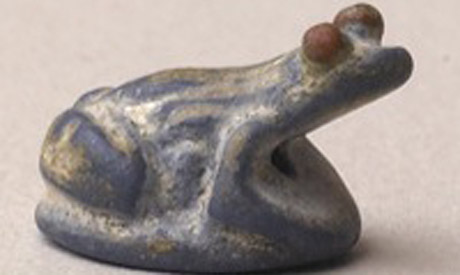
The British Museum is also cataloguing another 16,000 Egyptian artefacts from Petrie’s excavations that are now part of the museum’s collection. Among these objects are 2,000 tiny amulets and a frog from the ancient city of Akehenaten at Tell El-Amarna city.

For more interesting topics related to archaeology, visit archaeology excavations.
Thursday, October 13, 2011

Richard Hall, Who Died Of Cancer Sept. 13, 62 Years, Has Conducted Excavations In York


Richard Hall, who died of cancer Sept. 13, 62 years, has conducted archaeology excavations in York, which showed that the popular image of Vikings Scandinavian thugs plan to rape and looting has been moved.

His research has revealed another image, less familiar with the Vikings as citizens, craftsmen, artists, merchants and housewives.

Hall, interest generated during history lessons in school subjects, when he said that although much was known Norman invaders of England, very little was known of the Norse Vikings'. "Others were more interested in the dark ages, or Greece, but I realized the British were just very dark age," he said.

The dreaded stereotype came from the writings of the monks who were literally at the tip of the Viking attacks. Their monasteries were attacked because it contained a lot of mobile wealth, and the monks could be enslaved. As a result, Hall explained that "the horror stories spread throughout Europe to describe [the Vikings] as a disgusting pagan group from the north."

When an invading force led by Ivar the Boneless arrived in New York in 866, the ancient Roman colony of Eboracum collapsed. The outline of the Roman fortress remained, but the other buildings were long gone. The Saxons had Eoforwic renamed, but not much had changed.

The Vikings changed the name of the city for more Danish "Jorvik" and created a thriving community based on agriculture and trade, leaving a legacy of street names - the suffix "gate" that attaches to the streets of the city many (Viking "gata" meaning "street"). In 1066 York was much larger in size, status and the population it had ever been.

Hall of Jorvik investigation began in 1970 when the approval was given to the dismantling of a factory of soft copper port ("Cup of the manufacturer of the street"), the way the new shopping center. In 1976 he was appointed director of the excavations of 1000 square meters of the site before development began.

There he discovered the remains of tenth-century buildings and tight acacia wood, pine located across the street and surrounded by moist, spongy layers of earth provides anoxic (without oxygen) conditions similar to those of a swamp.

In addition to sculptures, jewelry, bone and wood, metalwork and coins, wet conditions helped preserve everyday objects such as wood, leather, cloth, insects, wells and latrines, even a Viking and its contents. The smell of 1,000 years, Hall recalled, "we arrived at full speed." In addition, there are luxury goods from as far as Byzantium and the Persian Gulf, along with products from around the British Isles and northern Europe.

"Archaeology has shown that these people took the sword in the first place," Hall said, "but most definitely, adapted, was engaged in trade and quickly became part of the local community of farmers and fishermen. "

The excavations took five years and has created a huge local and international interest. Rare once seen as an important part of working to get citizens to participate in the project, and gave viewpoints around the site where the work could be progressed.

Huge selection of discoveries has been a business owner, skipper Ian, York Archaeological Trust to propose, who worked for Hall, that the excavation should be done under the permanent exhibition of the planned shopping center. Fortunately, the developers were happy with the idea, and the Jorvik Viking Centre, which helped develop the Hall, was opened in 1984.

The center has become one of the most successful archaeological exhibitions in the world. Visitors travel in a "car time" monorail that takes the last scene of Viking different (many of them - like the butcher, fishmonger and latrines - with appropriate scent) To date, nearly 17 million people. visited attraction.

Richard Andrew Hall was born in Ilford, Essex, May 17, 1949. The work of his father in flax led the family in Belfast, where Richard was educated at Royal Belfast Academical Institution. He read Archaeology at Queen's University in Belfast, where he graduated in 1971. His thesis, which was updated hardware catalog Viking era in Ireland, marked the beginning of a lifelong interest. Later in the decade of 1980, took a PhD at Southampton University with a thesis on the cities of the English Danelaw.

Hall began his career in the archaeological excavation of several sites in Dublin and Derby, and Mount Grace Priory in the Cartuja near Northallerton, Yorkshire.

Moving to New York, York Archaeological Trust joined in 1974 as supervisor of the excavations, which may serve as Director of Archaeology and deputy director of the trust. He also served as a professor in the Department of Continuing Education at the University of Leeds.

Hall led the expertise to advise many international searches, including the Viking sites in Scandinavia, including a major archaeology excavation of the Viking port Kaupang, Norway. In 2001, archaeologists have found evidence that the Vikings left the region by mid-century, the ninth, raising the possibility that New York had been colonized by the Vikings in the region of Kaupang.

Hall was a trustee of the Foundation of the protection of archaeological heritage conservation, and served on the Board of the Society of Antiquaries of London Executive Council of British Archaeology and the Board of Directors of the Institute of Archaeologists, where he served as president from 1987 to 1989. E 'was also president of the Society of Medieval Archaeology and the Yorkshire Archaeological Society.

In addition to the archaeological Viking Hall has been active in conservation and analysis of tissue church and supervised the excavation of what is believed to be the oldest complete crypt Saxon England, uncovered during work on Ripon Cathedral. In 2005, he conducted investigations of Ripon charter horn, a horn carved in directing a musical instrument ceremonial believed to have been given to the city in AD886 by Alfred the Great. Among other things, he discovered that the horn had been archived in what experts believe music was an attempt to improve its tone and resonance.

In 1980, Ward and his collaborators published a series of reports on Coppergate excavations, and Hall also wrote several books about the Vikings and their world. Exploring the world of the Vikings (2007) studied the Viking culture, from its origins in Scandinavia during the first millennium, during the assault, trading and settlement, settlements in the last survivor of the 15 th century in Greenland.

First marriage of Linda Tollerton Hall was demolished. In 1991, she married an expert in ceramics, Ailsa Mainman, which shows him with their two children.


For more interesting topics related to archaeology, visit archaeology excavations.

The Outer Wall Of Fort Hawkins Is The Purpose Of The Archaeological Excavation


Daniel Brown of Warner Robins was standing next to a trench deep red at Fort Hawkins, on Wednesday looked into a framed screen dangling in the air. He poured a bucket of clay crumbled Georgia on the screen, sift until his hands were red and a cone of red powder well up on the earth below.

Left Behind the screen was slow to give charred bones, glazed tiles, and other objects of frontier workers who live 200 years ago.

Brown, a local volunteer to work with the archaeologist Daniel Elliott, a break to help identify a part of a flintlock pistol scraped the ground.

Artifacts are the rich product of a search to locate an outer wall surrounding Fort Hawkins during the War of 1812. The search began this week and continues until October.

The wooden wall of 14 feet around the fort in 1808 was probably added to prevent the British from bombing the height of the Ocmulgee River, said project coordinator Marty Willett Fort Hawkins.

"We have one of the richest archaeological sites in America, War of 1812," says Willet.

Like the U.S. Army Headquarters, Fort Hawkins played an important role in the war. Elliott calls it "the Pentagon and the South," and said that some items, more than 1,000 men - as well as the soldiers of just 7 years - were placed in the fortress, which was also an important commercial center.

"Very few places throughout the South of that time has never been drilled," said Elliott.

The nonprofit Fort Hawkins Commission plans to use the results as digging a plan to build a fence copy in time for the bicentennial of the war next year.

And 'the second phase of archaeological investigation at Fort Lamar Institute, one of the leading archaeologists in the south-east. The first time in 2007, graduated from the strong impression, for the first time the discovery of the brick buildings, walls, fence and more.

"Every time we return, we discovered a new part of the fortress, we did not know was there," said Elliott.

Sections of the site actually stored in a school built in 1920, which is locked into an object of the metro looters, he said. Macon Public Works employees recently contributed their homes on large blocks of concrete foundation of the school, and Elliott has expressed his eagerness layer of the colonial era "junk" below.

They dig can transform structures other than palisade wall. The wall leads to what was once a house of the second block replica is on the corner opposite the place now. The wall can also meet a residency subsequent slaves, a plantation that was built on the site in 1828, and a possible civil war ground of the battery, says Elliott.

Other features such as buildings inside the fort has not been excavated in the future.

After work a few days 'in the rain and mud, Elliott and his team have found a strange figure crouching dog tin from the colonial period, a girls' centenary monument American Revolution, and a pin shots cannon.

The top of the wooden posts of the fence barely visible on Wednesday by a thin layer of dust on the bottom of the trench 3 feet deep.

Russell Lewis, Macon used the spatula to scrape off layers of dirt dust pan, bucket, then, Byron Gene Green Screening.

"I wanted to be an archaeologist when I was a child, but ended up working at the family farm in Monroe County," said Green. "I was like a kid at Christmas, I was very happy to come and be part of that."

The public can view the archaeology excavation team at work during the week in October 08:30-16 30 hours to 15 hours a news conference October 31 to announce to all the important discoveries made during the search, said Willett.

Elliott said residents often visit the archaeology excavation site to share old photos of the fortress or the school that once stood there and helped the Fort Hawkins Commission to find items like a cannon, which were once used at the fort.

"The interaction with the local community is really cool here," said Elliott.

Willett said he is trying to arrange for children to participate in the weekend to dig a layer of dirt that screening was removed to create the trenches where archaeologists are working. Willett said he has found more than 3,000 artifacts, ranging from sculptures buttons horseshoes collecting surface of the case.

The two graves and reconstruction of the fence outside is funded by a grant of $ 100 000 from the Peyton Anderson Foundation, Willett said. The Fort Hawkins Commission does not receive any of Macon or Bibb County.

That could change. A proposal for a special order option local sales tax set to go before voters in November Bibb County includes $ 750,000 in support of Fort Hawkins, and donors of the Council of Fort Macon City said they expect to include more of the fortress in a future SPLOST so well.

Willett believes that Fort Hawkins Commission has about $ 3 million to build a shelter and develop demonstrations of living history, archeology participatory programs, classes in early American crafts, and other community programs.


For more interesting topics related to archaeology, visit archaeology excavations.

Wednesday, October 12, 2011

Mammoth Or Mastodon Picture Old Bones Found


A bone fragment at least 13,000 years, with an engraved image of a mammoth or mastodon were discovered in Florida, a new study.

While prehistoric art depicting animals with suitcases found in Europe, this may be the first in the Western Hemisphere, researchers reported Wednesday in the Journal of Archaeological Science.

"It's exciting, we find nothing like it in North America," said Dennis J. Stanford, curator of North American Archaeology at the Smithsonian National Museum of Natural History, who was a co-author of the report.

They hunted these animals, Stanford said, and "you see people drawing all kinds of images that have meaning and importance to them."

"Much of the real significance of these results is palpable emotional connection they allow us to empathize with people deep in the past," says Dietrich Stout, an anthropologist at Emory University in Atlanta who was not part of research team.

Cave paintings show animals have been found in Texas, but they were dated about 4000 years ago, much more recent than the recently discovered carved bone.

The bone fragment was found in Vero Beach, Florida, contains a carved image about 3 inches long from head to tail and about 1 3 / 4 inches from head to toe.

"There was a lot of skepticism about the authenticity of the incision to the bone until it is thoroughly studied by archaeologists, paleontologists, anthropologists, lawyers, engineers in materials science and artists, "lead author Barbara Purdy, University of Florida said in a statement.

The bone was found by a fossil hunter near a place known as the former site of Vero where human bones were found alongside the bones of extinct Ice Age animals during excavations from 1913 to 1916.

It 'was highly mineralized, which prevented the standard for dating, Stanford said. Mammoths and mastodons, but was killed in America 13,000 years ago, so he's older. "It could be very soon," he added.

However, the researchers wanted to ensure that there was an attempt to imitate the modern prehistoric art. They compared it with other materials on the site and studying with microscopes, which showed no difference in color between the grooves carved and the surrounding material. That, they say, said the two surfaces of the year.

Furthermore, the researchers said there were no signs of the materials or the slots were recently carved with metal tools.

"It 'has been carved by direct observation of animals, if they exist, or is a fake modern" and "there is every indication that the sculpture is the same age as the bone," said Christopher J. Ellis, an anthropologist at the University of Western Ontario, who was not part of the research team.

The only other report of an old carved bone of North America with the image of a mastodon came from Mexico in 1959, but questions were raised about the object, and then disappeared.

There seems to be the American premiere of a mammoth or mastodon, says anthropologist David J. Meltzer of Southern Methodist University.

"I think the authors have done a good job making the case for the piece to be genuine," said Metzger, who was not part of the research team.

The new discovery was made by James Kennedy, a fossil hunter in 2006 or 2007. Kennedy noted the figure in 2009, when he was cleaning the bones, and then contacted the researchers, who began to study artifact.

North America found an image similar to some found in Europe, raising questions about whether this is mere coincidence or evidence of a correlation between the two, the document notes.

Stout said that the suggestion that the similarities between this and the ancient art can mean a number of European central counterparties, or the movement of people across the Atlantic very soon is controversial. This idea has already been proposed by Stanford and others, but has attracted much criticism and suspicion of other archaeologists said.

Metzger also said he was "not a moment think that the model raises questions about the big question of the peopling of the Americas is just a single -. Very interesting - an uncertain age and origin, so you should not get too carried away with. "


For more interesting topics related to archaeology, visit archaeology excavations.

Young And Old Turn Out To Dig 'Day Of Pirates Treasure' Fun At Tin City


Founder Debra Frankel Freedom Party Waters Foundation was behind Tin City Day of Pirates where everyone has a taste of everything from ancient legends shipping time, Caribbean steel drums, costumes and much more.

Freedom Waters Foundation Foundation operates on the good will, a paid employee and a lot of community support for people with disabilities in recreational water, using communication and education.

The event has attracted a steady stream of locals and tourists Naples, most of whom were children, followed by a fully decked out in dress as a pirate.

Boat trips on the sun of Naples double cruise, documenting local vendors, live music, good food, entertainment and more children were all given the key and the correct day full of fun in the heart of the waterfront of downtown Naples.

Replicas of the ships of Christopher Columbus' Nina and Pinta will remain docked at Tin City, Sunday, April 10. While in port, the public is invited to a walk guides on board ships.

The "Nina" was built entirely by hand and without the use of power tools, and was called by Archaeology magazine "the most historically correct Columbus replica ever built." The art of building and details in the rigging make it a fascinating visit to the Age of Discovery. The "Nina" was used in the production of Depardieu's film "1492 with Gerard and directed by Ridley Scott.

For more interesting topics related to archaeology, visit archaeology excavations.

Tuesday, October 11, 2011

To Push The Palestinians To The Status Of World Heritage For The Birthplace Of Jesus


The Palestinians seek world heritage of the birthplace of Jesus' once the United Nations cultural agency to grant them a full member, and then nominate other sites in the territories occupied by Israel in the same position, the official said.

Hamdan Taha, a minister of the Palestinian Authority, dealing with antiques and culture, said UNESCO was the accession of Palestinian natural law. It is described as "regrettable" the objections of some governments, including the United States.

UNESCO Council decided last week that the Member States to vote on an application for full membership of Palestine, considered part of a Palestinian in Israel's opposition disk and the United States to be recognized as a state in the system United Nations.

"Being a member of UNESCO is a message of justice and rights. Why is that the Palestinians will remain outside the international system?" Taha said. "I see this as the culmination of long efforts in the last 20 years."

He said that after receiving full membership in UNESCO, to ensure the Palestinians do not want to revive the World Heritage List of Bethlehem and the Church of the Nativity, revered as the birthplace of Jesus's appointment was rejected this' year because the Palestinians were not a full member of UNESCO.

"This is a simple example of how Palestine has not been able to preserve its cultural heritage through the tools provided to each state in the world," said Taha.

"We ask the World Heritage Committee to enable this application," said Taha. "We expect that when Bethlehem, the other sites will follow."

These will likely include Hebron, an ancient city, is home to a shrine holy to Jews and Muslims, which is one of the most unstable of the West Bank.

The Palestinian vote on membership is expected that the General Conference of UNESCO, which runs from October 25 to November 10. The Palestinians have observer status with UNESCO since 1974.

U.S. opposes move, considering it as part of a unilateral offer to the Palestinians ignore the two decade-old peace process. Washington says talks with Israel are the only way to achieve the goal of a Palestinian state in the West Bank, Gaza and East Jerusalem.

UNESCO is the first UN agency to join the Palestinians have full order since President Mahmoud Abbas submitted his application to become a member state of the United Nations on September 23, also face the United States opposed firmly.

Israel's ambassador to UNESCO has condemned the decision, saying that politicization of UNESCO undermine their ability to fulfill its mandate.

For more interesting topics related to archaeology, visit archaeology excavations.
Top Condemns Jerusalem Dig Archaeologist As A "tourist Gimmick" Unscientific

An archaeologist who has worked with the Elad Association in the city of Jerusalem from the claim that the association and David Antiquities Authority began archaeology excavation work "without any commitment archaeological science."

Dr. Eilat Mazar - Hebrew University archaeologist who has worked in close collaboration with Elad last for years and is considered one of the most productive scholars in Jerusalem, and the City of David area, in particular - have severely Elad for the archaeology excavation of a large underground pit, called "Jeremiah's Pit", at the mouth of the City of David visitors 'center' complex.

In a letter sent a strong 10 days ago Professor Ronny Reich, president of the Council of Archaeology, Mazar demanded an urgent discussion of the excavations, which said it carried out in violation of accepted procedures.

Mazar against Elad says are targeted at a crucial time as the proposed law to privatize the public parks is being considered. If approved, the law allows you to Elad, which is buried in a private association, maintains and makes traveling in the city of David, who helps manage the historic site - located mainly in the Arab village of Silwan close to the center.

"To my amazement, I discovered that more than a year with the Antiquities Authority Elad is secretly planning tourist gimmick called" pit Jeremiah Project ", wrote the letter to the Mazar and said that the excavation is only two meters away from the mining area, which led between 2005 and 2008. He says he wanted to keep digging the current region, but has been prevented, "logistical reasons, as the site north of the Antiquities Authority to build a room can Elad special events ", and the proximity of the residential area and the road.

Mazar said the excavation of the pit area violates several accepted practices in archeology, including the excavation of an area of ​​outstanding under a simple "two places", or 10 square meters, making it difficult to analyze the results of the total area. An excavation of this size, Mazar said, only in situations where no other option.

Mazar is also essential for the diggers "to destroy the wall of the pit, which has not been properly investigated. It also notes that they dig "interfere with excavations in the vicinity" that would undermine its ability to conduct research in the field. She argues that this is not acceptable to transfer an area being excavated by an archaeologist at the other without prior consent.

Mazar of Jerusalem took these complaints to the Director of Antiquities, Dr. Yuval Baruch. She passed the Antiquities Authority director Shuka Dorfman, who in turn dismissed the appeals and confirmed the continuation of the excavations.

Antiquities Authority staff said yesterday that Mazar, who asked to dig the ground and was killed, was granted consultative status with the excavation, but she was not happy with him and turned to the board. An official response from the Antiquities Authority said that "the excavation was a salvage excavation for tourism and development of the national park. The proximity of the location of several archaeological excavations have been conducted, of which Dr. Mazar. It seems that Dr. Mazar attempts to acquire the site for themselves, and we regret it. "

Elad said that officials no association, but Antiquities Authority, who decides that archaeologists will conduct a search. Elad also claims that in several years Mazar was familiar with the project, which was designed to allow tour groups to visit the grave, and she even promised to challenge it.

Please Booz attorney for Elad, said in a letter that Mazar had signed a contract with the association, in the sense that there would be "any claim or lawsuit against Elad in future excavations." "In light of that promise clear and precise, how can we explain the demand for human rights today, as incomprehensible as can be, to continue the excavation on the site?" They feel in writing.

The lawyer added: "It is difficult to avoid the impression that your letter is nothing but an attempt to stop the work undertaken by legitimate and important our customer, because of the ego and credit alone, disguised as a pseudo-professional complaints. "Feeling threatened to take legal action against Mazar.

This weekend newspapers published advertisements Elad large inviting the public to visit the new road opened underground complex near the Western Wall. The ads were signed by the board of the new government of the association, headed by Nobel laureate Elie Wiesel.


For more interesting topics related to archaeology, visit archaeology excavations.

Monday, October 10, 2011

"First Temple In The World", Perhaps Only A Condo In The Stone Age: Canadian Science

A Canadian researcher has rocked the world of archeology, after a challenge of high profile complaints - such as the cover story in National Geographic in June - ". Birth of a religion", the ancient site in Turkey is the oldest temple known to the world and represents the

University of Toronto professor Ted ban ruins sensational claim just north of the Syrian border in southern Turkey, could be a single dwelling richly decorated than the sanctuary of the gods.

His performance, plus a long article published this month in the journal Current Anthropology, 11 reasoning challenge 000-year-old site, called Gobekli Tepe, represents a transition from Stone Age hunter-gatherer cultures in a more "civilized" is was formed around religious worship.

The site is richly carved pillars, a surprisingly sophisticated construction for the elderly was the key to the assumption of point of worship and was photographed on the cover of June geographically with the caption: ". First Temple in the world "

Banning, who earlier this year published the results of a site in northern Jordan, which has been described as the oldest cemetery in the Middle East, says in his latest paper Göbekli Tepe large stone monoliths decorated - which has sculptures of foxes, snakes and other images - may represent the artistic flowering of a national structure, where people lived year-round, instead of a holy place for pilgrims who traveled there to worship.

Drawing attention to the new signs of food preparation and manufacturing of tools on the site, the prohibition of the states in a summary of the study that "the presence of this evidence suggests that the site was not, after all, no tenure "and may have been a resident of the population.

"The assumption that" art "or even" monumental "art must be exclusively associated with specialized sanctuaries or other non-domestic space, or to resist control," said Ban. "There is abundant ethnographic evidence significant investments in the decoration of national structures and spaces, to celebrate the exploits of the ancestors, announce a family or head of generosity, or to record openings and other rituals at home. "

Banning told the News Post news it is not yet sure how his theory will be received throughout the archaeological community, while acknowledging that "the reviewers and commentators on the paper was divided in their reactions, some strongly defends the hypothesis temple or at least a modified version of it, others seem to find favor in much of my argument. "

The people who built Gobekli Tepe are known to have been hunter-gatherers, who had just before the development of more sedentary farming communities, which traditionally is a marked increase in so-called civilization.

Denial theories proposed on the site, which relies too much on the religious and social stratification of sophistication with the 'elite' leaders may be missing important features of a society of Gobekli Tepe.

"I think some of the houses of the time could be key to the kind of leadership that have emerged, but if it is automatically assumed that the buildings are impressive temples, rather than homes, you can just ignore that evidence of emerging elites "he said. "Besides, I'm afraid that the assumption of the temple, at least so people tend to interpret more broadly, which tends to impose ideas on the sacred that really are not very appropriate in a Neolithic".

For more interesting topics related to archaeology, visit archaeology excavations.