A strange legend surrounds a railroad crossing just south of San Antonio, Texas. The intersection of roadway and railroad track, so the story goes, was the site of a tragic accident in which several school-aged children were killed - but their ghosts linger at the spot and will push idled cars across the tracks, even though the path is uphill.
The story may be just the stuff of urban legend, but the accounts were intriguing enough that I wrote an article about the phenomenon, "The Haunted Railroad Crossing." The article included a photograph submitted by Andy and Debi Chesney. Their daughter and some of her friends had recently been to the crossing to test the legend, and she took some photographs. Inexplicably, a strange, transparent figure turned up in one of the photos. "They had no idea that it was in the picture until the next day when I printed out the picture and showed them," said the Chesneys. "It was really freaky. It appears to be a little girl carrying a teddy bear."
Other readers who have viewed the photo think it shows a little girl with a dog sitting at her feet. What do you think?
For more interesting topics related to archaeology, visit archaeology excavations.
Friday, December 30, 2011
Railroad Crossing Ghost - Happy New Year 2012 to ALL

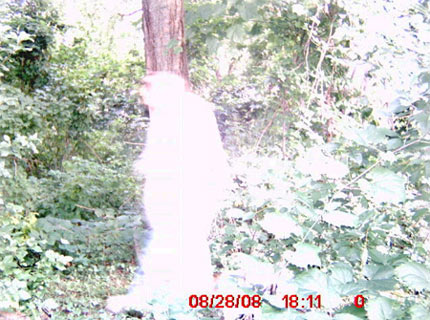
pparition Caught on Game Camera
This was taken by a game camera back in our woods. No one was back there at the time. There is a local history within feet of our woods known as the 22-Mile Tree. It was an inn and trading post in the late 1700s early 1800s. We also have pictures of orbs back there, all within the same time period.
For more interesting topics related to archaeology, visit archaeology excavations.
Irikaitz archaeological site -- host to a 25,000-year-old pendant
The recent discovery of a pendant at the Irikaitz archaeological site in Zestoa (in the Basque province of Gipuzkoa) has given rise to intense debate: it may be as old as 25,000 years, which would make it the oldest found to date at open-air excavations throughout the whole of the Iberian Peninsula. This stone is nine centimetres long and has a hole for hanging it from the neck although it would seem that, apart from being adornment, it was used to sharpen tools. This is one of a number of interesting findings made by the team led by Álvaro Arrizabalaga at this location: "Almost every year some archaeological artefact of great value is discovered; at times, even 8 or 10. It is a highly fruitful location."
Irikaitz lies behind the bath spa in Zestoa, on the other side of the river Urola, 14 metres from the river bank. The archaeologist from the University of the Basque Country (UPV/EHU) has been carrying out archaeology excavations here summer after summer, together with students and researchers from this and other universities and in cooperation with Aranzadi Science Society. Since 1998 they have uncovered 32 square metres; nothing compared to the eight hectares (at least) that this "gigantic" open-air site covers. This is archaeology, demanding a lot of patience, but the results are worth it: "You feel as if you have found something that has been waiting to fall into your hands for 200,000 years."
It is like a lottery
The tasks pertaining to an archaeological site are complex and lengthy in any case, but particularly so at Irikaiz. To start with, because it is in the open air. In the case of caves, it is known that they served as refuges for our ancestors and, once their location is identified, it is highly possible that archaeological treasures are found there. Open air archaeological sites, on the other hand, are discovered when some civil engineering infrastructure has to be built, and it is difficult to predict what will be found. Moreover, in Zestoa there are remains from the Lower Paleolithic, when there are hardly any references from this period in the Basque Country. According to Mr Arrizabalaga, when they started, "it was like a lottery. We did not know what to expect -- either about its chronology or about the kinds of remains likely to be uncovered."
Precisely because of this lack of references, they were fascinated when they came across "totally exotic" raw material: volcanic stones. "In the first dig, we thought at first that someone may have brought the rocks there when they were building the Urola railway, to use them as ballast. It was all so surprising and incredible," said the archaeologist. But no; this phenomenon had another logical explanation: "It is a geological rarity. In the Urola River valley there is a layer of volcanic stones; the river cut through these, took them to the surface and brought them to this place. This is why humans from prehistory came here -- there was no other place in the Basque Country with stones like these."
A margin of 350,000 years
The fact that the remains are so old or the features of the materials thereof so unusual make dating in Irikaitz very difficult, as most of the methods commonly used to this end are of little use here. A clear example of this is that any kind of dating with bone remains has had to be totally discarded; unlike in other sites; here there are hardly any such remains, the earth here being so acidic that it has consumed almost everything in this respect, leaving only stone tools and plant fossils.
There are, thus, few means for dating certain remains. There were two periods of human occupation in Irikaitz, the most recent being 25,000 years ago, the pendant discovered this summer being from that time. But, it is the older occupation that gives headaches in trying to date it. Yes, it dates from the early Stone Age (Lower Palaeolithic), but when exactly? There hardly exist archaeological sites similar to this one, to act as a reference. As this archaeologist explained, "there is no other case of the Lower Palaeolithic under these conditions along the strip of land bordered by the Bay of Biscay, and only a few like it in the whole of the Iberian Peninsula." It is impossible to narrow the dating to less than an interval of 350,000 years: "We know it cannot date from later than 150,000 years ago (when that period ended), and neither can it be prior to 500,000 years ago, because the sea covered the area during that period."
Therefore, of the 18-20 dating methods currently available, there are no more than two applicable to Irikaitz. Both involve luminescence, and with which Arrizabalaga's team are attempting to get results. The first method acts to specify when the sun illuminated a piece of quartz for the last time; without the wished-for results, however. The second is based on thermo-luminescence, a method with which they are working currently: this is applied to certain types of stones which have undergone heating from fires, and the measurement is based on the amount of radiation accumulated.
For more interesting topics related to archaeology, visit archaeology excavations.
Thursday, December 29, 2011
Lovers' pipe dreams emerge from Jerusalem excavation
An archaeological excavation in the Jewish Quarter of Jerusalem has uncovered a centuries-old clay pipe inscribed with the phrase "Love is the language for lovers."

Literally translated, the inscription reads "Heart is language for the lover." And, not surprisingly, it was most likely a gift to a lover, according to Shahar Puni, of the Israel Antiquities Authority.
"Clay pipes of this kind were very common in the Ottoman period, were mostly used for smoking tobacco, and some were even used to smoke hashish," Puni said in a statement. Hashish comes from the cannabis plant, like marijuana.
During this period, from the 16th to the 19th century, Jerusalem was part of the vast Ottoman Empire, a Turkish state that reached into Asia, Africa and Europe.
"The Ottoman authorities tried to combat this practice [smoking] but failed when it became clear that smoking was firmly entrenched in all levels of society. Pipes were also used as a piece of jewelry that could be worn on a garment, and smoking itself was popular amongst both men and women," Puni said.
Jerusalemite women are shown smoking clay pipes similar to this one in 19th-century drawings. Smoking was often done in cafes and with groups of friends, according to the Israel Antiquities Authority.
For more interesting topics related to archaeology, visit archaeology excavations.
Al Ain bears evidence of a culture's ability to adapt
The inclusion of 17 heritage sites in Al Ain in the prestigious Unesco's World Heritage List this year is a great boost for the UAE's culture on the international stage.

These sites join an exclusive club comprising the Great Wall of China, Egypt's pyramids, India's Taj Mahal and the Statue of Liberty in America.
Mohammad Amer Al Neyadi, Director of Historic Environment at the Abu Dhabi Authority for Culture and Heritage (Adach) said this international recognition will help shed more light on the lifestyle and customs of the people who lived in the region, which is today part of the UAE.
These residents of what is today Al Ain lived in houses made of sun-dried mud bricks. They also used these bricks to make dome-shaped tombs
The oldest archaeology discoveries in Al Ain testify to human occupation nearly 8,000 years ago and include flint tools, stone scrapers and fine arrowheads.
Artefacts, such as pottery, stone vessels and copper objects, have been found in collective graves at Hili and Umm Al Nar and reveal the extent of trading activity with places such as Mesopotamia as far back as 5,000 years. Locally-made and imported necklaces, pendants, axes, daggers, swords and many other objects, dating to between 3,000 and 4,000 years ago have been unearthed at Qattara.
Ancient settlements and graves from the Iron Age have are evidence of sophisticated industries producing fine bracelets, bangles and anklets made of bronze.
Neolithic period
In its observations, Unesco's World Heritage Committee said: "The cultural sites of Al Ain [Hafeet, Hili, Bidaa Bint Saud and the oases] constitute a serial property that testifies to sedentary human occupation of a desert region since the Neolithic period with vestiges of many prehistoric cultures."
It added that remarkable vestiges in the property include circular stone tombs (2500BC), wells and a wide range of adobe constructions: residential buildings, towers, palaces and administrative buildings.
"Hili features one of the oldest examples of the sophisticated falaj irrigation system which dates back to the Iron Age. The property provides important testimony to the transition of cultures in the region from hunting and gathering to sedentarisation."
Shaikh Sultan Bin Tahnoun Al Nahyan, Chairman of the Abu Dhabi Authority for Culture and Heritage (Adach), said: "These sites are the remaining examples of a culture marked by its ability to overcome a tough natural environment, complete with all its challenges and hardships.
"The native people survived here by adapting their lifestyles to the very limited resources that were available."
1 Jebel Hafeet Desert Park The park covers the necropolis of Hafeet Graves, Mezyad Fort and associated oasis, and the natural terrain immediately surrounding it. Several ridges leading from the main mass of the Jebel Hafeet mountain range extend northwards toward the city, each one featuring groups of Hafeet tombs.
The largest and most prominent part of the Jebel Hafeet cultural landscape, the Jebel Hafeet mountain range looms over the southern side of Al Ain, rising to a height of about 1,160 metres above sea level. It is an outlair of the extensive Hajar mountain range to the east, and represents the only true mountain in Abu Dhabi.
2, 3 and 4 Jebel Hafeet North Tombs, Al Ain Wildlife Park Tombs and West Ridge Hafeet Tombs Several ridges lead from the main mass of Jebel Hafeet and extend northwards towards the city, each one featuring groups of Hafeet tombs.
5 Al Naqfa Fort Beside the Hafeet tombs, the ridge features ruins of Al Naqfa Fort, located on a rocky outcrop commanding the approach to Al Ain Oasis. Based on the discovery of pottery pieces from the Iron Age and the late Islamic period, the fort is known to represent the earliest surviving defensive structure in the city. The location and active use of the modern-day cemetery and communal prayer ground near Al Naqfa indicate the significance of this location in the cultural life of Al Ain.
6 Hili Archaeological Park It is home to some of the most interesting archaeological finds. Sites from the Bronze Age (Hili 1, Hili 10, Hili Grand Tomb, Tombs E and N) lie in the southern half of the park, while the northern section has unexcavated mounds from the Iron Age. Sites located outside the park include the Hili 8 Bronze Age settlement and tombs, Hili 14 and Hili 17 Iron Age settlements and Hili 15 Falaj, the oldest water management system on earth.
The site includes the remains of a single building, which may have been the only central park of a larger settlement. Only the foundations of the building remain, as the original floors and the upper walls have been eroded away by time.
The type of pottery discovered indicate that the building belonged to one of the Bronze Age phases and it was reoccupied during the Iron Age.
One of the primary concerns of the local culture during the Bronze Age was the treatment of the dead, said archaeologist Abdul Rahman Al Nuaimi.
"From the second half of the third millennium BC there is a large number of tombs at Hili, which were circular in shape. The tomb was excavated by a Danish team in 1995 and reconstructd by an Iraqi team in 1973- 1975," he said.
7 Hili 2 Located west of the Hili Archaeological Park, this Iron Age village features well-preserved houses, large storage jars indicating a prosperous community and a surplus of cereals due to the new irrigation system in use.
8 and 9 Hili North Tombs A and B The two Umm Al Nar tombs in Hili North, located to the north of Hili Archaeological Park, are among the most outstanding features of the Umm Al Nar culture in southeast Arabia. The monumental tombs, two-story and circular in shape, are among the largest burials in the region.
10 Rumailah Located three kilometres west of Hili Archaeological Park, the rectangular mound suggests two levels of occupation: One that began in the last quarter of 2000BC, and secondly a major Iron Age site (1000BC), which became a large farming village, perhaps associated with the falaj irrigation system.
11 Bidaa Bint Saud The Bidaa Bint Saud site is dominated by an outcrop of stratified stone rising to about 40 metres above the surrounding landscape. Cemeteries and graves were discovered along the eastern side and on the top of the outcrop. The graves located along the eastern side of the outcrop are of a Bronze Age similar to those within the Hafeet assemblage. The group of Iron Age graves on the top of the outcrop also yielded artifacts such as pottery, stone vessels, dagger blades, arrowheads and beads, now on display in the Al Ain National Museum.
Archaeologist Abdullah Al Ka'abi said Bidaa Bint Saud gained importance during the Iron Age when it was known as a rural centre with a permanent farming community. A series of Iron Age sites to the north suggest a caravan route, linking Al Ain oases with other contemporary emirates such as Dubai, Sharjah, Umm Al Quwain and Ras Al Khaimah.A well was also discovered about 300 metres to the east of the outcrop,. The remains of a public building, a few hundred metres to the west of the outcrop, are the first of its kind discovered in the region.
Called Beit Al Falaj (House of the Falaj), it might have housed the administration of the falaj system, including the distribution of water rights. It could also have served as a trade counter on the routes heading towards the north.
In the region south of the building, two falaj sites were discovered, providing further evidence that the falaj system was indigenous to the region.
12 Al Ain Oasis The largest oasis is situated at the heart of what is today downtown Al Ain.
This oasis was fertile for several hundred years. The 3,000-acre site contains over 147,000 date palms, occasionally interspersed with fruit trees such as mangoes, oranges, bananas, figs and jujubes (known locally as sidr). Within the oasis are the remains of an old fortification and a mosque resored in traditional style.
Associated historic buildings include Al Murab'a Fort, Eastern (Sultan Bin Zayed) Fort, Al Jahili Fort, Shaikh Zayed Palace Museum and Al Ain National Museum.
Al Ain city, named after Al Ain Oasis, fully deserves its title of garden city in the desert as it is a fertile oasis city and its name (the spring in Arabic) derives from its originally plentiful supply of fresh water, which makes its way underground across most of the plain lying before the Omani mountains, according to Al Ka'abi.
13 Hili Oasis The northernmost oasis, located in the northern sector of the city. Archaeological evidence suggests that the Hili region has been inhabited and farmed for thousands of years. The oasis and its falaj system were of such importance to the families living there that they built two defensive watchtowers for protection.
These towers played an important role in the 1950s conflict known as the ‘Hili Attack'. Associated historic buildings include Hemad Bin Hadi al Darmaki House and the Hili Watchtowers.
For more interesting topics related to archaeology, visit archaeology excavations.
Wednesday, December 28, 2011
World’s OLDEST Eyes and FIRST ever fossil from Cambrian Period DISCOVERED.
A 515 million year old fossilised compound eye has been discovered in rocks from an archaeology dig on Kangaroo Island. From a period when it was thought creatures only had very basic vision, an eye similar to the complexity of a modern day arthropod, is one of the greatest fossils finds in modern history.
“There’s about 3000 little lenses all lined up with larger ones in the centre and smaller ones to the periphery,” SA Museum palaeontologist Dr Jim Gehling told 891 Breakfast.
“The only animals that we know of today that do that are arthropods, things like crayfish and crabs and your regular house flies.”
The fossil is believed to come from the Cambrian era, from 540 to 510 million years ago, when the ‘first real explosion of life’ evolved.
“This is a creature which probably had quite good vision for a marine creature.”
The fossil is the first of its kind from the Cambrian period to be discovered in the world.
The eye fossil was not discovered until Dr Gehling’s colleague Dr Jim Jago showed him a rock that contained a different type of fossil that the eye was discovered.
For more interesting topics related to archaeology, visit archaeology excavations.
World's oldest stock certificate found in Dutch Museum's Archive
A stock certificate from the Dutch India Company (its proper name was "Verenigde Oostindische Compagnie" or VOC) and issued in 1606 was discovered in the Netherlands. Its date precedes a stock certificate from the same company issued two weeks later, which is owned by a group of German investors.

The stock certificate was discovered buried away in the Westfries Archive and goes on exhibit at the Westfries Museum. The stock certificate, shown above, is dated September 9, 1606.
Ruben Schalk, a history student from Utrecht University, found the world's oldest known 'share' during his thesis research in the Westfries Archive in Hoorn.
The stock certificate is made out to the Enkhuizen inhabitant "Pieter Hermanszoon boode." His name was really Pieter Harmensz and he served as a personal assistant to the Enkhuizen mayors. After his death in 1638 he left the stock certificate to his widow and their daughter Ada. The document ultimately ended up in the Enkhuizen city archives which are kept in the Westfries Archive in Hoorn, the Regional Historic Center for eastern West-Friesland.
History of the VOC
The Verenigde Oostindische Compagnie or VOC was the country's biggest trading company during the 17th and 18th centuries. It was the world's first joint-stock limited liability company with freely transferable shares. The public share subscription ended on September 1st 1602, giving everybody the chance to participate in the new venture. Amongst the 538 Enkhuizen subscribers were remarkably numerous craftsmen, small entrepreneurs and citizens like Pieter Harmensz. With 540,000 guilders subscribed the VOC chamber Enkhuizen supplied, after Amsterdam and Middelburg, the third most capital to the company.
While the subscription period ended in September, 1602, Harmensz was making payments of 150 guilders when he made the final payment on September 9, 1606. This amount was entered in the Enkhuizen chamber's ledger. The stock certificate features a long series of notes on the inside of dividend payments up to 1650. Three other VOC stock certificates that are known to exist do not carry as extensive a number of note pages as the one discovered by the student, Ruben Schalk.
Museum questions ownership
The German group is planning to put its stock certificate up for auction. According to the Museum, it had originally been in the Archive up to the early 1980s and how it disappeared and ended up in Germany is unknown, but the German group has not admitted to any thievery and intends to sell its stock certificate for millions. The actual value of the world's oldest stock certificate has not been determined, though the Museum has no intentions of selling it. The Museum says the stock certifcate is 'priceless', refusing to place a value on it.
For more interesting topics related to archaeology, visit archaeology excavations.
Tuesday, December 27, 2011
Mayan Historical Story
The Maya nation is an homogeneous group of people who have occupied roughly the same territory for thousands of years. They speak some thirty languages that are so similar that linguists believe that they all have the same origin, a proto Mayan language that could be as much as 7000 years old! They will will explain how geographical isolation made the original language evolve towards an eastern branch subdivided into proto-K'iche and Mam and a western branch subdivided into proto-Q'anjob and proto-Tzeltal and how the further division of these sub branches gave rise to the 30 languages spoken today. The in situ evolution of their language implies that they were the original permanent inhabitants of the Maya area and suggests that that today's two million Mayas probably share a very ancient common genetic origin.
That is quite different from the warlike Aztec and Inca nations who invaded their neighbours and absorbed their populations by imposing their language, customs and religion. The Aztecs were a small ambitious "Chichimec" (savage) tribe from the north west who migrated into new lands, absorbed new ideas, evolved further and grew powerful enough to impose their language and gods (Huitzilopochtli), on the indigenous people they conquered. It is the story of outsiders becoming the governing elite of pre-existing populations for a relatively short time. The Incas of Cuzco were also a short lived foreign elite governing a wide variety of pre-existing nations.
The Maya had no centralised political leadership. They developed a common culture by absorbing and developing elements borrowed from their neighbours. The long count calendar, writing with glyphs and the basic tenets of their religion can be traced directly to the Olmecs through Izapa. The Olmec civilisation disappeared before the advent of the Christ but its heritage formed the basis for all other mezoamerican civilisations such as the Monte Alban Zapotec, the great Teotihuacan hegemony, the Tula Toltecs and finally the Aztecs.
The Maya were also influenced by Teotihuacan that controlled the Mexican highlands from the first to the seventh centuries. The Mayan golden age lasted five centuries from 300 to 800 AD. Then, they stopped building temples, declined and became fragmented in competing states that were easy prey for invading forces from the north such as the Toltec which had been expelled from Tula around the end of the 10th century. The Toltecs became the ruling elite of the Maya in the post classic period. Toltec gods were added to the Maya pantheon but the Toltecs were absorbed as they leaned to speak Yucatec Maya.
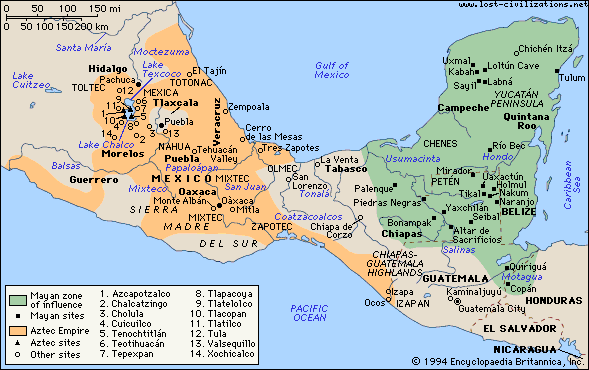
The Maya were organised in city states, sometimes co-operating, sometimes fighting each other but they shared the same beliefs and deferred to priests who derived power from their knowledge of astronomy, mathematics and numerology. The Maya were very much aware of the passage of time. They recorded some dates on stelae and probably much more in books that are lost now because fanatical Spanish Catholic priests destroyed them to eradicate "pagan beliefs". Retracing the history of the Maya is like finding the solution of a detective novel for we have to rely on whatever clues we can find in what is left of archaeological sites that the Spanish did not plunder or destroy.
There are many unanswered questions about the Maya but the cause of their decline remains the greatest mystery. Their civilisation was not destroyed by an overwhelming outside force. The Olmec suffered the destruction of San Lorenzo around 900 BC and that of La Venta around 600 BC but no such catastrophe befell the Maya. Similarly, Teotihuacan was destroyed by warfare around 700 and so was Tula around 1000 AD but Maya power disintegrated from within. Many hypotheses have been proposed, overpopulation, famine, epidemics, civil disorder... Some of these factors might have played a role in some places but I tend to think that the common people just stopped believing in the dogma the elites were using to establish their power and justify their excesses. Similarly, the disintegration of the Soviet Empire can largely be explained by the excesses of a corrupt elite and the subsequent disbelief in the supremacy of the communist system by the common people.
There are hundreds of known Maya sites spanning two millennia. It can get quite confusing so I built the table below as a quick reference of where some of the more important sites are located (southern highlands, central lowlands and northern lowlands) and the period they are best associated with (pre-classic, classic and post classic). The highlighted sites are linked to one of the pages of this website. The others provide a minimum of information on each site.
I hope this table will help you to get an overall picture of Maya history through its archaeological sites.
For more interesting topics related to archaeology, visit archaeology excavations.
Mysteries of the Maya Come Alive in Belize
For the people of Belize, Mundo Maya (The World of the Maya) is more than a joint program established with its neighbors to help preserve the rich Maya culture. It is a deep-rooted passion that is felt in every corner of this small Central American country.
While deeply immersed in the traditions of the Maya, Belize is now the only English-speaking country in the Maya world. The spirit of the Mundo Maya is in the faces of Garifuna (Carib-Indian) and Creole children, as they help prepare a daily meal in their villages. It is in the women dressed in traditional, colorful garb as they celebrate the Deer Dance, a nine-day Maya cultural celebration, or washing the family's clothes, waist-deep in creeks. It can also be found in the many professional guides who will gladly explain the mystical Maya culture at any one of the hundreds of Maya sites within Belize.

Belize is often referred to as the "Heart of the Maya" and boasts the highest concentration of Maya sites among all Central American countries. To truly appreciate the beauty of the Maya sites, you must appreciate the beauty of the Maya people, for it is within their past that Belize's ancient history unfolds.
The Maya were in Belize prior to the first millennium, and through the years suffered numerous persecutions. Among the most brutal was the Spanish Conquest in 1524 that led to continuous religious suppression committed to shattering the Maya culture. But the Maya spirit proved to be indestructible and has endured.
It is this desire to protect and preserve this rich cultural heritage that has led Belize and its Central American neighbors 3 Mexico, Guatemala, Honduras and El Salvador 3 to establish Mundo Maya in the late 1980's. The countries now work together to create programs that preserve and promote the legacy of one of the greatest civilizations of all time.
History of the Maya in Belize
History of the Maya in Belize
It is estimated that a thousand years before Europeans landed on the shores of Belize, a million Maya lived within its modern borders. In fact, the Maya civilization in Belize dates back to as early as 1500 B.C., and reached its peak between 300 and 900 A.D. The Maya's contribution to both society as well as modern day Belize are countless 3 from incredibly designed and engineered buildings, to the creation of the modern calendar, and even to the development of the written language.
The sheer magnificence of Maya accomplishments can be viewed at any one of the many ceremonial sites and temples that dot the Belize landscape. Only a few of the sites have been restored; most of the thousands of ancient Maya sites have been left in much the same condition in which they were found. More areas are discovered each year, and it is not uncommon to find artifacts anywhere within the country.
Maya Sites in Belize
Among the most famous sites found in Belize are Caracol, Xunantunich, Altun Ha, La Milpa, and Lamanai. Each is unique unto itself, and each reveals another aspect of this mystical civilization.
The largest of Belize's Maya sites is Caracol (The Snail). Located in the rugged backcountry of Belize's Cayo District, it can be reached by car through a dramatic drive through the Chiquibul Rainforest. The largest pyramid in Caracol is "Caana" (Sky Place) which rises 140 feet from its base. It represents the tallest man-made structure in all of Belize and represents a major Maya ceremonial center. Caracol is currently undergoing excavation and renovation.
Xunantunich (Maiden of the Rock) is one of the most accessible ancient Maya sites in Belize. Once a major ceremonial center during the Classic Period, Xunantunich overlooks the Mopal River, is composed of six major plazas, and is surrounded by more than twenty-five temples and palaces. Today, visitors can climb nearly to the top of El Castillo (The Castle), which stands at 135-feet tall. Xunantunich is located across the river from the village of San Jose Succotz and overlooks the lush forests of Belize and neighboring Guatemala.
Altun Ha (Water of the Rock) consists of two main plazas surrounded by thirteen temples and residential structures. Once functioning as a coastal trade center, the ruins of Altun Ha are quite famous. It was here the Jade Head representing the Sun God, Kinich Ahua, was found. Almost 6 inches tall and weighing nearly 10 pounds, the Jade Head is both the largest carved jade object in the entire Maya area, as well as, the national symbol of Belize.
La Milpa, the third largest site in Belize, is a ceremonial center with more than 24 courtyards and over 85 structures. In this Maya site stands the Great Plaza, one of the largest public spaces in the Maya world. Recent archaeological finds have included major burials with many jade goods. La Milpa is located in the Rio Bravo Conservation Area in northwestern Belize.
Lamanai (Submerged Crocodile) is located on the New River Lagoon, a 950-acre archeological site and one of Belize's largest ceremonial centers. Lamanai has one of the longest occupation spans and is home to numerous crocodiles. More than seven hundred structures have been identified, many of which are still buried. Visitors can observe the remains of two Christian churches and a sugar mill. In addition to these structures, several groups of black howler monkeys have made Lamanai their home. Visitors can see these playful creatures peering down at through the branches as they explore this ancient Maya site.
For more interesting topics related to archaeology, visit archaeology excavations.
Monday, December 26, 2011
Oldest Known Mattress Found; Slept Whole Family
The world's oldest known mattress has been unearthed in South Africa, archaeologists have announced.
The mattress—which consists of layers of reeds and rushes—was discovered at the bottom of a pile of bedding made from compacted grasses and leafy plants. The bedding had accumulated at the Sibudu Cave site in KwaZulu-Natal (map) over a period of 39,000 years, with the oldest mats dating to 77,000 years ago.
"What we have is evidence of plant bedding that is 50,000 years older than any previous site anywhere in the world," said study leader Lyn Wadley of the University of Witwatersrand in Johannesburg.
The compacted layers of fossil plants—excavated from sediments 9.8 feet (3 meters) deep—show that the bedding was periodically burned, possibly to limit pests and garbage.
Insect-Repelling "Top Sheet"
What's more, researchers believe the ancient people added a "top sheet" to the bedding made of insect-repelling greenery, possibly to ward off biting bugs such as mosquitoes and flies.
This fine covering of leaves may also represent the earliest known use of medicinal plants by humans.
The leaves are from the tree Cryptocarya woodii, or river wild-quince, a medicinal plant that produces insect-killing chemicals.
For more interesting topics related to archaeology, visit archaeology excavations.
Cambrian predator had killer eyes
A fearsome predator that swam in the Cambrian oceans was in fact a metre-long arthropod with killer vision, say researchers.
Palaeontologist Dr John Paterson, from the University of New England, and colleagues, have discovered the fossilised remains of compound eyes from a creature called anomalocaris.

"The fact that each eye in anomalocaris would have had over 16,000 lenses, means it would have very, very good resolution," says Paterson, whose work is published today in the journal Nature.
"When you consider that a modern housefly, for example, has about 3000 lenses, it's pretty impressive that an animal half a billion years old already has remarkable vision like this."
Around 500 million years ago, during the Cambrian, large alien-like creatures began to resemble modern animals, says Paterson.
"But you still had the odd freak swimming around," he says, referring to the metre-long free-swimming anomalocaris.
"It's an animal that's on its way to becoming an arthropod from an evolutionary point of view," says Paterson.
The creature would have propelled itself through the water by moving flaps down the length of its body in a wave-like pattern, he says.
It had a soft shrimp-like exoskeleton and fierce grasping claws and would have dined on soft-bodied organisms such as worms.
Missing attributes
But anomalocaris has presented a bit of puzzle to scientists because while it looked like it might be an arthropod, it was missing certain attributes.
Arthropods include animals with jointed legs such as insects, spiders, crustaceans and millipedes.
"But when you look at anomalocaris, it doesn't actually have any jointed legs," says Paterson.
Now, the discovery of fossilised compound eyes belonging to the animal has confirmed it is indeed an arthropod.
"Compound eyes are actually a definitive arthropod characteristic or trait," says Paterson.
The fossilised eyes were discovered alongside remains of the grasping claws and the body flaps in shale at Emu Bay on the northern coast of Kangaroo Island, off South Australia.
The soft tissue of the compound eyes were slowly replaced by a mineral called pyrite in a low oxygen sediment, says Paterson.
The discovery supports the idea that compound eyes evolved very early on in arthropod evolution, before the evolution of jointed legs or hardened exoskeletons.
For more interesting topics related to archaeology, visit archaeology excavations.
World's oldest bed found in South Africa
The world's oldest bed, dating back 77,000 years, has been discovered in a cave in South Africa.
The bed, made of bundles of sedge and wild quince leaves, was found by archaeologist Lyn Wadley of Wits University, while archaeology excavating a site at Sibudu in KwaZulu-Natal province, media reported citing the Cape Argus newspaper.
The site was a rock shelter on a cliff face on the banks of the Thongathi river, 40 km north of Durban, where Wadley has been working as an archaeologist since 1998.
Wadley found the bed (about 1x2 metres in size) buried more than three metres deep in sediments.
What was special about the bed was that it was covered with a layer of aromatic leaves from a plant called the river wild quince. No other tree leaves were found on the bedding, so the leaves were not there as a result of random leaf fall, the report said.
The leaves of the river wild quince have insect-repellent properties, especially against mosquitoes, so these bed-makers clearly had a good knowledge of herbal medicine, it said.
There was also evidence at the site that bedding was occasionally burnt, presumably to get rid of residual bugs.
The bed-makers were Middle Stone Age humans, skilled in making stone tools, including spearheads, knives and scrapers, as well as perforated-shell jewellery.
They also made bone tools and mixed ochre -- natural earth containing ferric oxide, silica, and alumina -- which might have been used as an insect repellent or as paint.
Before this extraordinary discovery, the earliest known beds were about 25,000 years old, and the earliest known use of herbal medicine was about 5,000 years ago.
For more interesting topics related to archaeology, visit archaeology excavations.
Sunday, December 25, 2011
Mexico's Mayan region launches apocalypse countdown
Less than 52 weeks are left before Dec. 21, 2012, when some believe the Maya predicted the end of the world. Unlike enthusiasts of other doomsday theories who suggest putting together survival kits, southeastern Mexico, the heart of Maya territory, plans a yearlong celebration.
Mexico's tourism agency expects to draw 52 million visitors by next year only to the regions of Chiapas, Yucatan, Quintana Roo, Tabasco and Campeche. All of Mexico usually lures about 22 million foreigners in a year.
It's selling the date, the winter solstice in the coming year, as a time of renewal. Many archeologists argue that the 2012 reference on a 1,300-year-old stone tablet only marks the end of a cycle in the Mayan calendar.
"The world will not end. It is an era," said Yeanet Zaldo, a tourism spokeswoman for the Caribbean state of Quintana Roo, home to Cancun. "For us, it is a message of hope."
Cities and towns in the Mayan region on Wednesday will start the yearlong countdown. In Chiapas the town of Tapachula on the Guatemalan border will start a countdown on an 8-foot digital clock in the main park exactly a year before the mysterious date.
In the nearby archaeological site of Izapa, Maya priests will burn incense, chant and offer prayers.
In the tropical jungle of Quintana Roo, between the resorts of Cancun and Playa del Carmen, people are putting messages and photos in a time capsule that will be buried for 50 years. Maya priests and Indian dancers will perform a ritual at the time capsule ceremony.

Yucatan state has announced plans to complete the Maya Museum of Merida by next summer.
"People who still live in Mayan villages will host rites and burn incense for us to go back in time and try to understand the Mayan wisdom," Zaldo said.
The Maya reputation for wisdom has people taking the alleged prediction seriously.
The Mayan civilization, which reached its height from 300 to 900 A.D., had a talent for astronomy.
Its Long Count calendar begins in 3,114 B.C., marking time in roughly 394-year periods known as Baktuns. Thirteen was a significant, sacred number for the Mayas, and they wrote that the 13th Baktun ends on Dec. 21, 2012.
The doomsday theories stem from a stone tablet discovered in the 1960s at the archaeological site of Tortuguero in the Gulf of Mexico state of Tabasco that describes the return of a Mayan god at the end of a 13th period.
Believers have taken the end-of-the world fears to the Internet with hundreds of thousands of websites and blogs.
"The Maya are viewed by many westerners as exotic folks that were supposed to have had some special, secret knowledge," said Mayan scholar Sven Gronemeyer. "What happens is that our expectations and fears get projected on the Maya calendar."
Gronemeyer of La Trobe University in Australia compares the supposed Mayan prophecies to the "Y2K" hype, when people feared all computer systems would crash when the new millennium began on Jan. 1, 2000.
For some reason, Gronemeyer says, people have ignored evidence that dates beyond 2012 were recorded.
The blogosphere exploded with more speculation when Mexico's archaeology institute acknowledged on Nov. 24 a second reference to Dec. 21, 2012, on a brick found at other ruins.
"Human beings seem to be attracted by apocalyptic ideas and always assume the worst," Gronemeyer said.
It's all a bit frustrating for serious Mayan researchers whose field has made huge strides in recent years.
"This new historical and archaeological knowledge is so much more interesting and mind-blowing than the fantastical claims about Maya prophecies one sees on TV, books or on the Internet," David Stuart, a specialist in Mayan epigraphy at the University of Texas at Austin, said in an email to The Associated Press. "We're dealing with thousands of newly deciphered texts and trying to weave together a coherent picture of Maya history and culture, which to me is as exciting as it gets."
While the 2012 hype might increase interest in the Maya, "that will probably be offset by the long and difficult effort ahead to correct the ubiquitous lies and misconceptions, even after 2012 has come and gone," he wrote.
Jonnie Channell of Albuquerque, New Mexico, says that 2012 "is going to be one of those things where people are definitely going to have to plan," not because of impending apocalypse, but because hotel rooms in the Maya region are probably going to be full.
Channell, who owns Maya Sites Travel Services, is surprised that she already has 24 reservations for three tour packages she is offering to major Mayan ruin sites in the week leading up to the solstice.
She named one "Beginning the New Calendar Era Under the Yucatan Stars."
"We put together these tours, and we've got lots of signups, and people are excited about it," she said. "If anybody thinks it's going to be the end of the world, then they better stay home."
For more interesting topics related to archaeology, visit archaeology excavations.
Ancient Mayan Ruins Have NOT Been Found in Georgia
If you’re been reading the left-wing Drudge Retort lately, you may have been jolted out of your armchair by a bit of exciting news: ancient Mayan ruins have been discovered in the mountains of North Georgia! According to the report, picked up from a fly-by-night Web pub called the Examiner, a small group of archeologists led by University of Georgia scholar Mark Williams discovered the 1,100-year-old city “on the southeast side of Brasstown Bald in the Nacoochee Valley.” Only, the report “is not true,” according to Williams, reached by email. “I have been driven crazy by this.”

The original story was written by one Richard Thornton — who claims that “like most Georgia and South Carolina Creeks, I carry a trace of Maya DNA,” and that his ancestors came to North America fleeing “volcanic eruptions, wars, and drought” — and it has certainly caught fire across the Twitter/blogosphere thanks to the general obsession with the 2012 Mayan prophecies. (Even the venerable Washington Post interrupted its regularly-scheduled news rapportage to alert readers that “a second brick found at a Mayan ruin also contained the Dec. 21, 2012, date.”)
But, as Williams says, “The Maya connection to legitimate Georgia archaeology is a wild and unsubstantiated guess on the part of the Thornton fellow. No archaeologists will defend this flight of fancy.”
Too bad for holiday cocktail-party conversation, the news of Mayan ruins among us appears to be bunk.
For more interesting topics related to archaeology, visit archaeology excavations.
Israeli archaeologists discover ancient clay seal in Jerusalem, suggest link to Temple ritual
A rare clay seal found under Jerusalem’s Old City appears to be linked to religious rituals practiced at the Jewish Temple 2,000 years ago, Israeli archaeologists said Sunday.
The coin-sized seal found near the Jewish holy site at the Western Wall bears two Aramaic words meaning “pure for God.”

Archaeologist Ronny Reich of Haifa University said it dates from between the 1st century B.C. to 70 A.D. — the year Roman forces put down a Jewish revolt and destroyed the second of the two biblical temples in Jerusalem.
The find marks the first discovery of a written seal from that period of Jerusalem’s history, and appeared to be a unique physical artifact from ritual practice in the Temple, said Reich, co-director of the archaeology excavation.
Very few artifacts linked to the Temples have been discovered so far. The site of the Temple itself — the enclosure known to Jews as the Temple Mount and to Muslims as the Noble Sanctuary — remains off-limits to archaeologists because of its religious and political sensitivity.
Archaeologists say the seal was likely used by Temple officials approving an object for ritual use — oil, perhaps, or an animal intended for sacrifice. Materials used by Temple priests had to meet stringent purity guidelines stipulated in detail in the Jewish legal text known as the Mishna, which also mention the use of seals as tokens by pilgrims.
The find, Reich said, is “the first time an indication was brought by archaeology about activities in the Temple Mount — the religious activities of buying and offering and giving to the Temple itself.”
The site where the seal was found is on the route of a main street that ran through ancient Jerusalem just outside the Temple compound.
Aren Maeir of Bar-Ilan University, a biblical archaeologist not connected to the dig, said the seal was special because it “was found right next to the Temple and is similar to what we see described in the Mishna.”
“It’s nice when we can connect an activity recorded in ancient sources with archaeological finds,” he said.
The seal was found in an excavation run by archaeologists from the government’s Israel Antiquities Authority. The dig is under the auspices of a broader dig nearby known as the City of David, where archaeologists are investigating the oldest part of Jerusalem.
The City of David dig, located inside the nearby Palestinian neighborhood of Silwan and funded by a Jewish group affiliated with the settlement movement, is the Holy Land’s highest-profile and most politically controversial archaeology excavation.
For more interesting topics related to archaeology, visit archaeology excavations.
Thursday, December 22, 2011
Child's Remains and Other Bones Identified at Canada's Oldest Indian Residential School in Brantford, Ontario
Archaeological surveys and test digs authorized by we, elders of the Kanien'keha:ka Nation, have been conducted at the former Mohawk Institute Indian residential school since October 1.
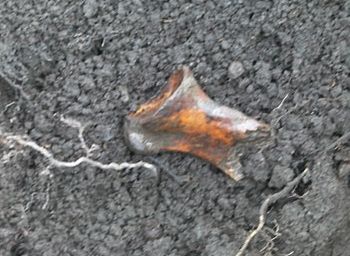
This past week, while on the grounds of the school, our researchers along with Kevin Annett -Rawennatshani, who acts with our approval, have unearthed what has been described as human remains. One bone among sixteen uncovered has been identified, through preliminary visual examination by a competent archaeologist, as that of a young child. This bone sample is described by the same archaeologist as “definitely human”.
A test dig in a twenty square foot area on grounds adjoining the former Mohawk Institute have revealed a considerable number of bones, as well as buttons which have been confirmed to be part of the children's school uniforms. Large deposits of coal were also found associated with these remains, all at a depth of barely two feet. Several of the bones have also been cut up, suggesting that the bodies may have been deliberately dismembered, while other bones were broken.
We declare the area on and near the former Mohawk Institute to be a crime site under our jurisdiction, and we will not allow representatives of the Crown or Church of England, or the government of Canada, access to these excavations because of their complicity in this crime.
These institutions have consistently refused to disclose the evidence they possess regarding the Mohawk Institute and the deaths of children under their legal care, and therefore, we are proceeding to charge these bodies with crimes against humanity in international courts of justice, based in part on the forensic evidence we have uncovered.
We now call upon our community and the world to rally behind our efforts to bring recognition to the remains of children buried on the Mohawk Institute grounds, and our work to excavate this site. Prior to any possible repatriation of these remains, and because these remains may include children from other indigenous nations, we look to those nations to participate with us in this work and welcome their input, and we urge them to begin their own archaeology excavations at local Indian residential schools.
We appeal to other nations to send archaeological and forensic specialists and international observers and peacekeepers to our territory to operate under our Mohawk jurisdiction, to assist with our inquiry and protect the burial sites until the remains can be accorded a proper burial according to our diverse traditions. Until these experts arrive to conduct a professional archeological excavation of these graves, we are temporarily suspending our archaeology excavations.
As our investigation continues, the bone samples will be subjected to further forensic tests, and this data about the human remains uncovered at the Mohawk Institute will be prepared in a final report to be delivered in the spring of 2012 to human rights courts and Parliamentarians in Europe, as part of a campaign to bring charges of genocide against the Crown of England, the government of Canada, the Anglican Church in Canada and other guilty parties.
For more interesting topics related to archaeology, visit archaeology excavations.
Preserving Artifacts of Anti-Semitism
Anti-Semitic propaganda used to be mass-produced and available in the guise of home accessories. Manufacturers in Europe and the United States caricatured Jews as shabby, greedy and menacing, and put these depictions on cigar boxes, candlesticks, trays, tiles, walking sticks, puppets and board games.

Peter Ehrenthal, a Judaica dealer in Manhattan, has assembled about 600 anti-Semitic artifacts ranging from somewhat jokey to appalling. On Jan. 5 a third of his collection will go on view at the Wolfson Museum of Jewish Art in Jerusalem in a yearlong show, “The Eternal Jew: Objects of Hatred From the Peter Ehrenthal Collection.”
Mr. Ehrenthal, 91, who runs Moriah Galleries on Fifth Avenue, is a Jewish dentist’s son from Romania who lost much of his family during the Holocaust. He said he spent tens of thousands of dollars for some anti-Semitic works. Although he concentrates on pre-World War II material, some items in his collection date to the 15th century. Nineteenth-century peddler statuettes are mildly unflattering, while the posters with graphic accusations of theft and murder can be sickening.
"Today’s Jews are not used to seeing themselves like this," he said during a recent interview at the gallery, while he leafed through a catalog of the collection. He added, "I grew up with this." On the table beside him was a recent acquisition: a cookie jar in the form of a kneeling Jew clutching money bags, an object typical, Mr. Ehrenthal said, of anti-Semitic works once made by the Royal Doulton factory in Britain.
His purchases often turned up in the backrooms of galleries and bookstores; dealers after World War II, wary of offending customers, would keep anti-Semitica out of sight. Mr. Ehrenthal has found works designed by important artists, including the British illustrator E. A. Cox and the Viennese sculptor Bruno Zach.
In the collection’s Americana contingent, a matchbook promotes lakefront “restricted camps” that excluded Jews. A Life magazine illustration by the cartoonist Harrison Cady shows tiny Jews tying up a Gulliver representing New York society, with ribbons labeled “real estate,” “jewelry” and “haberdashery.”
Peter Ehrenthal and his son Michael, a co-owner of the gallery, have not decided what to do with the collection after the Israel exhibition, but hope to find a museum willing to keep it together. They have a few objects on view at the gallery: a German tankard depicts soldiers banishing Jews to Palestine, and in a bronze relief a Jew begs for mercy at a customs post.
During previews at the Wolfson Museum, older visitors have come away shaken, said the curator, Nurit Sirkis Bank. "They are offended, they have tears in their eyes," she said. "But they say it is so important to exhibit this material."
For more interesting topics related to archaeology, visit archaeology excavations.
Wednesday, December 21, 2011
Heritage Minister John Penrose gives protection to Star Carr, Yorkshire's answer to Stonehenge
On the advice of Language Historical past, the beginning Mesolithic website at Celebrity Carr, South Yorkshire is being made a planned monument for its scarcity and historical significance.

The status provides legal security for the website where last season a group of archaeologists, from You are able to and the Higher education of Stansted, found The united kingdom's most well-known remaining home. The home schedules to at least 9,000 BC - when The united kingdom was part of ls The european union. The research group found the 3.5 meters rounded framework next to an historic pond at the website, near Scarborough, which archaeologists say is equivalent in significance to Stonehenge. They also excavated a well maintained 11,000 year-old shrub footwear with its debris still complete and the first proof of construction in The european union.
John Penrose said: “The variety of discovers on offer at Celebrity Carr and its history which goes back to 9000 BC are unmatched in Language the archaeology of gortyn and it continues to be one of the most essential Mesolithic sites in The european union.”
Nick Bridgland, Designation Team Innovator for the South at Language Historical past, said: “The continues to be at Celebrity Carr, such as what may be the first building known in The united kingdom, are unmatched in Language the archaeology of gortyn and status as a Appointed Ancient Monument understands this significance. Preparation Celebrity Carr will help archaeologists handle the website successfully and take out critical archaeology excavations to restore the quickly ageing continues to be so we can all learn as much as possible about this exciting period of prehistory.”
Star Carr is an beginning Mesolithic profession website near Scarborough, South Yorkshire and is an extremely unusual website due to its amazing success of natural content from this primitive time frame and the proof of designed components on the website. It is known for the excellent variety of discovers and historical features from the website. Some of these are aesthetically amazing such as the head-dresses now in the Language Art gallery, while some, such as proved helpful wood, display the beginning use of diamond resources for construction.
Dr Nicky Milner from the Higher education of You are able to and Dr Chantal Conneller and Robert Taylor from the Higher education of Stansted have proved helpful at Celebrity Carr since 2004.
Dr Milner said: “It is very good information that the nationwide significance of Celebrity Carr has been officially accepted and it will now be officially covered. We are really awaiting undertaking further archaeology excavations which will help us reply more questions about how our forefathers resided, just after the end of the Ice Age.”
Dr Conneller added: “The scheduling of Celebrity Carr verifies its location as The united kingdom's most essential Mesolithic website. We are excited that the discovers from our excavations - in particular the home and the wood made program - have greater our comprehension of such an well-known website.”
The status of Celebrity Carr comes less than monthly after the statement of a Queen’s Wedding loved-one's birthday Reward to the Higher education of You are able to in identification of the Office of Archaeology’s powerful function in expanding the opportunity of the archaeology of gortyn.
For more interesting topics related to archaeology, visit archaeology excavations.
Archaeological Survey of India Celebrates Its 150th Anniversary
The Himachal Pradesh set up here Friday all handed down a quality asking for changes in the middle act to allow authorities organizations and individuals in the condition to develop or remodel their components near historic and secured typical monuments.
Moving the quality, Primary Reverend Prem Kumar Dhumal said, "Since area is at a top quality in the Himachal Pradesh and the inhabitants is improving, it has now become a genuine need of the individuals to training their right to development."
The quality looks for changes in the Historical Websites and Continues to be (Amendment and Validation) Act of 2010, which forbids development or restoration of components within a 100-metre range of typical monuments announced as "ancient" and "protected".
Dhumal particularly requested for changes in Area 20-A and 20-B of the act.
The chief minister first desired that the Historical Study of India`s prohibition control should be decreased from 100 to 50 meters and the specific control from 200 to 100 meters. But when weight associates and Presenter Tulsi Ram intervened, the primary minister reworded his own quality to say "the location of the maintained monuments" rather than specify range from it.
For more interesting topics related to archaeology, visit archaeology excavations.
Tuesday, December 20, 2011
Will the secret over the Excellent Pyramid's secret doors be settled in 2012?
I care say yes. After almost two generations of unsuccessful efforts, possibilities are now powerful that scientists will expose next season what is behind the key doors at the center of Egypt's most spectacular chart.
New details on the lasting secret were already predicted this season, following a bot development of the 4,500-year-old pharaonic mausoleum.
But unrest in The red sea froze the venture at its most ensuring point, after it created the first ever pictures behind one of the Excellent Pyramid's strange doors.
Now the Substantial Government of Antiquities (SCA), once led by the debatable yet charming Zahi Hawass, is gradually coming to giving lets for excavations and historical analysis.

Giza Pyramids Position Toward Metropolis of Sun God
"As with other tasks, we have had to resubmit our app to be granted to proceed. We are currently awaiting the various committees to formalize the acceptance," venture objective supervisor Mark Whitehead, of the development organization Scoutek UK, informed Uncovering Information.
"Once we're granted to proceed, I have no uncertainty that we can finish our function in 2012," he included.
Built for the pharaoh Cheops, also known as Khufu, the Excellent Pyramid is the last other wonder of the historic community.
For more interesting topics related to archaeology, visit archaeology excavations.
Incomparable objectives on a boat known as Sea Cloud
Every vacation should be implanted with sentiment, starting with a feeling of wonder. It would be challenging to embellish the effect of a four-masted barque, the Sea Impair, on our life. There is the adrenaline of the boat – no mail going these days can go with the Sea Cloud’s illustrious historical past or the appearance and practical knowledge she provides. Individuals reserved the voyage because the boat is like no other. From the first, dubious perspective, we know we are in the world of dream.
She is a famous mail, generally known as the most stylish and beautiful going boat on the water, and the list of those who have traveled the world on her is proof of her wonder. She has been going in the Aegean Sea and along the Turkish seacoast since 1985.

After speculation of her approaching pension, the Sea Impair is provided from a significant and significant repairing with the splendor of hardwood floors, finished metal (original rooms function fire places and pebble baths), pebble and precious metal accessories that beautifully supplement her constellation of sails, geometries of collections and rigging. The only sensation better than status on her units as you get into a have in Chicken or Portugal is to be onboard under full vacation along the Dalmatian seacoast of France, Montenegro or the unique western side seacoast of Chicken. As a traveler from Chicago, illinois (that’s Shu-CAW-guh) mentioned, it is all ultra-civilized.
Leaving slot under vacation you see the skipper’s control “All palms aloft!” and as you look up, the sails are elevated manually, you see the team struggling out onto the yardarms while collections are uncoiled, capstans turn, and mariners heave and take. There is such synchronised frustration of purposeful action in a range and measurement that it is challenging to believe. Like miracle, the sails bounce and load with breeze flow turbine and that is when you see the quiet, the strange movement and instantly you are missing in that association with the components that poets and mariners have was battling for decades to explain. There is nothing like it. 34,000 sq ft of textile unfurl from yardarms to hook the breeze flow turbine – enough vacation to cover a whole metropolis prevent. The massive masts are as high as a 20-story building. Is charted, climate is tested and marketing and sales communications are managed via tv and computer.
The Sea Impair is as stylish these days as when heiress Marjorie Merriweather Publish and her man, Walls Road magnate E.F. Hutton, released her, developing the greatest, most luxurious going private boat ever designed. It was a no-brainer. They performed variety to Master Gustavus of Sweden and the Fight it out of Windsor among others, who would regale later partners with reports of their activities onboard mail. Today she benefits 58 visitors in 30 rooms and two Owner’s Locations. There is a degustation list with excellent dinner furniture set in spots enriched with spotlit orchid flowers and soft-footed servers who choreograph the dish.
The Sea Impair has a significant “wow” element. The collaboration of conventional vacation and deluxe touring was amazing. For some, a flashback to their younger generation. For others, a first-time practical knowledge onboard a square-rigger and remarkable chance to discuss a long-forgotten era of vacation under vacation.
Aboard mail is Nationwide Regional professional Acceptance Fielder, whose specialization features historical past, lifestyle and dialects of the Dalmatian seacoast. She is a lecturer of historical past at the Higher education of Az. Also, maritime archeologist Robin the boy wonder Woodward, an specialist on Mediterranean sea historical past and maritime the archaeology of gortyn who has focused several archaeology excavations and spoken publicly substantially on the region’s historical past and sites. And long time naturalist Sharon Grainger, a Lindblad Expeditions-National Geographic-certified picture lecturer who has led trips around the world with digicam in palm and an eye on the miracle of each lifestyle she looks at.
The boat is an exercise in controlling stylish form and operate – the cosmetic here is eternal. That is the key.
For more interesting topics related to archaeology, visit archaeology excavations.
Monday, December 19, 2011
True History of Mayan Calendar 2012 - Rare evidence information
With mankind returning up quick on 2012, marketers are assisting viewers products up and depend down to this strange — some even telephone it apocalyptic — time frame that historic Mayan organizations were looking forward to hundreds of decades ago.
Since Nov, at least three new guides on 2012 have came in general audience book stores. A 4th is due this drop. Each occurs in the awaken of the 2006 achievements of 2012: The Come back of Quetzalcoatl, which has been promoting a large number of duplicates monthly since its generate in May and number more than 40,000 in list. The guides also develop on well-known interest in the She, motivated in aspect by Mel Gibson's November 2006 movie about Mayan many, Apocalpyto.

Authors differ about what mankind should anticipate on Dec. 21, 2012, when the Maya's "Long Count" work schedule represents the end of a 5,126-year era.
Journalist Lawrence John anticipates wide-spread accident in Apocalypse 2012: A Technological Research Into Civilization's End. Religious healbot Tim Jackson anticipates a renewal of a "true stability between Beautiful Womanly and Masculine" in The Trend of 2012: Vol. 1, The Planning. In 2012, Daniel Pinchbeck anticipates a "change in the dynamics of attention," aided by ancient ideas and psychedelic pharmaceutical use.
The accumulate to 2012 reflects pleasure and worry stated on the eve of the new century, commonly known as Y2K, though on a lesser range, says Ruby Garrett, person faith manager at Publishers Regular. She says marketers seem to be relationship viewers who believe mankind is developing its own green problems and really needs historic ancient information.
"The unity I see here is the apocalyptic objectives, if you will, along with the fact that the planet is in the entrance of many individuals brains these days," Garrett says. "Part of the benefit these soil made use of is that view that we need to reconcile with the Earth to spend less ourselves."
But college students are bristling at efforts to weblink the historic She with styles in modern spiritual techniques. She many, known for innovative composing, numbers and astronomy, blossomed for decades in Mesoamerica, especially between A.D. 300 and 900. Its Extensive Count number work schedule, which was concluded under Language colonization, monitors more than 5,000 decades, then starts over at season zero.
"For the historic She, it was a large party to make it to the end of a whole routine," says Sandra Respectable, management manager of the Groundwork for the Improvement of Mesoamerican Research in Clear Stream, Fla. To provide Dec. 21, 2012, as a end of the world or moment in time of cosmic moving, she says, is "a finish production and a opportunity for a lot of people to cash in."
For more interesting topics related to archaeology, visit archaeology excavations.
Looking up our convict previous
AFTER determined hours of digging, Higher education of WA Physician of Viewpoint college scholar He Winter weather is close to discovering little-known information about You are able to and Toodyay’s convict previous.
Among the discovers are the is still of three You are able to convict store structures, seven Toodyay convict structures, damaged clay-based plumbing, old containers and other artefacts that could well provide some exciting information into the Avon Valley’s legal record.

Following archaeology excavations in the two areas, Mr Winter weather has released a research article in this month’s leading the archaeology of gortyn paper Modern australia Archaeology that reviews on his development.
He said the key aim of the dig was to examine the local convict way of way of life, the interactions between the various categories that made up convict companies and the effect of jail way of life on local group.
“We are looking at the day-to-day existence of convicts because a lot of the historical previous is about the jail program rather than their way of life,” he said.
Though research is continuous, Mr Winter weather said the unusual framework of the structures recommended development was badly monitored and there was a high income of “ticket-of-leave” men.
The solution program started in 1853. Criminals carried from the UK to Modern australia who had provided a period of probation and proven excellent habits could be granted certain liberties.
Once given a solution of depart, a convict was authorized to search for career in a specified region but could not depart that region without the authorization of the authorities. Each change of company or region was noted on the ticket
Mr Winter weather said his research were beginning to find how prisoners around You are able to and Toodyay resided.
For more interesting topics related to archaeology, visit archaeology excavations.
Any Archaeologists Here? Peculiar Designs In Town Of Mark
Archaeology Excavations near the Gihon Springtime in Jerusalem’s Town of Mark have discovered three strange V-shaped marks that have archaeologists absolutely confused. The strange patterns, which each evaluate about 1.5 toes long, are designed into the foundation ground of a space that was in use, according to old ceramic sherds, until at least the overdue 9th millennium B.C.E.

Unfortunately, the archaeology excavation has discovered few signs to indicate either the indicating or operate of the designs, while only one other example, discovered more than a millennium ago in a regional subterranean route that is still unexcavated, has ever been noted in Jerusalem.

“The marks are very strange, and very fascinating. I’ve never seen anything like them,” said Eli Shukron, of the two administrators of the continuous archaeology excavation. Shukron speculates the marks may have assisted assistance some type of wood made framework within the space, although its likewise possible they could have had some either practice or simply routine operate.
For more interesting topics related to archaeology, visit archaeology excavations.
Sunday, December 18, 2011
Jerusalem Holy Site Excavations Unearth History, Controversy
Archaeology Excavations at a Jerusalem site holy both to Jews and Muslims have revealed new facts about the dating of its construction, Israeli archaeologists said.
Coins struck by Valerius Gratus, the Roman procurator of ancient Judea, in 17/18 A.D. were found recently beneath the lowest layer of the Western Wall of Jerusalem’s Temple Mount, which Muslims refer to as the Haram al-Sharif or Noble Sanctuary. That dates the building of this part of the site to more than two decades after the death of King Herod, the ruler credited with its construction.

“Here we have an important archaeological addition, independent of the historical record, that work on the Temple Mount took a very long time, far after Herod’s death,” said Ronny Reich, the archaeologist overseeing the excavations.
While the discovery “doesn’t detract from Herod’s greatness in planning the Temple Mount,” it confirms the extent to which his heirs had to finish the job, Reich says.
Final work on the Temple Mount stretched on into the middle of the first century, according to contemporaneous historian Josephus Flavius, who witnessed its destruction by Roman troops in 70 A.D. The project was so massive that the city was left with thousands of unemployed workers on its completion, Josephus wrote.
Herod’s Expansion
The coins were found among debris covering a Jewish ritual bath, or mikvah, that was paved over as part of Herod’s massive expansion of a much smaller pre-existing site housing the Second Temple. Just north of the archaeology excavation area is the “Wailing Wall” section reserved for Jewish prayer, and inside the compound is the al-Aqsa Mosque and the gold-plated Dome of the Rock Muslim shrine.
The digs alongside the Western Wall, including the excavation of a drainage canal that extends out into the Arab neighborhood of Silwan adjacent to Jerusalem’s Old City, have drawn criticism from Palestinian and Muslim officials. They point out that among the excavation’s funders is the Ir David Foundation, a non-governmental group that also sponsors Jewish settlement in Silwan.
“We are talking about a network of tunnels that Israel is digging which endangers the walls around the compound and also dozens of homes in Silwan,” said Sheikh Ekrema Sabri, head of Jerusalem’s Higher Muslim Council. “The Israeli intention is very clear and that is to destroy the Muslim roots in and around the city of Jerusalem.”
Reich responds that Israel’s Supreme Court considered complaints against the excavations and ruled they could proceed, pointing out that no digging takes place under the Temple Mount itself.
For more interesting topics related to archaeology, visit archaeology excavations.
Ottawa nixes Norway’s ask for for come back of traditional submerged ship
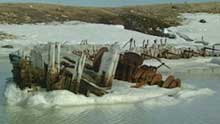
Ottawa has flipped down a ask for for a authorities move let for a submerged Arctic mail once traveled the world the first Western adventurer to vacation the Southern west Report and the first person to arrive at the Southern Publish.
As the tale goes, Norway's Roald Amundsen purposely trapped the Maud in an Arctic ice group in 1918, calculating the boat would flow with the present to the Southern Publish. Unfortunately, the mail became cornered and, after a few years, a broke Amundsen was required to provide it to Hudson's Bay Company, the Nationwide Publish describes.
The fur-trading large rebranded the Maud to the Baymaud and used it as a sailing factory and stereo place before it went under in Arlington Bay in 1930.
Then, in 1990, HBC moved the damage to Norwegian specialists for $1 and they presented with down the title to them in May.
In May, the Nationwide Publish authored that the Maud Dividends Home save team was preparing a multi-million dollars adventure to increase the damage with unique balloons. Supported by Norwegian people, the team desired to support it on a burst and tow it through the Southern west Report back to Norwegian, where it would be maintained in a art gallery outside Oslo.
It seemed the venture was a go—that is until Ottawa got in.
The Canada authorities now wants a complete traditional research to be performed on the damage. The situation came as delight to the Norwegians because the mail had never been outlined as an traditional website.
"At the time of or app being presented with down in, we were knowledgeable that Maud was not authorized on this collection," paperwork an argument released on the team's website on Friday.
"Despite this we do not fight, in concept, an traditional research, but we consider a further specific research of the Maud as it is these days at the seabed moreover to what is already accumulated through our Study and Records of 2011 to be of minor value."
While the Norwegians are discouraged at Ottawa, there are some Canadians happy that the Maud might remain in Canada ocean. According to Nunatsiaq Announcement, a number of Arlington Bay citizens began a case to keep the mail in the ocean outside its group.
"While we don't reject the significance of the Maud to Norwegian," the case flows, "one also cannot reject the truth that she is a Canada traditional website that has been here since 1930 and should not be eliminated."
For more interesting topics related to archaeology, visit archaeology excavations.
Friday, December 16, 2011
Scroll fragments could 'shed light' on O.T. text
The potential contribution to Dead Sea Scroll scholarship of nine scroll fragments owned by Southwestern Baptist Theological Seminary was underscored when several SWBTS professors discussed their research to date during the Society of Biblical Literature's 2011 meeting in San Francisco.
"Southwestern's scrolls contain readings of Old Testament passages that are nowhere else attested," Ryan Stokes, assistant professor of Old Testament, noted after the SBL's three-day mid-November meeting. "We are just beginning to comprehend their importance for the field, but we expect them to shed light on how we came to have the Old Testament text that we have today."
Southwestern Seminary currently houses the largest collection of fragments owned by an institution of higher education within the United States. The seminary will host an exclusive exhibit of the scrolls from July 2, 2012, to Jan. 11, 2013. To learn more about Southwestern Seminary's exclusive "Dead Sea Scrolls and the Bible" exhibit, visit http://seethescrolls.com.
At the SBL meeting, Southwestern professors introduced the scroll fragments to the academic community, demonstrating the seminary's commitment to contribute to the field of biblical scholarship.
Steven Ortiz, associate professor of archaeology and biblical backgrounds and director of Southwestern's Tandy Institute for Archaeology, introduced the session focusing on the scroll fragments.
In addition to Stokes, Southwestern faculty members who presented research were George Klein, professor of Old Testament; Eric Mitchell, associate professor of Old Testament and archaeology; Ishwaran Mudliar and Joshua Williams, assistant professors of Old Testament.
Ortiz said scholars at SBL noted the potential contribution that Southwestern's scroll fragments have for Dead Sea Scroll scholarship.
"The accumulation of data and how it was presented showed that these were some important fragments," Ortiz said. Southwestern's professors displayed an in-depth knowledge of the particular fragments they researched, Ortiz said, as well as setting forth the implications the fragments have for a broader field of research.
"With the initial announcement of Southwestern's acquisition [in January 2010], all the emphasis was placed on the purchase of the scrolls," Ortiz said. "So that is the only thing that people knew about Southwestern's Dead Sea Scroll fragments.
"After this presentation, the perception has shifted, and now they're seeing that Southwestern is serious about becoming a center for biblical research, as the Dead Sea Scrolls affect biblical scholarship."
Ortiz said Southwestern professors will continue this contribution to biblical scholarship by placing the seminary's fragments within the larger corpus of the scrolls. They also have contacted scholars outside the seminary who are researching other unpublished scroll fragments. In time, the seminary will publish its scroll fragments in a major peer-reviewed journal on Dead Sea Scroll research.
During the SBL meeting, Southwestern also invited scholars from outside the seminary to present research related to the Dead Sea Scrolls. Ortiz noted that Southwestern was "very fortunate to have top scholars on the panel," including Bruce Zuckerman, director of the West Semitic Research Project and associate professor of Hebrew Bible at the University of Southern California. Zuckerman led a team that photographed Southwestern's Dead Sea Scroll fragments last September. During SBL, Zuckerman discussed the imaging technology that allows scholars to publish ancient texts in high-definition as well as to read otherwise illegible texts.
Peter Flint, professor at Trinity Western University and co-director of the Dead Sea Scrolls Institute, and Sydnie White Crawford, professor of classics and religious studies at the University of Nebraska-Lincoln, also participated, discussing the significance of the Dead Sea Scrolls and their relevance to biblical studies.
In particular, Flint argued that Southwestern's scroll fragments, alongside others, have revealed which biblical texts were most widely read by the Jewish community that preserved the Dead Sea Scrolls and hid them in the caves near Qumran. As such, the scrolls not only illuminate the biblical text, but they also inform scholars about those who copied and read the scrolls 2,000 years ago, during Jesus' lifetime.
For more interesting topics related to archaeology, visit archaeology excavations.