Showing posts with label Mayan archaeological sites. Show all posts

Sunday, July 22, 2012

New Maya Temple Found


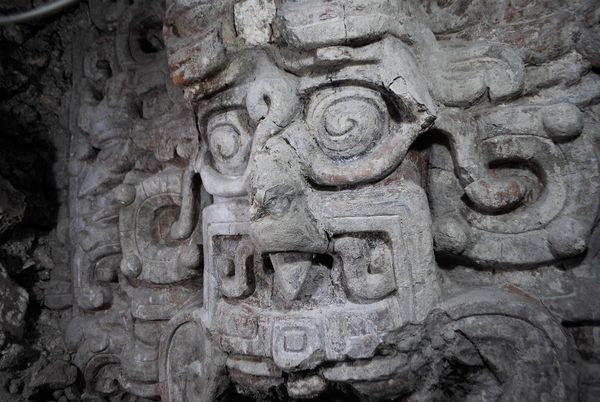
Some 1,600 years ago, the Temple of the Night Sun was a blood-red beacon visible for miles and adorned with giant masks of the Maya sun god as a shark, blood drinker, and jaguar. Long since lost to the Guatemalan jungle, the temple is finally showing its faces to archaeologists, and revealing new clues about the rivalries kingdoms of the Maya.
"This has been a growing awareness to us since the 1990s, when it became clear that a few kingdoms were more important than others," said Brown University archaeologist Stephen Houston, who announced the discovery of the new temple Thursday.
By 2010 archaeologists working on a hilltop near the ancient city center had discovered 45-foot-tall (13-meter-tall) Diablo Pyramid, Atop it they found a royal palace and a tomb, believed to hold the city's first ruler, who lived around A.D. 350 to 400.
Solar Power
The sides of the temple are decorated with 5-foot-tall (1.5-meter-tall) stucco masks showing the face of the sun god changing as he traverses the sky over the course of a day.
One mask is shark like, likely a reference to the sun rising from the Caribbean in the east, Houston said.
The noonday sun is depicted as an ancient being with crossed eyes who drank blood, and a final series of masks resemble the local jaguars, which awake from their jungle slumbers at dusk.
In Maya culture the sun is closely associated with new beginnings and the sun god with kingship, Houston explained. So the presence of solar visages on a temple next to a royal tomb may signify that the person buried inside was the founder of a dynasty—El Zotz's first king.
Maya archaeologist David Freidel added, "Houston's hypothesis is likely correct that the building was dedicated to the sun as a deity closely linked to rulership. The Diablo Pyramid will certainly
Facing Out
"We tend to think of kings being completely autonomous, but for the Maya, a sacred king was often part of a hierarchy of kings," the Penn Museum's Martin said.
"So the people at El Zotz at times may have been heavily under the influence of Tikal, and when powers were weak at Tikal, they may have been completely independent or may have linked themselves with more powerful kings somewhere else."
"A Lot More Discoveries" to Come?
Despite the obvious care that was taken to construct and preserve the newfound temple, it wasn't used for long. Evidence at the site suggests the building was abandoned sometime in the fifth century, for reasons unknown.
"It's like they just dropped their tools and left" in the middle of once again expanding the temple, Houston said. "I think what you're looking at is the death of a dynasty."
The answer to this mystery and others could become evident as more of the Temple of the Night Sun is uncovered.
"Only 30 percent of this facade has been exposed," UCR's Taube said. "I think there're going to be a lot more discoveries and a broader understanding of what this building actually show in the future."

For more interesting topics related to archaeology, visit archaeology excavations.

Thursday, May 19, 2011

Mayan archaeological sites, graves found in southeastern Mexico


Mexican experts have discovered seven new Mayan archaeological sites and an "important concentration" of pre-Columbian graves in the southeastern state of Yucatan, the National Institute of Anthropology and History, or INAH, said.

The vestiges, which include architectural structures, ceramic pieces, lithic fragments and human burial sites, were found in the rural community of Sitpach, five kilometers (three miles) east of Merida, the state capital.

The pieces date back to the Maya's Late Preclassic period (400 B.C.-200 A.D.), which "changes the previous chronology for this Maya region" in that area of the country, INAH said in a statement.

The finds were the result of a project to protect the archaeological heritage that lies in the subsoil on Merida's outskirts, the statement said.

The new sites were found in an area covering roughly 1,000 hectares (2,470 acres) and are known as Oxmul, Polok Ceh, Cuzam, Chan Much, Nichak, Tzakan and Chankiuik.

According to INAH, Oxmul is an especially important archaeological site where 75 pre-Columbian graves were found containing the remains of Indians buried with polychromatic vessels and other ceramic pieces "never before seen in this Maya region."

Archaeologist Luis Raul Pantoja Diaz, coordinator of the Merida Region Archaeological Project, said in a statement that these finds of "earlier, well-organized populations with an elaborate social stratification" have altered the previous chronology of the ancient Maya culture.

For example, archaeologists have corroborated their hypothesis that Yucatan's northern region had been populated as far back as 400 B.C. - rather than only starting in the Classic period (200 A.D.-600 A.D.) as had been previously believed.

"These are areas of the municipality of Merida that were thought not to have been populated by such remote pre-Columbian groups because these are lands that weren't productive," Pantoja said.

Pantoja said archaeologists have found architectural structures made from materials that show evidence of "intense social and economic development."

"We now know that in the space where Merida now sits there's an early architecture, ceramic pieces, lithic fragments and human graves, basic elements that will serve to complete the history of this region of northern Yucatan," he said.

The specialist said that thanks to the Merida Region Archaeological Project researchers have explored "more than 15 sites located on the outskirts of the city, where the INAH thus far has registered 29 points with archaeological vestiges; meanwhile, there are 170 sites registered in the entire municipality of Merida."

All of the archaeological material recovered from the archaeology excavations will remain at INAH's offices in the Yucatan, where it will be analyzed by specialists in archaeology, restoration and physical anthropology to determine its precise age.

Source from : http://latino.foxnews.com

For more interesting topics related to archaeology, visit archaeology excavations.