Sunday, July 31, 2011

Rome archaeologists find Apollo mosaic


Archaeologists have unearthed a 2,000-year-old mosaic in Rome depicting the Greek god Apollo surrounded by his muses in a cellar once used as a park tool shed near the Colosseum, officials said on Friday.

“This is a very important discovery. The mosaic is in perfect condition and it can be dated exactly to between 64 and 109 AD,” Umberto Broccoli, head of the culture department of the Rome city council, told reporters on a visit.

Archaeology Excavations are being done in an underground gallery of the ancient Trajan Baths, a vast structure near the ruins of Nero’s palace, the Domus Aurea.

The parts of the mosaic uncovered so far are made with various shades of bronze-coloured tesserae and show columns, Apollo and one of the muses.

A series of unique frescoes have already been found in the cellar space, including a cityscape and a group of men pressing grapes to make wine.

Archaeologists
believe there are more mosaics to be uncovered and have said they need an extra 680,000 euros ($978,000) to finish the archaeology excavation.

For more interesting topics related to archaeology, visit archaeology excavations.

‘Made-in-Turkey’ archaeological digs raising concerns

Turkey’s Culture and Tourism Ministry has recently turned the licenses for a number of archaeological digs over from foreign to Turkish teams. Although the ministry says the implementation is due to the lack of work at the sites, some claim otherwise, saying there is more to archaeology than digging the ground.

When German archaeologist-businessmen Heinrich Schilemann stumbled upon the ancient city of Troy in today’s province of Çanakkale nearly 150 years ago, initiating the first archaeological excavation in Turkey, he could scarcely have thought other non-Turkish colleagues would one day be prevented from digging in the country’s soil.

Although many of Turkey’s myriad archaeological sites – such as Ephesus, Antioch, Troy, Knidos, Alacahöyük and Hattuşa – were initially found and dug by foreign archaeologists, recent announcements from Turkey’s Culture and Tourism Ministry suggest this will soon change. The recent cancellation of several licenses for important digs that had been run by foreign scientists for decades, has precipitated a new debate on how to evaluate archaeological studies.

“Some of the foreign-run excavations are going well, but some groups only come here, work for 15 days and leave,” Culture and Tourism Minister Ertuğrul Günay said regarding the reason for the canceled licenses. “We are not going to allow that. If they don’t work on it, they should hand it over.”

Among this year’s canceled licenses are Xanthos, Letoon and Aizonai in the provinces of Antalya, Muğla and Kütahya, respectively. The excavations had been conducted by French and German teams for many decades.

“What I am told is that there hasn’t been enough study in the area in recent years, that’s why the archaeology excavation was handed over to us,” Burhan Varkıvanç, the new head of the excavation team in Xanthos told the Hürriyet Daily News.

Archaeologist Sema Atik, who took over the excavations in Letoon, gave a similar answer.

“As far as I know, this policy is something the ministry is giving a lot of importance to,” Atik said. “My team was asked to take over the excavations a few months ago and we accepted it.”

Rising quality of Turkish archaeology

Haşim Yıldız, the adviser for a restoration team in Hierapolis, an ancient Greco-Roman city on top of the Pamukkale travertine falls in the Aegean province of Denizli, said the reason behind the takeovers was the rising quality of Turkish archaeology.

“In the past, Turkish archaeology was not so developed. That’s why many of the excavations were being run by foreign teams,” Yıldız told the Daily News. “Now, Turkish archaeologists have the same knowledge and techniques.”

Yet, according to Professor Mehmet Özdoğan, former chair of the Department of Prehistory at Istanbul University, the idea of handing over one’s project to another team is unacceptable.

“Archaeological excavations have their own momentum, you cannot measure a team’s work by how much time they spend on the site,” Özdoğan told the Daily News. “The fact that their field study may not last for a long period doesn’t mean that there is no work being done on the site.”

‘Science does not have a nationality’

Necmi Karul, chair of the Istanbul Archaeologists’ Association, gives another perspective.

“Science becomes much more productive when it is universal,” Karul said. “Canceling licenses due to lack of work on site will only turn Turkish archaeology upon itself. The ministry should think of other ways to increase productivity,” he told the Daily News.

According to Karul, the number of foreign archaeologists in Turkey has been decreasing over the past 15 years.

“Science doesn’t have a nationality. If we create such an impression, many other good archaeologists will give up the thought of working in Turkey. Turkey has thousands of archaeological sites, the ministry should support more excavations,” Karul said.

There are currently 201 excavation projects in Turkey, according to data from the ministry. While 122 of them are run buy Turkish archaeologists, 48 are run by foreign teams.

Many archaeology excavations in Italy and other EU countries are also run by foreign teams, said Alessandra Ricci, assistant professor of archaeology and art history at Istanbul’s Koç University.

“Archaeology should be about collaborations beyond borders,” Ricci told the Daily News. “Archaeology is not just about how much earth you are removing, but it also requires data processing, conservation and research. All of this work should be evaluated together, and it should be considered as a healthy [overall] exchange of scholarship.”


For more interesting topics related to archaeology, visit archaeology excavations.

Thursday, July 28, 2011

Ancient Sacrificer Found With Blades in Peru Tomb?


The tomb was found at Chotuna-Chornancap, a coastal site near the Peruvian city of Chiclayo (map). The site was once an important ceremonial center of the Lambayeque culture, also known as the Sicán.

The culture lived along the northern coasts of Peru from around A.D. 800 until around 1375, when the neighboring Chimú civilization conquered the Sicán.


Previous archaeology excavations at Chotuna-Chornancap by Peruvian archaeologist Carlos Wester La Torre, who led the team that found the purported sacrificer, revealed a temple containing the remains of several women who were mutilated as part of human-sacrifice rituals.

Wester and other Peruvian archaeologists have suggested that the rulers of Chotuna-Chornancap may have claimed to be the descendants of Naylamp, a god-like figure from the sea that legend says founded the Sicán culture.


Copper-Skirted Sacrificer

The new tomb discovery was made during excavations of a section of Chotuna-Chornancap that was used to perform crop-fertility rituals, according to the team.

The skeleton belonged to a male between 20 and 30 years old, and that the tomb was built sometime in the late 1200s or early 1300s A.D., toward the end of the Sicán period, they say.

The cause of death of the tomb's inhabitant is unknown, but based on the kind and quantity of artifacts buried with him—including ceramic pots, a skirt made of copper disks, and ornate copper knives—the team thinks he was a member of the Sicán elite and possibly performed ritual human offerings by order of a priest.

Wester speculated that a sacrificer was more than just a simple executioner. He would have been entrusted with other responsibilities related to the ceremonies surrounding the sacrifices, the archaeologist added.

Ceramic and metal objects were also found near the tomb—possibly left as offerings to the dead sacrificer, or they may be evidence of another tomb, said Wester, director of the Brüning National Archaeological Museum in the city of Lambayeque.


Or Is a Knife Just a Knife?

Archaeologist and Sicán expert Izumi Shimada said the new tomb could shed light on what the Sicán culture was like just prior to its collapse.

Previous studies, including Shimada's own work, have focused largely on the Sicán-Classic, or middle-Sicán, period, which lasted from A.D. 900 to 1100.

Wester's work "fills a large void that we have," said Shimada, of Southern Illinois University, who was not involved in the new discovery.

But Shimada said it's still too early conclude that the person buried in the tomb played a role in Sicán human sacrifices.

Knives made from precious metals such as copper or even gold were status symbols for the Sicán elite, Shimada said. It was typical for members of the upper class to be buried with such blades.

"The presence of such a knife alone does not provide enough basis to say the person was a priest or that they performed sacrifices," Shimada said.

"Unless the knife were analyzed and contained DNA or blood samples, you cannot really make that kind of logical connection."

For more interesting topics related to archaeology, visit archaeology excavations.

Archaeologist confirms 2,000-year-old relics safe in Phuket


An inquiry into the whereabouts of ancient beads, ceramic vases and glass shards excavated by a Phuket archaeological team in 2005 has revealed that the artifacts are safe on the island.

The relics are all estimated to be more than 2,000 years old.

A letter of complaint was filed with the Crime Suppression Division by Sutha Pratheep Na Thalang on March 14.

The letter, submitted on the behalf of the “people of Phuket”, claimed that the beads were not put on display at Thalang National Museum, as required by Thai law.

Reports made by Thai TV Channel 3 called the archaeologists who found the beads into question, but Capt Boonyarit Chaisuwan of the 15th Regional Office of Fine Arts – and a member of the excavation team who found the beads – announced yesterday that the beads were still on Phuket.

Capt Boonyarit explained to Mr Sutha and members of the Phuket media gathered at the 15th Regional Office of Fine Arts in Thalang that the beads were collected on two separate occasions

The beads were put on display for a short period in March this year, but were then removed from public viewing so further research and study could be conducted on them.

“Every step of the way, my exploration has had many witnesses including my staff, villagers and media. They were all allowed to monitor the excavations,” Capt Boonyarit said.

The first archaeology excavation was in Ranong in 2005 and a second site was discovered in a different Ranong district in 2010.

More than 1,000 samples were collected, including etched beads, rouletted ware, crystal stones and stone instruments used to make the beads.

Capt Boonyarit explained that the beads were not kept on permanent display at the museum for safety reasons as well as research.

“Thalang National Museum is not the safest place to display these precious national artifacts and I need to conduct more in-depth study on them,” he explained.

Mr Sutha said he was satisfied with the explanation and that it was good to know the beads were still safe in Phuket and not sold on the black market.

For more interesting topics related to archaeology, visit archaeology excavations.

World War II Internment Camp Archaeology Project


It may be among the least studied aspects of World War II: the fate of German soldiers captured by Allied forces.

Archaeologist
Adrian Myers is hoping to fill in part of this historical gap with his World War II Internment Camp Archaeology Project.

With an NGS/Waitt grant, Myers and his team have begun researching a World War II prisoner of war camp in Manitoba, Canada. Occupied from 1943 to 1945, the camp, at its peak, held about 400 German soldiers captured in North Africa after the Second Battle of El Alamein, an important victory for the Allies. In July 2009, with help from Jerram Ritchie, Adrian completed the first phase of fieldwork.

None of the original buildings at the Canadian POW camp still stand, but many signs of its existence remain visible. Myers and his team used basic equipment, such as GPS, tape measures, digital cameras, and weatherproof notebooks, to record the site. Earth and concrete foundations could be seen where the buildings had once stood. They also discovered the camp's concrete incinerator, two garbage dumps, and a decaying wooden canoe carved by the POWs in their spare time. There were POW-built gardens with walls made of cobblestones. Many of these are still visible. The team also discovered many smaller reminders of the prisoners' daily lives, including a broken mug and saucer and even beef bones leftover from one of their meals.

In summer 2010, Myers plans to return to the site with an expanded research agenda and more team members. They will start with comprehensive and precise digital mapping of all the remains, from large foundation walls down to individual fragments of broken glass. They will collect a sampling of the surface artifacts and then excavate in a few small test areas. This will determine where larger excavations will be carried out in 2011. Any artifacts discovered will be carefully labeled, packaged, and transported to the Historical Archaeology Laboratory at the Stanford Archaeology Center for further study.

Myers hopes his team's investigation of this historical site will contribute to a greater understanding of this time in history.

For more interesting topics related to archaeology, visit archaeology excavations.

Wednesday, July 27, 2011

3,500-year-old ancient treasure unearthed in Turkey

The return of a 3,500-year-old sphinx statue to Anatolia and the archaeology excavation of a 2,000-year-old racing arena in Muğla this week are part of the ongoing preservation of Turkey's rich history.


The 3,500-year-old statue of a sphinx, removed from Turkey almost a century ago, was returned to the country Wednesday. The Boğazköy Sphinx, which was taken to Germany 94 years ago for restoration, made its İstanbul debut at a presentation ceremony on Wednesday at the Archaeology Museum. Almost 4,000 years old and standing 2.8 meters tall, the sphinx originally stood on the right side of the south gate of Hattuşa, once the capital of the ancient Hittites.

“The Boğazköy Sphinx has been returned to our land. Today is a historic day,” Culture and Tourism Minister Ertuğrul Günay said on Wednesday during a press conference in İstanbul's Eminönü neighborhood.

Back in May Germany agreed to return the sphinx to Turkey, ending growing hostility between Berlin and Ankara over the statue's return. In 1915 German archaeologists discovered the sculpture, representing a figure with a lion's body and a human head, in the ruins of Hattuşa in Central Anatolia, and brought it to Germany for restoration.

Also this week, archaeologists unearthed a 2,000-year-old arena used for gladiator games in Mugla's Yatak district, once the site of the ancient city Stratonikeia. Dr. Bilal Söğüt, a professor in the department of archaeology of Pamukkale University and the head of the archaeology excavation, said, “We know gladiators lived in this time period, and we know their graves are here.”

Dr. Söğüt said they first unearthed the blocks of the racing arena in 2009, when they were studying the city's northern gate. “Finding the arena was a very important development,” Sogut said. “We will be able to learn details such as what harnesses were like.” The excavation is being carried out by a team of 30 archaeologists and 45 faculty members and students, Sogut said.

For more interesting topics related to archaeology, visit archaeology excavations.

Rare gold bell discovered in Jerusalem

An archaeological excavation has unearthed an extremely rare gold bell which is thought to have belonged to an important dignitary. The object was found in the interior of a drainage channel close to Temple Mount, where the Jerusalem temple once stood. Archaeologists agree that such remarkable finds do not come along often.

According to experts, the bell adorned the garments of a dignitary and was a sign of importance, as it warned people that someone of high rank was approaching. It is thought to date from the period of the Second Temple in the first century CE. At the time, a temple is said to have stood at the area where the bell was found.

Holy texts describe the garments of the priest Aaron with great precision and refer to a bell, or even several bells. However, there is no concrete proof that the relic was part of the ceremonial garbs of an important priest, although this does seem to be the most plausible explanation.

For more interesting topics related to archaeology, visit archaeology excavations.

Xanthos excavations turned over to Turkish archaeologists


A Turkish archaeology team has taken over archaeology excavations in the ancient city of Xanthos due to the slow progress under the guidance of French teams. The ancient site has been on the UNESCO World Heritage List since 1988.

Turkish archaeologists will now be responsible for a dig at the ancient city of Xanthos in the Mediterranean province of Antalya due to the slow pace of excavations under French teams that have been working at the site for 60 years.

Bordeaux University has passed on the archaeology excavations to a team under the guidance of Professor Burhan Varkıvanç, head of the Archaeology Department at Akdeniz University in Antalya.

Turkish scientists have already begun excavations at Xanthos, which had historical significance as the Lycian capital in the 2nd century BC. Akdeniz University’s 23-member team will conduct excavations at the site for two months, said Varkıvanç, adding that the untouched mosaics of the ancient city would be repaired and that the site would soon be cleared.

British archaeologists initiated the first excavations in the ancient city between 1838 and 1842. Many sculptures, reliefs and architectural pieces, such as the Monument of Harpy, the Tomb of Payava, and the Nereid Monument were loaded onto ships and taken to England.

The excavations in the republican period were conducted by the French universities of Paris and Sorbonne in 1950. After an interval, the excavations were resumed by a Bordeaux University team under Jacques de Caurtils’ direction in 1990.

Although the French carried out the excavations for 60 years, their alleged lack of progress caused reactions in Turkey. The Turkish Culture and Tourism Ministry inquired about taking over the excavation last year, but the process was delayed following a request by the French Foreign Ministry.

Center of culture and commerce

Xanthos was the name of the Lycian civilization’s capital city and the river on which the city was situated. Throughout history, Xanthos was a valuable city for other civilizations to conquer as it was the Lycian center of culture and commerce; the Persians, Macedonians, Greeks and Romans all invaded the city and occupied adjacent territory.

Today, the site of Xanthos overlooks the village of Kınık. Once over 500 meters long, the Roman Kemer Bridge crossed the upper reaches of the river near the present-day village of Kemer.

The site has been listed as a UNESCO World Heritage Site since 1988, and a Roman theater and the findings on the west side of the theater still attract visitors. Only the duplication of a few of Xanthos’ monuments with hieroglyphics and other works of art can be seen in the region; the original sculptures, monuments, works and other remnants are exhibited at the British Museum.

Xanthos was mentioned by numerous ancient Greek and Roman writers. Strabo notes Xanthos as the largest city in Lycia. Both Herodotus and Appian describe the conquest of the city by Harpagus on behalf of the Persian Empire, in approximately 540 BC.

According to Heredotus, the Persians met and defeated a small Lycian army in the flatlands to the north of Xanthos. After the encounter, the Lycians retreated into the city, which was besieged by Hapargus. The Lycians destroyed their own Xanthos acropolis, killed their wives, children, and slaves, and then proceeded on a suicidal attack against the superior Persian troops. Thus, the entire population of Xanthos perished, except for 80 families who were absent during the siege.

Source from : http://www.hurriyetdailynews.com

For more interesting topics related to archaeology, visit archaeology excavations.

Tuesday, July 26, 2011

3,000-year-old altar uncovered at Philistine site suggests cultural links to Jews


A stone altar from the 9th century BCE was found in an archeological dig on Tel Tzafit, a site identified with the biblical Philistine city of Gat. The altar is reminiscent of Jewish altars from the same period and sheds light on the cultural links between the two peoples, who fought each other for centuries.

The altar is approximately one meter tall, half a meter wide and half a meter long. It was found by a team of diggers led by Prof. Aren Maeir of the Land of Israel and Archaeology studies at Bar-Ilan University. The most outstanding features of the altar are a pair of horns on its front and a cornice in the middle. Its form is reminiscent of the descriptions of the Jewish altars in the scriptures, with the most noticeable difference being that the altar in the Temple was described as having four horns, while the Gat altar has only two.

Maeir said Monday the altar demonstrates the cultural proximity between the two nations, traditionally cast as the most bitter of enemies in the scriptures. “Every group continues defining itself distinctly, but there’s intensive interaction. Think about Samson for a second,”

he said. “It doesn’t matter if the story is real or not. It’s true he kills them and they kill him, but on the other hand, he does marry a Philistine woman and take part in their weddings.”

“The altar a small, but an impressive and special window into the Philistine and Israelite cultures of the time in general, and their rituals in particular. It’s not every day we find items from the biblical times so closely related to items described in the biblical text.”

Maeir has led the digging project at Tel Tzafit, in the southern coastal plain, for 15 years, with much of his work concentrated on the Philistine layer of the site. Gat was the most prominent and powerful city of the Philistines for much of that people’s existence, and Meir believes it was at times the largest city in all of the Land of Israel, until it was finally sacked by Hazael, king of Aram-Damascus, in 830 BCE. He said that the fall of Gat was the single most important geopolitical event of the century. Testimonies of the destruction, including a layer with thousands of pot shards, were evident in every dig at Tel Tzafit.

According to Maeir, the fall of Gat and the weakening of the Philistine kingdom in the south of Israel was what allowed the rise of the Kingdom of Judea and the golden era of Judean kings in the 8th and 7th century BCE.


For more interesting topics related to archaeology, visit archaeology excavations.

Archaeological digs add depth to historic Fort William Henry site


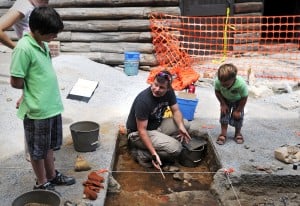
Part social science classroom, part tourist draw, archaeological digs at Fort William Henry could put new information in history books and cash in local coffers.

Monday through Friday throughout the summer, about 16 students of local archaeologist Dave Starbuck are moving back through history, one trowel-swipe at a time, as curious visitors look on. It marks the first time in 11 years crews have dug inside and around the French and Indian War-era fort.

Starbuck and his students and volunteers spent the last decade digging in Fort Edward.

"It seemed like the time was right," Starbuck said, referring to digging at the Lake George site. "It's not only about research; it's about making a difference."

That difference is something the newly formed French and Indian War Society takes seriously.

Museums throughout the world are undergoing a 21st century transformation to better meet the expectations of tourists who are inundated with advertising and connected to the web.

"The public has very new expectations," Starbuck said. "They don't want to just see rows of old junk on the shelves anymore."

But Fort William Henry, a relatively small, private museum, hasn't substantially changed its presentation of artifacts in nearly 50 years. Fort officials hope the archaeologists in the trenches can add an interactive component to patrons' experiences and yield some new artifacts for a planned exhibit modernization.

"We hope to tell a story, not just find things to put into a case," said Melody Viele, the project coordinator at Fort William Henry.

As crews dig within the reconstructed fort's walls and outside in its trash dumps, visitors take tours of the site. Tour guides explain what's been found, adding context to a collection of partially rotten beams, shards of pottery or rusting hand-forged nails. Crews inside the fort plan to shift to the east side of the courtyard this week and begin digging for the first time at the site of the British barracks that were burned to the ground by the French in August 1757.

"Some people think it's just part of the show," said dig guide and historical interpreter Dale Erhardt, referring to the tourists' reactions to the work.

The locally-based French and Indian War Society is hoping to use the area's connection with James Fenimore Cooper's "Last of the Mohicans," the most widely known fictional tale about the war that took place in and around Lake George, to expand the region's presence in the historical tourism market.

"The history gets lost in all of the commotion in Lake George," Starbuck said. "People remember the Civil War, World War II and, to a lesser extent, the Revolution, but the French and Indian war, and its importance, gets lost on people."

For more interesting topics related to archaeology, visit archaeology excavations.

Volunteers unearth clues to town's past


Artifacts uncovered in a Freeport archaeological dig help tell the story of one of the community's earliest residents.Mary Cook stopped scraping the compacted soil with a small trowel and calmly announced her discovery, struggling to contain her excitement.

Cook's colleagues gathered around and she continued uncovering the rusted iron object, found Tuesday afternoon during an archaeological dig at the former Abraham Grant farmstead.

As more of the object became visible, it appeared that Cook, a retired business owner who lives on Orrs Island, actually might have discovered an old horse bit. She kept on scraping and eventually determined that it was, in fact, a key, lost more than 200 years ago and found just 4 inches beneath the forest floor.

"It's a huge key," Cook concluded. "It's the coolest thing we've found yet."

Cook is one of 10 adults participating this week in the first archaeological field school hosted by the Freeport Historical Society. The dig is taking place on Grant's Point, where one of the town's earliest residents lived in the late 1700s and early 1800s.

The point is part of the 140-acre Pettengill Farm property -- off Flying Point Road, on the eastern shore of the Harraseeket River -- which is owned and managed by the historical society.

The dig is part of the society's summer-long program, "Diggin' History: Piecing Together Pettengill Farm's Past," which includes an exhibit of discoveries from past digs, weekly activities for children and archaeological tours of the farm.

The dig started Monday at a remote site about a quarter-mile beyond the quaint, white 1810 saltbox that is the centerpiece of the farm. It's continuing work done in the 1990s by archaeologist and teacher Norm Buttrick, who led Freeport High School students in finding evidence of a succession of houses on Grant's Point.

Participants in the field school paid $335 for the week or $100 per day. Still, they consider themselves volunteers, helping the historical society fulfill its mission to learn more about the farm as they each fulfill a desire to be on the front lines of digging up history.

They're working on hands and knees, in designated squares, alone or in pairs. They include Jon Tyndall of Durham, who's on vacation from his job at a Georgetown boatyard, and Stanley Dobson of Portland, who's newly retired after 25 years at B&M Baked Beans.

"It's very fun, pulling up old stuff and wondering where it came from," Dobson said, his white T-shirt covered in soil and sweat. "It piques the imagination a little bit. We've found shards of bottles and pieces of pipe stems. You can imagine someone sitting here by a fire, having a drink and enjoying the view."

The dig is being overseen by Peter Morrison, a Freeport archaeologist who has worked at major historical sites such as Popham Colony, Fort Knox in Prospect and Fort Pentagoet in Castine. He and his wife, Pam Crane, also an archaeologist, are excavating a 1749 tidal grist mill on a tributary of the Kennebunk River for the Kennebunkport Conservation Trust.

"One of the nice things about the Grant site is that it hasn't been occupied since the early 1800s, so things haven't been moved around, dug up or disturbed," Morrison said.

It's also a pleasure, he said, to work with eager would-be archaeologists, who relish each hand-forged nail and every sliver of pottery that's being scraped from the ground and sifted from buckets and buckets of earth.

"There's no one out here who'd rather be somewhere else," Morrison said.

The dig site is where Abraham and Susannah Grant lived with their family from the 1780s or earlier. A deed indicates that he bought the property in 1791 from Benjamin Parker, who lived in what is Yarmouth today.

Scattered bricks and granite foundation stones uncovered in the 1990s show that Grant built a house at some point that measured about 30 feet by 30 feet. Items being discovered this week were likely tossed out the back door into a rubbish heap.

By Friday, with any luck, Morrison and his crew might discover the padlock that fits the 5-inch-long key discovered by Cook on Tuesday afternoon.


For more interesting topics related to archaeology, visit archaeology excavations.

Monday, July 25, 2011

A dig into Malta's Roman past at zejtun


It is midday and the July sun is scorching but none of the archaeologists working in the open field are complaining as they busily unearth the 2,000-year-old past at the site of the former Roman villa in zejtun.

They wear sun hats and sunscreen as they dig millimetre by millimetre, using micro tools such as trowels and dainty paintbrushes. This is a typical behind the scenes of an archaeological dig, which we never get to see in Indiana Jones and other blockbuster movies.

There are no “holy grails” to unearth, no “crystal skulls”. Archaeology is less about thrilling adventure and more about painstaking patience. The “lost ark” can be anything from a tiny shred of pottery to a rut in a hole.

The excavations, that have been going on since 2006, have so far revealed that the site is older than previously thought.

“The data will be thoroughly analysed when the excavations terminate. However, at the lower levels we have found Punic pottery, which indicates this was not just a Roman villa. A Phoenician-Punic building, dating to the third century BC, had been there before,” Anthony Bonanno, head at the University’s Archaeology Department, said.

This archaeological site, located within the grounds of the St Thomas More Junior Lyceum School for Girls, was first discovered in 1961 during the construction of the school.

Subsequent excavations re­vealed that, in the past, the site had been the location of a thriving olive oil industry and a nearby villa. The villa probably belonged to someone ranking in the “lower-middle class” of society at the time.

“There is no mosaic as one would find in a luxury Roman villa, instead the floors are tiled and the walls are plastered with coloured stucco,” Prof. Bonanno said.

Other insights into past life are, unfortunately, scarce because the 1960s and 1970s excavations were bereft of crucial documentation.

The need to recover data in an attempt to reconstruct the economic and environmental history of the site and its environs has seen the University resuming the Żejtun excavations in 2006. The villa is one of four remaining sites in Malta that date to this period, including the Roman Domus in Rabat, San Pawl Milqi and Ta’ Kaċċatura in Birżebbuġa.

The one at Żejtun was a very important archaeological site in the south as it was the only one with potential to be visited by people, Prof. Bonanno said. He explained that four trenches were opened, incorporating parts of the 1972-1976 excavation limit as well as previously unexcavated areas. This meant archaeologists had to first dig the recent past before getting to the Roman period.

Excavation co-director Nicholas Vella said: “There are areas where we found soft drink bottles and sweets’ wrappers from the 1970s.”

Pottery findings help to date the architectural elements and the areas left intact in the 1970s. The context of the findings is of greater value than the find itself.

“The archaeological process is not just the digging. The greatest chunk of the time involves documentation, with draughting and planning,” Dr Vella said.

He pointed to a large cistern cut in the rocks unearthed recently. Would that be an ancient form of toilet? “No, that was a reservoir to collect water from the roofs of all buildings in the vicinity. Remember, in the south of Malta the water was scant, so every drop was precious,” he explained.

The excavations come to an end next week and the site will be covered up again not leave anything to the elements. The exposure over the last 30 years led to some serious deterioration.

This year sees the start of a preservation programme initiated by Din l-Art Ħelwa and the University with the help of the HSBC Malta Foundation.

The first phase of the project includes emergency conservation treatment and the erection of a temporary shelter. The programme was expected to take two years and would protect the ruins from water infiltration, invasive vegetation and exposure to the elements, Dr Vella said.

The long-term aim is to present the idea to the public in an appropriate manner. In March, the team will be taking part in a symposium organised by Wirt iż-Żejtun to present the first findings of the excavations to promote the importance of this site on a regional and national level.


For more interesting topics related to archaeology, visit archaeology excavations.

Roman skeleton unearthed on building site


ARCHAEOLOGISTS from Northampton have discovered human remains which could be more than 1,600 years old.

The team from Northamptonshire Archaeology discovered the remains of a man while they were carrying out investigations on a building site.

A small piece of pottery found alongside the crouched skeleton was used to date the burial to somewhere between the years 43 and 410 – suggesting the body is Roman.

Archaeologist Andy Chapman said: “It was a very interesting find.

“There’s a Bronze Age barrow next to where we found the remains so it looks like the Romans just came along 2,000 years later and buried this man right next to it.

“It was a really interesting site for our team to work on.”

Because the piece of pottery which was found next to the body was so small, experts will now use carbon dating techniques on the remains to work out more accurately how old they are.

Mr Chapman said: “The bones were actually in a fairly poor condition, because they were in quite sandy soil.

“So the body was pretty poorly preserved, but hopefully the carbon dating will give us a bit clearer picture of how old the remains are.”

Despite the exact age of the remains not yet been known, tests on the bones have already revealed the man suffered from arthritis in his back.

As with much of Northamptonshire Archaeology’s work, the site the team was excavating was outside Northamptonshire, on a former RAF radar base in Norfolk.

Before finding the Roman remains at the RAF Watton site, the team had found six Bronze Age axes and five cremation burials nearby.

The team from Northampton examined the site before the development of 154 homes could take place there.

Edward Paker from housing developers Bennett Homes said: “Our site at Watton has been the site of a number of important discoveries in recent years and this latest one is no exception.

“It’s fascinating to see the remains.”

The Roman remains which were found by the archaeologists in Norfolk have now been removed from the site and will be handed over to the Norwich Museum Service.

For more interesting topics related to archaeology, visit archaeology excavations.

Crossrail archaeology dig unearths mass burial ground


Archaeologists surveying the ground at Liverpool Street station in preparation for Crossrail tunnelling have unearthed hundreds of skeletons on the site of a historic mental health hospital.

Opened in 1247, St Bethlehem hospital was the first institution dedicated to mental health patients and is believed to have led to the coining of the word "bedlam".

The site now lies beneath what will be Liverpool Street's new Crossrail ticket hall.

There are 20 archaeology digs along the Crossrail route and they have to be completed as part of the planning regulations.


For more interesting topics related to archaeology, visit archaeology excavations.

Friday, July 22, 2011

Governor stresses for starting Archaeology Department in HPU

The Himachal Pradesh Governor Urmila Singh today stressed the need to start the Archaeology Department in the state university besides introducing tourist guide course to generate employment avenues for youth.

Speaking in the inaugural function of the three day long 42nd Foundation Day celebrations of the Himachal Pradesh University here, she said the state was rich in cultural heritage and Archaeology Department could make people aware about the glorious historical background of the State.

Singh, who is also the chancellor of the University, said there were plenty of employment opportunities in the tourism sector and added that introducing Tourist Guide Course could help in guiding the tourists coming to the state.

For more interesting topics related to archaeology, visit archaeology excavations.

An Empire of the Mediterranean


'Carthage must be destroyed'—the title of Richard Miles's book was the constant theme of the Roman statesman Marcus Porcius Cato (234-149 B.C.). In the last years of his long life, Cato became obsessed with Rome's old rival, the city that had unleashed Hannibal on the Roman Republic and brought it to the brink of destruction.

Famed for his oratory as well as his stern morality, the old man was frequently asked to give his opinion in the Senate. Regardless of the topic, his last sentence was always the same—"And I think Carthage ought to be destroyed." A rival countered by ending his own speeches with "And I think Carthage ought not to be destroyed," but Cato carried the day, although he died before Carthage was captured in 146 B.C. The city was demolished and the site formally cursed by Roman priests. The oft-repeated story of the ground being sown with salt is a much later invention, but the destruction of Carthage as a political state was total.

The subtitle of the book is the more revealing, for this is not primarily an examination of the three Punic Wars fought between Carthage and Rome but instead a full history of "The Rise and Fall of an Ancient Civilization." Those epic conflicts, and indeed the savage wars fought between Carthaginians and Greeks to dominate Sicily in the fifth and fourth centuries B.C., are just part of the bigger story.

The campaigns are covered intelligently, but even the biggest battles rarely rate more than a paragraph. Richard Miles is instead concerned with the wider context of these struggles, and his book is all the more valuable for that.

History is proverbially written by the victors. Carthaginian civilization was much older than that of Rome, and its mother city of Tyre in modern Lebanon boasted a sophisticated culture also predating the achievements of Classical Greece.

Yet Carthage was destroyed and with it so much of our knowledge of its glories. Greece was also conquered by Rome, but as the poet Horace put it, "captured Greece conquered the fierce captor." The Romans fell in love with Hellenic learning and literature, the passion fueled by a deep-seated sense of their own cultural inferiority.

Educated Romans were fluent in Greek as well as Latin. The first Roman historian was Fabius Pictor, and he was inspired to write at the end of the third century B.C. by the war with Hannibal, but he did so in Greek. No Roman was ever inspired to write in the Punic language of Carthage.

For more interesting topics related to archaeology, visit archaeology excavations.

Archaeology professors call on Livnat to keep posting scientific


Under the proposal, Livnat could appoint as chairman "a leading scientist in the field of history or archaeology, after consulting with the National Academy of Sciences."

The legislation's explanatory notes state: "Current law requires the minister to choose from a limited number of candidates, while there are actually many worthy candidates for the position who are not members of Israel's National Academy of Sciences."

Political agenda?

Critics say the amendment is meant to enable Livnat to appoint right-leaning archaeolgists to the council, which advises both the Antiquities Authority and the responsible minister on archaeological matters.

The letter to Livnat was signed by Prof. Oded Lipschits of Tel Aviv University; Prof. Zeev Weiss of the Hebrew University; Dr. Haim Goldfus of Ben-Gurion University and Prof. Arthur Segal of the University of Haifa.

"We see it as part of our scientific and public role to uphold the quality of research and teaching in the field and to maintain the scientific, academic and public standing of archaeological research in the State of Israel," they wrote.

Livnat plans to meet with the signatories today. Her office said that legislation was meant to prevent the minister's hands being tied in the making of appointments.

Four heads of university archaeological institutes have asked Culture Minister Limor Livnat to cancel the amendment she is sponsoring to the Antiquities Authority Law, which critics say aims to block left-leaning professionals from key positions in the authority.

The current law stipulates that the chairman of the Antiquities Authority Council, the governing body of the authority, must be a scientist who is a member of the National Academy of Sciences, and that there must also be two other members of the council who are affiliated with one of the country's five universities.

For more interesting topics related to archaeology, visit archaeology excavations.

Thursday, July 21, 2011

New blog on excavations at Maya city of Ceibal (Seibal)


Takeshi Inomata and Diana Triadan have returned to the Maya city of Ceibal/Seibal, first excavated by Harvard in the 1960s. They are excavating right now, and they have an excellent blog at the New York Times in the series "Scientist at Work: Notes from the Field."

Start with their first entry, from Feb 17, 2011; from that site you can follow the subsequent posts. Or go to the general site, Scientists at Work, for the current post.

There are several posts now. This is an outstanding chronicle of an archaeology excavation; check it out.

For more interesting topics related to archaeology, visit archaeology excavations.

What happened to the people of Calixtlahuaca after the Spanish conquest?


Most Aztec-period cities and towns continued on as Spanish-colonial cities after the Spanish conquest of 1521. From Mexico City to Cuernavaca to Xochimilco to Texcoco, and many others, these towns were settled by Spaniards (sometimes only a few, sometimes many).. Christian churches were built and the towns flourished in the Colonial economy and on into modern times, where they still exist today.

But not Calixtlahuaca. This Matlatzinca city went from a populated urban center and political capital to an abandoned ruin within a few decades after the Spanish conquest. The city of Toluca, on the other hand, was either nothing or a small village in pre-Spanish times -- no credible archaeological site has been found for pre-Spanish Tollocan. But by the mid-1500s Toluca had a large Franciscan church and convent, and the city went on to become capital of the state of Mexico, and the country's fourth major industrial center today.

We know that the occupation of at least some of the houses at Calixtlahuaca continued for a couple of decades after 1521, because we find ceramic figurines with Spaniards in Spanish dress and poses (see photo). These are in the final occupation layers of the site. But we don't think the occupation continued much beyond a few decades, because we did not find colonial middens with cow and horse bones, glazed ceramics, iron nails, etc. This lack of 16th century colonial debris is not a definitive indication of abandonment, however. In the Teotihuacan Valley, Tom Charlton reported years ago that rural Aztec villages continued functioning for up to a century after 1521 without obvious colonial material remains like these. But Calixtlahuaca was not a rural village - it was the most powerful capital between Tenochtitlan and the Tarascan Empire. So if it HAD continued to be occupied, we would expect to find things like: (1) a sixteenth century church; (2) these kinds of Spanish colonial artifacts.

So, what happened? Most likely, the residents of the city were forcibly moved into Toluca. The Spanish authorities instituted a practiced called "congregación" in which they moved native peoples into towns and cities (the better to control them, to con vert them, and to tax them). Many of the congregaciones left evidence in Spanish official archives, but any documents describing a congregación to Toluca have unfortunately not survived (Jarquin 1994).

But the abandonment of Calixtlahuaca is likely, given that in 1561, the Spanish crown granted land to found the village of San Francisco Calixtlahuaca, which was the origin of the modern town of the same name. I looked at the official decree today in the Archivo General Agrario in Mexico City. The text is accompanied by a crude map, showing the lands granted to the new town. Not being a paleographer, I had trouble reading the sixteenth century handwriting. There is a brief description in a catalog of the archive, however (Olmedo 1998:84). If the residents of Calixtlahuaca had kept living at the site, or if they had moved down off the hill to the site of the historical town, one would not think that the crown would issue a decree founding the town.

This area was part of the "Marquesado del Valle" estate of the conqueror Hernando Cortés. Soon after 1521 he started raising cattle and pigs in the vicinity of Calixtlahuaca, and the new town in 1561 was probably populated by his employees or subjects.

The main church in San Francisco Calixtlahuaca today dates to the nineteenth century. But the small church at the cemetery, just outside of town, is much older. Perhaps this was the main church from the sixteenth century, or perhaps an older church was torn down to build the modern one. The cemetery church has a fascinating carved stone relief embedded in its wall. This drawing is by Hanns Prem from 1970 (see Prem 1980).. The relief shows the Christian date at top "1563 año", and the date for that year in the Aztec calendar at the bottom (6 Reed). We have no idea whether this relief is from the village or from another place entirely. It would be fascinating if 2years after the founding of the new colonial town, someone put up a carving in both the Spanish and Aztec calendars. By the 1700s, there were at least some Nahuatl speakers in San Francisco Calixtlahuaca, as evidenced by a will published by Caterina Pizzigoni (2007).

This model is still somewhat speculative. We would love to have more data on what happened to all those people in the early to mid sixteenth century. According to published catalog, the Archivo General Agrario supposedly has another map and document from San Francisco Calixtlahuaca, from 1575 (Esparza et al. 2000:160-161), but they could not find it at the archive today (even when I showed them the published catalog entry). Maybe we will find additional sixteenth century documentation. But for now, the outline sketched above makes sense out of both the archaeological and the historical data.

Two years ago, the newspaper Milenio published a nice article on Calixtlahuaca and our project. It was called "Calixtlahuaca: La nostalgia del poder," referring to the fact that the positions of Calixtlahuaca and Toluca were reversed during the colonial period. Before 1521, Calixtlahuaca was a big capital city and Tollocan (if it existed at all) was a small village. Today, Toluca is the state capital, and Calixtlahuaca just a village. But that village has some great ruins (our site!) and the big city has none.

Source from : http://calixtlahuaca.blogspot.com/

For more interesting topics related to archaeology, visit archaeology excavations.

The 1563 Calendrical Relief


In talking about the 1563 calendrical relief shown in my previous post, Angela suggested that it could be a foundation monument. In 1561 the town of San Francisco Calixtlahuaca was founded following Spanish law (a decree from the Viceroy). If there were Nahuatl speakers among the new residents who retained a notion of ancient altepetl ceremonies and procedures, perhaps they had the relief carved to give the new town a measure of traditional legitimacy.

I was in the village Saturday, delivering copies of our reports to various people, and I realized that I wasn't sure where my photos were of the cemetery church and the relief. So I went over and took some new photos. The light was very good on the relief. Why is it incorporated into the church wall? When was it put there? What does it tell us? Wish I knew.

I'm not sure what year this church dates to. Its probably discussed in one of the books on Franciscan church architecture in the State of Mexico, but my copies are back home in Arizona. Here are some images of the front of the church. If you can date the church stylistically, let us know! My guess is 17th or 18th century.

For more interesting topics related to archaeology, visit archaeology excavations.

Tuesday, July 19, 2011

Showers Turning To Rain


The only symbol I would even dare to conjure up a solid interpretation would be the wavy lines "pouring" out of the horizontal line. How many of you would guess it represented rain?

I certainly would and at the same time this particular symbol is so powerful compared to the others on this section of the wall I have to believe that it is more of a petition...Something beyond just a desire...A prayer if you want to call it that....A prayer for rain...And not just a little rain....But a lot of rain.

For more interesting topics related to archaeology, visit archaeology excavations.

New Stones From Ancient Symbols


It is not often one meets a true artist who is in sync with their material of choice as well as the messages they create. Will Johnson posses a master's touch of precision sandblasting with stone of all sorts and sizes...from precious to sacred....from personal to substantial. Custom etched natural stone - Decorative sandblasting on granite, basalt, slate, marble and sandstone rock. Custom entry stones, special garden stones, rustic memorial stones, sacred power stones....even your personal symbol.

I met Will almost 10 years ago and over the past decade have had the opportunity to see him in action....from the initial concept to final execution of his masterful sandblasting technique.

If you are fortunate enough to live in Washington state and have a specific design in mind.....or a special rock you want to 'tattoo' with your personal mark...email Will to start the process.

For more interesting topics related to archaeology, visit archaeology excavations.

Sacred Geometry Shapes: Meaning and Significance


Symbols carved, etched and painted on rock faces, stone pillars, temples, scrolls and manuscripts are seen as man’s early attempts to document and convey the profound and the sacred to fellow clan members as well as future societies.

From simple organic shapes to complex patterns including the ever present spiral, these markings were carved or painted by the people living off the land and belonging to different cultures spanning thousands of years.

In most cases, it is difficult to decipher the exact meaning of many of these ancient symbols, but some have been deciphered.

One symbol in particular is the Flower of life. Considered one of the oldest symbols, the Flower of Life can be found around the world.

The Flower of Life

This shape, called the Flower or Life, contains within it a secret shape, called the fruit of life. It has 13 spheres which hold within them several geometrical and mathematical principles that, according to some, represent the universe. So, gifting one the flower of life is gifting them a dynamic symbol representing the order of the cosmos, in a piece of art. It contains the patterns concerning Creation as it came out of the “Great Void.”

The Flower of Life is common to all major world religions. For example, in ancient Egypt, it can be seen in the ancient Temple of Abydos. In Israel, you can see it in the Galilee and Mesada’s ancient synagogues. The circle theme can be seen in Celtic design and medieval cathedral. This matrix of concentric circles is also found in China, Japan, India, throughout Europe and in North Africa, and is even found in both North and South America.

After wearing the flower of life, some people report that they experience both physical and psychological differences. They experience galloping heart beats, breaking free from old fears, seeing predictive dreams, etc. It is known to be the strongest of all sacred geometry shapes.

To date, the Temple of Osiris at Abydos, Egypt, has the oldest Flower of Life design. It is carved out of granite and perhaps represents the Eye of Ra, an authoritarian symbol of the days of the Pharaoh. Other examples of the Flower of Life can be seen in Assyrian, Phoenician, Asian, Indian and Middle Eastern architecture and medieval art.

For more interesting topics related to archaeology, visit archaeology excavations.

Monday, July 18, 2011

A Brief History of Isthmia


The archaeological site at Isthmia lies in a region of Greece known as the Korinthia, with Korinth as the most famous city in that area (Figure 5.1). There is archaeological evidence that humans have lived in the Korinthia since the Neolithic Era (New Stone Age; ca. 6500-3000 BC).

The region produces a brown stone known as chert that can be fashioned into tools such as axes and sickles. Archaeologists have found fragments of such tools scattered throughout the Korinthia along with pottery from the Neolithic period. Isthmia is one of the sites where Stone Age artifacts have been found. There were Neolithic settlers at a place called the Rachi, a ridge near the future site of the Temple of Poseidon. Unfortunately, not enough artifacts have been found to determine the size of the site or how long it was inhabited.

Archaeologists have also found signs of habitation at Isthmia during the Bronze Age (ca. 3000-1200 BC). The last part of the Bronze Age is known as the Mycenaean Period (ca. 1600-1200 BC). During this period Greece was divided into kingdoms and agricultural products and trade goods flowed into the palaces of each king. Most palace sites were fortified by walls constructed from large irregular stones in a kind of construction known as Cyclopean masonry.


Some of this kind of masonry has been found at Isthmia, and it has been suggested that the Mycenaeans attempted to build a wall across the Isthmus to protect southern Greece from northern invaders. It is now thought that this wall was not for defense, but it probably does reflect a Mycenaean presence in the area. There is other evidence that Isthmia was inhabited during the late Bronze Age (Figure 5.2). From pottery we know that people lived near the site, but the size of the settlement was probably small.

The Dark Age of Greece (ca 1200-800 BC) was characterized by massive depopulation, as many late Bronze Age sites were destroyed. The general level of material culture in Greece also declined, and finds of artifacts from this period are fewer and smaller than in the Mycenaean Period. Again, archaeology allows us to discover what kinds of things were going on at Isthmia.

Pottery finds reveal that it was during this period, perhaps during the 11th century, that the site was first used as a center for religious activity. The reason for this observation is that the pottery found there includes pieces normally used only in religious ritual. There was a road running through the Isthmus, and during this period a small shrine stood along this road near the Saronic Gulf.

For more interesting topics related to archaeology, visit archaeology excavations.

Greek Mythology


History and mythology help explain the world of antiquity, the world the classical archaeologist seeks to illuminate. Classical archaeologists - unlike archaeologists working in many other areas - have many written sources and unwritten stories they can use to help them understand the way ancient people thought and acted.

What is a myth? One of the most enduring legacies of ancient Greece is the collection of stories that tell the tales of gods and heroes (Figure 3.1). Collectively these stories are known as myths. What do we mean when we call them myths? Today when we say "oh, that's just a myth," what we mean is "oh, that's not true (even if many people believe it)." Are myths, then, stories that are not true?

The oldest definition of the Greek word mythos comes from Homer, and it means "word," "speech," or "story," without any of the connotations of falsehood that our term myth has. As time progressed, mythos more and more implied "hard-to-believe stories" so that by the time of Plato (early fourth century B.C.) mythos had most of the connotations that our word "myth" has.

We still have not defined myth. At a very basic level, a myth is a story. However, a myth is a special kind of story. Fritz Graf, in his book Greek Mythology (Baltimore 1993) defines myth as a "traditional tale", with two characteristics that distinguishes it from a legend or a fairy tale. First, a myth is adaptable to many literary genres. Second, although flexible, a myth's adaptability is limited by the fact that a myth must be culturally relevant.

Because a myth is adaptable, it can take many forms. The most famous type of literature which contains myth is epic poetry. Our earliest sources for Greek myths are Homer's Iliad and Odyssey, written in the 8th century B.C., though they were based on an earlier, oral poetic tradition. Later examples of epic include Apollonius Rhodius' Argonautica (3rd c. B.C.), which tells the story of Jason and the Argonauts. Furthermore, myths are not confined to epic. Pindar (early 5th c. B.C.) made frequent use of myth in the odes he wrote commemorating the victors of the Olympic (and other) games. Finally, Athens' three greatest dramatists, Aeschylus, Sophocles, and Eurpides, employed myth almost exclusively in their plays; historical dramas were quite rare.

Because myth is so adaptable, we have no one "sacred text" which tells us all the Greek myths in their definitive forms. Each myth, in fact, had no definitive form, because each storyteller, poet, and playwright felt free to shape the myth according to his own needs. Sometimes the adaptations can seem minor. Aeschylus, for example, made Agamemnon the king of Argos in his play Agamemnon, while previous tradition unanimously places made him king of Mycenae. Sometimes, however, the adaptations are very significant. In his play Helen, Euripides feared that as an adulteress who deserted her husband, Helen of Troy would not be a very sympathetic character. Therefore he changed the story. Eurpides' Helen was in Egypt the whole time, and had nothing to do with starting the war which killed so many Greeks and Trojans. The key point is that each new version must continue to invoke something in its audience. If the new story fails to do this, if it loses its relevance to its culture, it is meaningless and can no longer be called myth.

For more interesting topics related to archaeology, visit archaeology excavations.

A Brief History of the Development of Southeastern Archaeology


Archaeology's earliest roots in the United States is evident in the writings of Thomas Jefferson who systematically excavated an Indian mound on his property at Monticello. Jefferson dug a trench through the mound and noticed that this mound had various strata of differing soil colors and consistency. He also uncovered several burials and through this evidence, he surmized that that the mound had been created with the placement of the burials and then capped over with soil and that this process had been repeated a number of times throughout the years until the mound reached its final height of 12 ft.

Jefferson's work on the mound was ahead of its day in three respects. First, he was one of the first people on this continent to excavate at all. Second, his excavations were done with such care that they enabled him to clearly view the stratigraphy of his trench. This was remarkable considering that it wasn't until the 1930s that archaeologists began paying attention to stratigraphy.

And third, Jefferson was seeking an answer to a question that he posed, then, through his experimental procedures, he was able to draw conclusions. In essence, he used what we are taught in school today is the scientific method. Thomas Jefferson wasn't simply interested in gathering artifacts, he was interested in learning about the people who inhabited this land before him through the only means at his disposal, those things which they left behind with their burials.

Clarence B. Moore

Although Jefferson took copious notes and published the methods of his research along with his results, his practices were not followed by archaeologists in the years to follow. While many surveys were conducted throughout the eastern United States in order to locate and document early Native American sites, perhaps the archaeologist leaving the greatest legacy in Alabama was Clarence B. Moore.

C. B. Moore was a wealthy man born in Philadelphia, Pennsylvania and educated at Harvard University. At the age of 40, Moore puchased a flat bottomed steamship, named the Gopher, and navigated the Florida rivers during the summer. Concentrating on the shell middens and sand burial mounds along the rivers of Florida, year after year, C.B. Moore carefully excavated sites along the waterways. While Moore reserved the warmer months for traveling along the southeastern waterways and excavationg sites, the winter months were spent analyzing his findings and writing reports that were published by the Journal of the Academy of Natural Sciences of Philadelphia.

In 1899, Moore ventured into Alabama traveling up the Alabama River. Then, in 1905, Moore traveled up the Black Warrior River where he spent most of his time excavating two mounds and surveying Moundville, a Native American center with over 20 mounds. Impressed by the size of the site and by the elaborate artifacts Moore uncovered, he returned the following summer to continue archaeology excavations. Moore was one of the first archaeologists to explore Moundville and document his findings, and, although his methods were not as sound as Jefferson's, he nevertheless provided modern archaeologists with a wealth of information that might otherwise have been lost.

For more interesting topics related to archaeology, visit archaeology excavations.

Sunday, July 17, 2011

2700 antiquities handed back to Swat Museum

Wah Cantt—Officials of Taxila Museum have handed over 2700 antiquities to the officials of the Department of Archaeology Khyber Pakhtunkhwa for the rehabilitation of Swat Buddhist Museum.

The Swat Museum was closed following a bomb blast in February 2008, and its unique archaeological treasure was shifted to reserve vault of Taxila Museum for safety and security.

A three-member team of the Department of Archaeology Khyber Pakhtunkhwa headed by Aman Ullah Khan, Assistant Curator Swat Buddhist Museum visited Taxila Museum and took over these over 2700 antiquities of Gandhara.

Talking to newsmen on Sunday, Aman Ullah Khan said this treasurer includes 250 stone sculptures, 100 statues of lord Buddha, 1200 coins, 50 stucco sculptures, a large number of anthological material, pots, burial pottery and life stories of Buddha from birth to death.

He said due to law and order situation in Khyber Pukthoonkhwa along with threats from militants, this archeological treasurer of great Gandhara civilization was shifted from Swat to the Taxila Museum.—APP

For more interesting topics related to archaeology, visit archaeology excavations.

Dig archaeologists uncover the remains of ancient body in field

The remains of what is thought to be an Iron Age resident have been found in a field in Caithness.

The skull, teeth and other bones were discovered during an archaeology excavation of a broch at Thrumster, just south of Wick.

The contents of the makeshift grave are the latest to emerge from a drive to unearth the still-buried secrets of an archaeology-rich area.

For more interesting topics related to archaeology, visit archaeology excavations.

No bones about it, this mastodon dig was big


Diggers at an archaeology excavation in west-central Colorado turned up almost 5,000 large bones in seven weeks from mammoths, mastodons, giant ground sloths, bison, horses, deer and camels. They also uncovered thousands and thousands of smaller remains, such as rodent teeth and salamander vertebrae.

The scientists in charge knew early on that this dig would require more shovel work than they could do alone, so they called in reinforcements, including 15 educators from the surrounding valley. These teacher-volunteers worked alongside the scientists and other volunteer diggers, turning up clues to the creatures that inhabited this area between 150,000 and 50,000 years ago.

The dig ended July 3, having yielded 4,826 large bones in seven weeks and leaving the teacher-volunteers with lessons to pass on to their students.

Sandy Jackson, who teaches archaeology and anthropology at Colorado Mountain College, found a dozen bones during her six days at the site, including a mastodon's patella, or kneecap, which first appeared to be a big, round rock about 8 inches across.

"You always describe to the students the size of the animals, but when you are actually holding the bone, it really brings it home," she said.

This wealth of prehistoric animals’ remains had accumulated in an ancient lake on a ridge above the resort town of Snowmass Village, some 100 miles west of Denver.

"Animals, plants, insects, even small crustaceans all piled on top of one another," said Ian Miller, curator of paleontology at the Denver Museum of Nature & Science. Excavating through the layers of sediment holding the bones was “as if we are reading from the pages of the history of life in the Rockies.”

An opportunity
Andre Wille, a science teacher at Aspen High School, found a mastodon jaw on his last day at the site.

"It is massive, like the size of a table, a small table — very large and powerful, and obviously prehistoric,” Wille said. The jaw, with molars intact, had been dyed black, probably by plant pigments, as it sat on the bottom of an ancient lake on the spot. “I found a lot of other great things, but that definitely topped it.”

Like other teachers, Wille began looking for a way to get to the site after hearing in October that the first bones, from a mammoth, turned up over the blade of a bulldozer at the site of a future dam. The Denver museum took charge of the excavation, removing about 600 bones, then returned in May for a seven-week dig that wrapped Sunday so construction could resume on a dam to hold a reservoir for the community below.

In addition to calling on roughly 250 trained paleontology volunteers, the museum scientists reached out to educators as extra hands for 10-hour days of often hard labor and as communicators who could share their experience.

Wille not only plans to tell his students about the experience and show photos, he envisions bringing his students to the site and encouraging them to come up with theories about how such a prehistoric menagerie of animals came to be buried there.

Importance of small things
Shovels weren’t the only tools for paleontologists looking for clues to ancient environments. Excavators also packed up soil from the site for screen washing, a process by which the dirt is filtered through sieves in the search for things too small to catch a digger's eye.

For Georgina Levey, a sixth-grade teacher at Aspen Middle School, finding the small things was one of the best parts.

“I found a couple of vertebrae from a salamander; they are just awesome to look at," Levey said, explaining that these backbones were no bigger than a quarter of her fingernail. "To be able to look at bones that small and realize you can find that even among all of these enormous things is awesome to me."

More than the charismatic big bones, small finds can tell about year-round conditions at the site, Miller said.

"A big animal like a mastodon can pick up and walk away if they don't like it," he said. "Small guys like salamanders, they can't go anywhere; their entire life is spent here."

A rite of passage
An initiation came with the first bone Jackson and other diggers found. After millennia of saturation by ancient lake water and burial in the soil, the bones released water when uncovered. This liquid became celebratory champagne.

For more interesting topics related to archaeology, visit archaeology excavations.

Thursday, July 14, 2011

CT scans unravel mysteries of Field Museum's mummies


One of the Field Museum's mummies is a 40-year-old woman who had lower back pain. A second was a teenager who may have jumped to his death. Another mummy has no torso. "It was a bit of a shocker" learning that within the sarcophagus was a skull and legs but nothing to join them, said J.P. Brown, associate conservator for the museum's department of anthropology. The murky life and times of the Field's ancient mummy collection, the largest in the Americas, recently got a little clearer. Since July 6, select mummies from ancient Egypt and Peru were given CT scans in a trailer in the museum parking lot. The CT machine was donated by Genesis Medical Imaging in far northwest suburban Huntley.

Stone Age relics may be hidden in Western Isles' seas

Submerged sites of ancient communities could be hidden in the seas around the Western Isles, according to experts. Dr Jonathan Benjamin and Dr Andrew Bicket believe the islands' long and sheltered lochs have protected 9,000-year-old Mesolithic relics. Rising sea levels may have covered up to 6.2 miles (10km) of land on the west coast of the Outer Hebrides (BBC News)

Archaeologists warn 'thoughtless' attacks could destroy moorland relics


Vandals could be destroying some of the country's most valuable carved rocks and stones, experts warned yesterday. A principal West Yorkshire archaeologist says he has "serious concerns" about the future of the carved rocks and stones on Rombalds Moor, Ilkley, after a spate of attacks. (Ilkley Gazette)

Past uncovered at Papamoa

As future development in the Wairakei area at Papamoa East looks to extend south with high density housing, a team of archaeologists is delving into the area's distant past. Led by Ken Phillips, the team was called in by Bluehaven Management, which is involved in large-scale property development in the area. Chief executive Bill Miller said the firm called in archaeological consultants when required, as part of their resource consent obligations. (Bay Of Plenty Times)

More Viking-Era Artifacts Surface in Salme Dig


An archaeological excavation that resumed last week in Salme on the island of Saaremaa, a site where ancient ships were previously found has turned up more Viking-era ship rivets and sword fragments.(Estonian Public Broadcasting)

Bronze sculpture from 16th century found in Mexico

A bronze sculpture more than 430 years old was found on the Pacific coast in the northwestern Mexican state of Baja California, the National Anthropology and History Institute, or INAH, said.The discovery was made by INAH members and researchers from the United States two weeks ago and is a unique piece within the collection of goods recovered over a 12-year period by the Manila Galleon Project in Baja California. (Fox News Latino)

Shabbat boundary rock with Hebrew etching discovered


An ancient rock inscription of the word "Shabbat" was uncovered near Lake Kinneret this week – the first and only discovery of a stone Shabbat boundary in Hebrew. The etching in the Lower Galilee community of Timrat appears to date from the Roman or Byzantine period. (Jerusalem Post)

Roman-era shipwreck reveals ancient medical secrets

A first-aid kit found on a 2,000-year-old shipwreck has provided a remarkable insight into the medicines concocted by ancient physicians to cure sailors of dysentery and other ailments. (The Telegraph)

Ethiopian lake sediments reveal history of African droughts

A new survey of Lake Tana in Ethiopia – the source of the Blue Nile – suggests that drought may have contributed to the demise of the Egyptian Old Kingdom, around 4200 years ago. (PhysOrg)

For more interesting topics related to archaeology, visit archaeology excavations.