Sunday, July 29, 2012

Exclusive statue found at dig


Culture and Tourism Minister Ertugrul Gunay has offered a newly exposed Hittite sculpture in Hatay's Reyhanl district. "There is no other similar piece in the world, it is unique," Gunay said of the sculpture that was found during excavations at the Tell Tayinat ancient site.
Gunay was visiting the area to examine the excavation works, and the presenting occasion took place at Hatay Archaeology Museum. The excavation works are being conducted under Toronto University Archaeology professor Timothy Harrison.
The excavations have been ongoing since 2004 at the Tell Tayinat Tumulus, said Gunay, who also thanked the excavation team for uncovering such a priceless piece. Noting that in June the team also found a number of other very valuable Anatolian figures; Gunay said this new discovery was exclusive. "This sculpture is different. It is 1.5 meters long and it weighs 1.5 tons. It is a figure with a beard and long hair, and it seems to be holding a weapon. This shows that the society in these lands that it came from was a warrior one."
Noting that these sculptures revealed life before Christ, Gunay said the founding also shed light on the early Hittite era in Turkey. "This discovery reveals the Anatolian life in Turkey. This find is not Roman or Greek," he said. The sculpture shows motifs similar to other Anatolian figures, but it is very different from other discoveries uncovered so far, said Gunay. Although it is made of basalt stone, the eyes of the sculpture are artificial.
The rest of the sculpture has not been found, indicating that it may well have been damaged. However, the upper part is in very good condition, said Gunay, who added that he had never seen such a big sculpture anywhere else in the world.
The sculpture has been sent to the Hatay Archeology Museum, where it will be restored by a professional team. The excavation team at Tell Tayinat comes from all over the world, including Canada, Turkey, and the United States.
During Gunay's visit, excavation president Harrison showed the sculpture to the press. Harrison also showed that there is writing that says "Suppiluliuma" at the back of the sculpture.

For more interesting topics related to archaeology, visit archaeology excavations.

Wednesday, July 25, 2012

Thiruthangal Excavation At Virudhunagar

Thiruthangal is a small town in Virudhunagar district in the Indian state of Tamil Nadu. Thiruthangal Nindra Narayana Perumal Temple is also one amongst the 108 Divya Desams, Vishnu temples revered by saint poets, Alwars of 6th-9th century. Thiruthangal is well connected by bus and train and can reach by air via Madurai.
Thiruthangal is once a part of Sivakasi amongst the biggest exporter of fire crackers all over the country and abroad, and it is also famous for the hardworking of people. Historical Prime Minister Jawaharlal Nehru called "Kutti Japan" which means "Small Japan". It also has Granite quarries namely Standard Granites and PRP Granites.
Thiruthangal is situated in Sivakasi Taluk of Virudunagar district at about 4 kms north of Sivakasi Town. In the epic Silapathikaram, Thiruthangal is referred as an important settlement. Trenches were laid at the western extremity of the village. Microlithic flakes and core material were found beyond the depth of 65 cm. Flat based vase, dish, bowl, large and narrow mouthed pot were also unearthed. Black and red ware shreds occurred at a depth of 65 cm. An interesting find is a terracotta object, which contained a unique pre-fired symbol, believed to be the Srivatsam. These objects are datable to megalithic period (1000 BCE to 300 CE).
For more interesting topics related to archaeology, visit archaeology excavations.

Sunday, July 22, 2012

New Maya Temple Found


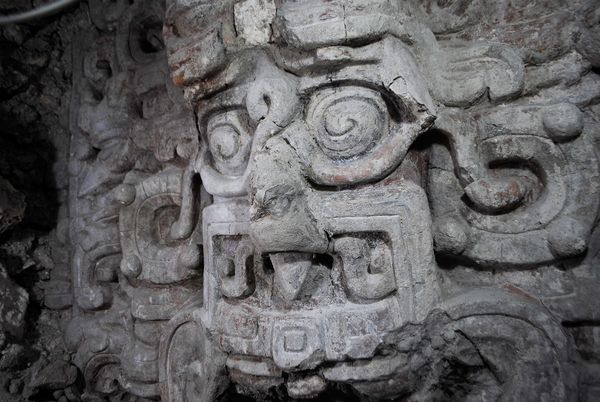
Some 1,600 years ago, the Temple of the Night Sun was a blood-red beacon visible for miles and adorned with giant masks of the Maya sun god as a shark, blood drinker, and jaguar. Long since lost to the Guatemalan jungle, the temple is finally showing its faces to archaeologists, and revealing new clues about the rivalries kingdoms of the Maya.
"This has been a growing awareness to us since the 1990s, when it became clear that a few kingdoms were more important than others," said Brown University archaeologist Stephen Houston, who announced the discovery of the new temple Thursday.
By 2010 archaeologists working on a hilltop near the ancient city center had discovered 45-foot-tall (13-meter-tall) Diablo Pyramid, Atop it they found a royal palace and a tomb, believed to hold the city's first ruler, who lived around A.D. 350 to 400.
Solar Power
The sides of the temple are decorated with 5-foot-tall (1.5-meter-tall) stucco masks showing the face of the sun god changing as he traverses the sky over the course of a day.
One mask is shark like, likely a reference to the sun rising from the Caribbean in the east, Houston said.
The noonday sun is depicted as an ancient being with crossed eyes who drank blood, and a final series of masks resemble the local jaguars, which awake from their jungle slumbers at dusk.
In Maya culture the sun is closely associated with new beginnings and the sun god with kingship, Houston explained. So the presence of solar visages on a temple next to a royal tomb may signify that the person buried inside was the founder of a dynasty—El Zotz's first king.
Maya archaeologist David Freidel added, "Houston's hypothesis is likely correct that the building was dedicated to the sun as a deity closely linked to rulership. The Diablo Pyramid will certainly
Facing Out
"We tend to think of kings being completely autonomous, but for the Maya, a sacred king was often part of a hierarchy of kings," the Penn Museum's Martin said.
"So the people at El Zotz at times may have been heavily under the influence of Tikal, and when powers were weak at Tikal, they may have been completely independent or may have linked themselves with more powerful kings somewhere else."
"A Lot More Discoveries" to Come?
Despite the obvious care that was taken to construct and preserve the newfound temple, it wasn't used for long. Evidence at the site suggests the building was abandoned sometime in the fifth century, for reasons unknown.
"It's like they just dropped their tools and left" in the middle of once again expanding the temple, Houston said. "I think what you're looking at is the death of a dynasty."
The answer to this mystery and others could become evident as more of the Temple of the Night Sun is uncovered.
"Only 30 percent of this facade has been exposed," UCR's Taube said. "I think there're going to be a lot more discoveries and a broader understanding of what this building actually show in the future."

For more interesting topics related to archaeology, visit archaeology excavations.

Thursday, July 19, 2012

Archaeologists of Italy hope that they got the skeletons of Mona Lisa

Archaeologists of Italy hope that they got the skeletons of Mona Lisa

Everyone is very eager to see the smiling face of the Mona Lisa’s picture throughout the year but now everyone can see the skeleton of Mona Lisa. Archaeologist of Italy says that they got the Lisa Gherardini’s skeleton this week. She was the masterpiece of Leonardo da Vinci which is present now in The Louvre in Paris. Mona Lisa’s skeleton was found near Sant’Orsola convent which is Florence. The bones of Mona Lisa will be exanimate in the Department for the Conservation of Cultural Property

Mona Lisa Skeleton
Lisa Gherardini was the spouse of a wealthy cotton vendor known as Francesco Del Giocondo. Most fashionable experts acknowledge that the woman portrayed in the Mona Lisa was Lisa Del Giocondo, who became a nun after her spouse's loss of life. She passed away at the age of 63 at the Convent of Saint Ursula on July 15, 1542. The skeleton was uncovered about five feet under the convent's unique ground along with other parts of individual bones and backbone. The dig which started again last month, discovered an individual bone this week. The bone will go through assessments to identify if they match with the skull got last month
Mona Lisa skeleton Image
The DNA in the bone will be in contrast to the model's two children. Once the researchers have confirmed that the bone and skull fit in with the design, forensic performers will make an effort to restore her face and see how it measures up to the 500-year-old edition colored by da Vinci - and perhaps fix the question of the Mona Lisa's enigmatic grin in the process, the review said
Skeleton Mona Lisa
"We don't know yet if the bone fit in with one individual bone or more than one. But this verifies our speculation that in St. Ursula convent there are still individual bone and we cannot leave out that among them there are bone owed to Lisa Gherardini," archaeologist Silvano Vinceti, who is in charge of the dig was estimated as saying by the paper

For more interesting topics related to archaeology, visit archaeology excavations.
Friday, July 13, 2012

Archaeologists Find out Bulgarian Herculaneum

Archaeologists Find out Bulgarian Herculaneum

Bulgarian archaeologists have discovered a exclusive for the Bulgarian Black Sea coast under water district with remains from an beginning Byzantine fortress. Archaeologists discovered a Bulgarian Herculaneum named Akra on the Akin cape near Chernomorets on the southern Black Sea coast. The details was revealed by the National History Museum’s Director (NIM), Bozhidar Dimitrov, discussing in an unique interview Bulgarian 24 Chassa (24 Hours) daily.

Bulgarian Herculaneum
The archaeological team was lead by Ivan Hristov is continuous excavations on the cape, where an exclusive for the Bulgarian Dark Sea shore marine region with remains from an beginning Byzantine adventure have been discovered. The adventure, originally considered to be known as Krimna, times from the end of the 5th millennium A.C. According to Hristov, the initial set by the Avars, in some way enclosed the discovers into the world, in the same way to the lava from Vesuvius closing Pompeii. The hefty floor rooftops flattened protecting everything beneath. Dimitrov informed 24 Chassa that the discovers involved several completely maintained boats, clay-based amphorae, lights, magnificent small cup mugs, along with a number of clay parts, which will be renewed. The items were made at the time by builders in south African-american and then taken to Similar by delivers. The NIM Director further reiterates that after getting a thorough look at the discovers and searching greatly into records, he noticed that this has been a town very just like the German Herculaneum in the way it has been maintained, and that he was prepared to modify his preliminary perception the town was known as Krimna. "Most likely it was the same as now – Akra. In historical Ancient greek Akra indicates cpe but also a adventure and a citadel. Many traditional records validate it; there was such huge town," says he. The group is currently working in southeast the adventure, where, as Hristov reviews, a huge number of discovers had been found in a small area because the development had been very heavy. Hristov and his group need a ban on all development in the area to be able to retain the valuable findings.The landscapes western from Chernomorets are still unchanged by development, and very stunning, but personal people have stated already possession on the areas.

For more interesting topics related to archaeology, visit archaeology excavations.

Thursday, July 12, 2012

Archaeologist Uncovers Evidence of Hernando de Soto's Expedition


When Spanish Conquistador Hernando de Soto stepped on the shores of Tampa Bay, Florida with visions of gold floating through his head, he had no mapped route, no idea of what lay in front of him and not an inkling that this trip would end in his death.
As De Soto and more than 600 troops set off from Tampa Bay into the humid Florida interior they cut a path following Native American trails as they searched for wealth, food and shelter. They were lured by promises of riches farther north, and the Spanish forces ended up plundering and killing indigenous populations along the way.
De Soto never found the gold or the land route to China that he was looking for. Instead the first European to cross the Mississippi River found a watery grave when a fever took his life somewhere on the river's western banks in either present day Louisiana or Arkansas.
With De Soto's passing, his route through Florida and into the southeastern United States became obscured in history and given over to interpretation... until recently. A local Florida archeologist recently uncovered what some of his contemporaries claim has been more elusive that the prized gold De Soto searched for... evidence of his journey through Florida that could redraw the Spanish explorer's path and help expose more archeological sites in the region.
"It gets rid of the guesswork now on the route through Marion County," said Ashley White, the archaeologist who found the site in Florida's Marion County, according to the Ocala Star-Banner. Now, we know for sure he came up through the Black Sink Prairie to Orange Lake and looped around through Micanopy.
White, who lives on a 700-acre property owned by his bioarchaeologist wife, Michelle White, came across the discovery of De Soto's encampment almost by luck. While for years he had found Native American artifacts on the property, it wasn't until a series of hurricanes and storms in 2005 thrashed Florida and turned up White's soil that he found something out of the ordinary: a coin minted before De Soto's 1539 expedition.
Nearby White also came across a 16th century structure that turned out to be the mission of San Buenaventura de Potano, established a number of years after De Soto made his way through the area. On that site, White uncovered, were white copper coins and brown streaks where the church's post used to be.
At first, the archaeologist didn't fully comprehend the significance of his find. The original thought was that it was a Spanish ranch outpost, and that was our hypothesis for probably two years of the work here, White said, according to the Star-Banner. "(The De Soto) trail, it's not the first thing on your mind in Central Florida archaeology."
On closer examination of the first site, however, White began to come across handmade beads and other coins similar to those found on other Florida mission buildings along Native American trails. Missionaries most likely used De Soto's records to establish their churches along the paths.
"This (the De Soto site) is an extremely important site, historically and archaeologically," Gifford Waters, historical archaeology collections manager of the Florida Museum of Natural History.
The discovery has drawn praise both locally and nationally. The local media has covered the find extensively and this fall White and his family will unveil the finding at Appleton Museum of Art. Last week the Explorer's Club, the famed society dedicated to scientific exploration, announced White's findings via its Twitter account. White's discovery now opens the door for more research both at his site and in other sites around the region where De Soto may have camped on his way to his demise.
"The discovery of the (Potano) site is really a beginning, not an end," said Gerald Milanich, the author of multiple books about De Soto's expedition and curator emeritus in archaeology of the Florida Museum of Natural History at the University of Florida, according to the Star Banner. "The start of a lot more research, of learning about the area. It helps us to understand what things were like on a summer day in 1539, and I'm sure it's very exciting for people to realize that they had a very important bit of history right in their own backyard."

For more interesting topics related to archaeology, visit archaeology excavations.

Tuesday, July 10, 2012

Mensusa and Extravagance Archaeology

Mensusa and Extravagance Archaeology

Introduction

Some people and some sites are very interesting and supportive to know about archaeology information and archaeology varieties. For example Mensusa online shop site which is very supportive to promote archeology information.Unfortunately the study of Archaeology has always endured its media coverage inside media.The image written by popular media features fluctuated enormously from the adventure and excitement from the days of Indiana Jones for the lesser excitement connected with following it on programs for example "Time Team". Something is for particular; it has never had the glamour it deserves.

Some from the sites available for visit for all those of us who are not professors can be of incredible value and often rouse excitement and interest. Lately I've conceded that not every archaeological site has to succumb to their inevitable image connected with desert landscapes and digging, there are several of us who absolutely visit them however you like.


New Variety

Mensusa-Archaeology


A new variety of archaeology aficionados is actually rising, one which is populated through the wealthier and more demanding in our midst and that spend somewhat more time and money versus average tourist on enjoying the truly great prize that the learning of ancient cultures represents. These new social tourists are demanding as not only they would like to enjoy incredible sites but they would like to do so in comfort, and that if you ask me makes perfect impression. Just because you feel yourself interested in a dig won't necessarily mean you must spend the night in a tent fighting down mosquitoes or mind blowing snakes! How about dealing with the dig, enjoying the site and the tour, and then walking to your hotel where a nice meal and a comfortable bed give time and chance for reflection and much more study?

Conclusion

Archaeology and extravagance go together and, smacking tradition inside face, I firmly believe these are not mutually exceptional! Mensusa is always promoting archaeology information.

Wednesday, July 4, 2012

History of underwater archaeology


People have probably always loved history. Already Herodotus, the Greek historian, was fascinated by past civilizations. The ancient Greek and Romans also believed in a Golden Age in times past, when everything supposedly had been much well. During the middle Ages in Europe, this belief continued, letting ancient Rome and Greece represent that lost Golden Age.
Early salvage and diving
The interest in maritime finds was awoken by the find of the Nemi Ships in the 15th century. After that, very little happened until the invention of helmet diving in the early 19th century.
Using helmet divers, the wreck of Royal George (sunken 1782) was salvaged around 1830, but not for archaeological reasons. The wreck was simply an obstacle that had to be removed.
In 1836 the Dean Brothers discovered the wreck of Mary Rose, and salvaged a few objects. Perhaps this is the first case of underwater investigations, made of historical interest.
Also, in 1856 the submerged settlement in the Zürich Lake was investigated by divers and historians.
The diving archaeologist
During the following 70 years, many historic ships were salvaged (pillaged) by divers, but only for commercial reasons. The valuables were sold, and a museum would get the rusty iron cannon or minor objects such as Roman lead anchors. But there was no archaeological investigation.
The first systematic archaeological underwater investigation was probably the recovery of the Nemi Ships in 1929-32, which ware investigated on land, after being towed ashore.
The first case of diving underwater archaeology may have been 1933-39 when the Swedish warship Elefanten (1564) was investigated by helmet divers together with historians.
The breakthrough came after World War II. Thanks to the scuba diving equipment developed by Emile Gagnan and Jacques-Yves Cousteau, the underwater world became instantly accessible, and many new ancient wrecks were found at a rapid pace.
A pilot case for archaeology with scuba divers was the Grand Congloué wrecks in France, investigated 1951-57 by Cousteau and Fernand Benoît. When the divers started digging down in the layers covered by sand, they first thought it was one wreck, while in fact it was two wrecks on top of each other.
After the Grand Congloué, many underwater archaeology investigations have been made, by pioneer archaeologists such as Nino Lamboglia, George F. Bass, Peter Throckmorton, and many others.
The methods have improved – slowly and tediously even the smallest objects are recorded, as clues to our understanding of people from times past.
Even though Cousteau was not an archaeologist, he contributed immensely by promoting popular interest for underwater mysteries.
The future?
The problem is time and money. Underwater archaeology, like most aspects of education and culture, can never survive on a pure commercial basis.
Only a few sites can be investigated, while others are left untouched for the future. Leaving sites for the future is an excellent idea in theory. But in reality they risk being robbed by treasure hunters.
For more interesting topics related to archaeology, visit archaeology excavations.

Sunday, July 1, 2012

10 Space Archaeology Stories You Must Read


Following on from my popular post, 10 Space Archaeology Novels You Must Read, here’s a list of ten great space archaeological short stories. Where the prior post approached a “top ten”, this list can only be taken as a number of stories that I recommend, based on my limited reading.
There are literally generations of magazines and anthologies that I haven’t read and which might contain brilliant space archaeological stories. Nevertheless, I think it’s safe to say that a few stories here would count among the best, such as ‘The Red One’, ‘The Sentinel’, ‘Lungfish’ and ‘Omnilingual’.
‘The Red One’ (1918), by Jack London
Set in the Solomon Islands, this astonishing tale is decades ahead of its time in its science fictional concepts, while simultaneously being appallingly of its time in its depiction of the indigenous Solomon Islanders.
‘Rescue Party’ (1946), by Arthur C. Clarke
Clarke’s story about an expedition of aliens exploring the doomed and deserted planet Earth is an early example of a tale in which humans are the vanished civilization being studied.
‘The Sentinel’ (1951), by Arthur C. Clarke
The kernel around which the novel and movie 2001: A Space Odyssey were built. A classic conception of one version of the probe hypothesis (‘The Red One’ is another). Interestingly, the iconic black monolith of the movie is a shiny pyramid in the original story. Clarke’s predictive power goes awry here when a character fries sausages in the galley of the expedition’s lunar rover.
‘For Those Who Follow After’ (1951) by Dean McLaughlin
A fine story about the inevitability of extinction, in which an alien civilization leaves behind a cache of artifacts for those who follow after.
‘Jupiter Five’ (1953), by Arthur C. Clarke
Another Clarke story! Archaeologists discover and explore a giant alien vessel orbiting Jupiter … seems like a precursor to Rendezvous with Rama in some ways. Interesting from an exopolitical viewpoint to note that in the story worlds cannot be claimed but salvage, even world-sized ships, arguably can.
‘The Star’ (1955), by Arthur C. Clarke
One of Clarke’s great stories. Archaeology is used here to powerfully illustrate the pitiless indifference of the cosmos to all that sentient beings hold dear.
‘Omni lingual‘(1957), by H. Beam Piper
Almost certainly the best space archaeological story ever written. A deeply archaeological story about the first expedition to a city of the vanished Martian civilization. The conceptual breakthrough around which the story is based is almost commonplace now but still powerful.
‘The Waiting Grounds’ (1959) by J. G. Ballard
From Ballard’s brief period of truly science fictional writing, a tale of deep time and transcendent vision, based on the discovery of mysterious alien megaliths on another world.
‘Lungfish‘(1986), by David Brin
Brin’s story is a fascinating typology of interstellar probes, clearly the work of someone who has thought long and hard about the implications of the probe hypothesis.
‘Diamond Dogs’ (2001), by Alastair Reynolds
A cool and characteristically Reynoldsian take on the big dumb object story: the exploration of an enigmatic alien artifact. Pays homage to its antecedents (such as Algis Budry’s Rogue Moon) as it breaks new ground.
For more interesting topics related to archaeology, visit archaeology excavations.